Reg No. - CHHBIL/2010/41479ISSN - 2582-919X

Bypoll Results: TVK Takes Lead in Tamil Nadu as BJP Shows Strength in Bengal and Assam
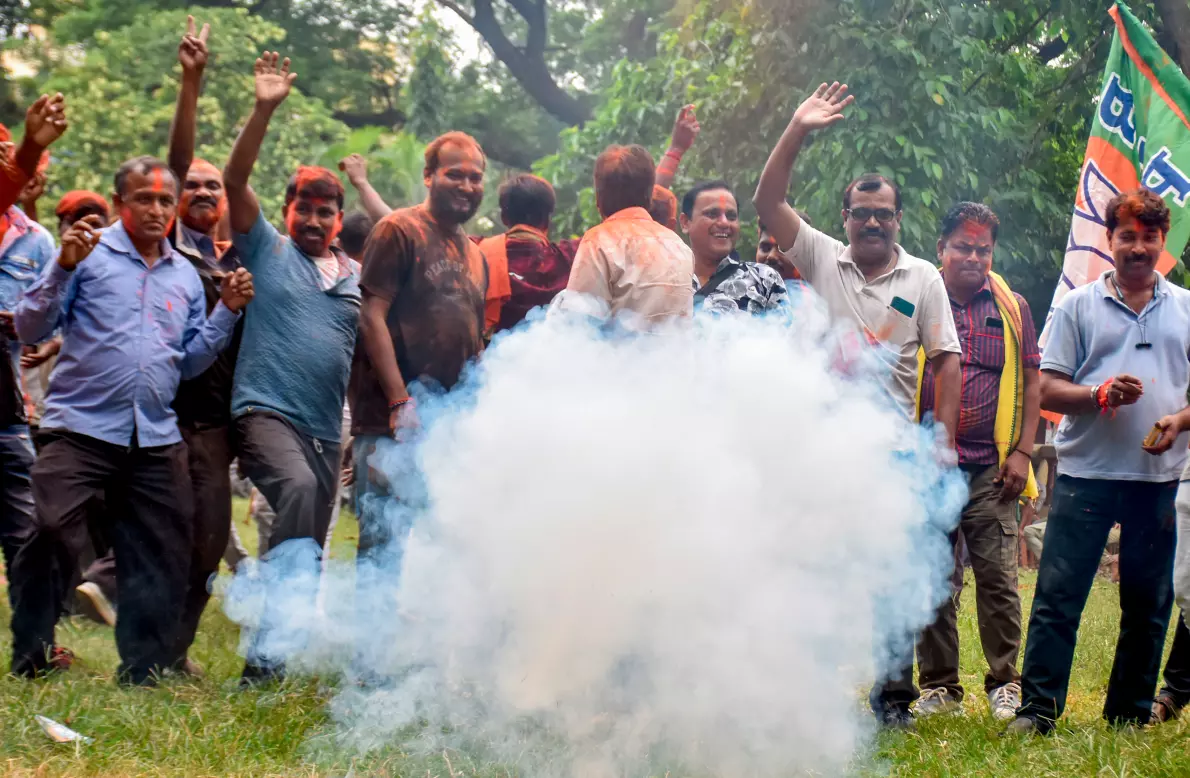
BJP supporters celebrate during the counting of votes for the Rejinagar Assembly by-election in Murshidabad district, West Bengal, on Friday, October 9, 2026, as the party records major gains in the latest round of by-elections. (Photo: PTI)
Assembly by-election trends put regional political equations under scrutiny, with Vijay’s Tamilaga Vettri Kazhagam seeking to establish itself as a serious electoral force while the BJP looks to consolidate its position in eastern and northeastern India.
Key Highlights
- Tamil Nadu, West Bengal and Assam emerge as important political battlegrounds in the latest by-election developments.
- Actor-turned-politician Vijay’s Tamilaga Vettri Kazhagam (TVK) faces a significant test of its electoral appeal in Tamil Nadu.
- The BJP’s performance in West Bengal and Assam is being closely watched for indications of its organisational strength and voter support.
- The results could influence political alliances, campaign strategies and preparations for future electoral contests.
- Political observers caution that individual by-election outcomes cannot automatically be treated as a verdict on an entire state.
India’s latest round of by-elections has delivered significant political gains for the ruling parties in Tamil Nadu, West Bengal and Assam, with results and counting trends on Friday, October 9, revealing how political loyalties are evolving following the Assembly elections earlier this year.
Chief Minister C. Joseph Vijay’s Tamilaga Vettri Kazhagam (TVK) secured victories in both Madurantakam and Dharapuram in Tamil Nadu, passing its first electoral test since assuming power. Meanwhile, the Bharatiya Janata Party (BJP) recorded victories in West Bengal’s Nandigram and Rejinagar Assembly constituencies and emerged victorious in Assam’s Nagaon Lok Sabha by-election.
In Puducherry, the All India N.R. Congress (AINRC), led by Chief Minister N. Rangasamy, retained the Thattanchavady Assembly seat, completing a round of contests largely favourable to the parties already holding power in their respective states.
The outcomes are politically important because they offer an early assessment of public confidence in governments formed after the 2026 Assembly elections. They also expose challenges facing opposition parties attempting to regain lost electoral ground.
Tamil Nadu: Vijay’s TVK Wins Both Seats, But Opposition Remains Competitive
Tamil Nadu witnessed one of the most closely watched contests, with Chief Minister Vijay’s TVK defending its political credibility against established rivals, particularly the All India Anna Dravida Munnetra Kazhagam (AIADMK) and the Dravida Munnetra Kazhagam (DMK).
TVK candidates Maragatham Kumaravel and P. Sathyabama emerged victorious in Madurantakam and Dharapuram, respectively. Both had previously represented the AIADMK before switching allegiance to Vijay’s party.
Their victories carry particular significance because the by-elections were triggered by their resignations after joining TVK. The contests therefore became a direct examination of whether voters would continue supporting the candidates after their change of political affiliation.
For Vijay, the outcome provides an opportunity to demonstrate that TVK’s electoral appeal extends beyond the enthusiasm generated by his popularity as a film star.
However, the margins of victory were less commanding than the party might have expected. The opposition maintained a competitive presence, particularly in Dharapuram, suggesting that TVK cannot afford to underestimate its established political rivals.
A Changing Political Landscape
Tamil Nadu has traditionally witnessed intense competition between the DMK and AIADMK, two parties that have dominated the state’s political landscape for decades.
The emergence of TVK as the governing party has disrupted that familiar arrangement.
Vijay’s transition from cinema to politics has introduced a different dimension to electoral competition, combining celebrity appeal with the responsibilities of governance.
Yet electoral popularity and administrative performance are two different challenges.
As Chief Minister, Vijay must now demonstrate his government’s ability to address employment, infrastructure, education, public services and the aspirations of younger voters.
The by-election victories strengthen his political standing, but they do not eliminate questions about the durability of TVK’s support.
For the AIADMK, the results raise concerns about retaining experienced leaders and protecting its traditional voter base. For the DMK, the challenge lies in rebuilding an electoral coalition capable of challenging the ruling party.
West Bengal: BJP Consolidates Its Position in Nandigram and Rejinagar
West Bengal delivered another major political development as the BJP secured victories in Nandigram and Rejinagar.
Nandigram remains one of the state’s most politically significant constituencies because of its association with Chief Minister Suvendu Adhikari and the political battles that helped reshape Bengal’s electoral landscape.
BJP candidate Hasirani Rath registered a commanding victory in the constituency, where the party had established an overwhelming lead during counting.
The result reinforces the BJP’s organisational presence in an area that has repeatedly occupied centre stage in Bengal politics.
However, Rejinagar may carry even greater significance for the party’s longer-term electoral strategy.
BJP candidate Shankharav Sarkar defeated his principal opponent, Ghulam Nabi Azad of the Aam Janata Unnayan Party, by a reported margin of 75,691 votes.
The result is particularly noteworthy because Rejinagar has a substantial Muslim electorate, estimated at around 70 per cent.
While the BJP can legitimately regard the victory as an important political achievement, the constituency’s demographic composition alone cannot establish precisely how different communities voted. Such conclusions require detailed polling and electoral data.
Opposition Fragmentation Under Scrutiny
The Bengal results also raise questions about the effectiveness of opposition parties operating without a consolidated electoral strategy.
A divided opposition can struggle even in constituencies where dissatisfaction with the government exists.
The BJP’s victories suggest that organisational strength, candidate selection and local political equations continue to play an important role in electoral outcomes.
Opposition parties have raised allegations of electoral irregularities and intimidation, while the BJP has rejected such accusations.
These competing claims require examination through the appropriate electoral and legal processes rather than being treated as established facts.
For the BJP government in West Bengal, the immediate political advantage is clear. Nevertheless, maintaining public confidence will depend on delivering the development commitments made during election campaigns.
Assam: BJP Wins Nagaon Lok Sabha Contest
Assam produced another decisive result for the BJP, with former IAS officer Devasish Sharma defeating All India United Democratic Front (AIUDF) chief Badruddin Ajmal in the Nagaon Lok Sabha by-election.
Sharma’s victory margin exceeded 1.72 lakh votes, according to later result reports, demonstrating a substantial advantage over his principal opponent.
Congress candidate Sibamoni Bora also contested the election but remained behind the two leading candidates.
The constituency witnessed a reported voter turnout of 76.19 per cent during polling on October 6.
The election became necessary after former Congress MP Pradyut Bordoloi resigned from the Lok Sabha and subsequently contested the Dispur Assembly constituency on a BJP ticket.
Although the result does not materially alter the balance of power in Parliament, it carries political significance for the BJP’s position in Assam.
Regional Voting Patterns Remain Important
Nagaon’s electoral geography offers an interesting perspective on the complexity of Assam politics.
During counting, Sharma performed strongly in Assembly segments including Morigaon, Raha, Jagiroad and Nagaon-Batadrava.
Ajmal maintained an advantage in segments such as Dhing, Samaguri, Laharighat and Rupahihat.
These variations demonstrate that constituency-wide victories can conceal substantial differences in local political preferences.
The BJP’s success strengthens its position, but opposition support in particular areas indicates that the political contest remains competitive.
For Congress and the AIUDF, the outcome presents difficult questions about candidate selection, electoral coordination and their ability to expand beyond existing support bases.
Puducherry: AINRC Retains Thattanchavady
Puducherry’s Thattanchavady Assembly constituency also voted in favour of continuity.
AINRC candidate Ashok Anand won the by-election by a margin of 8,482 votes, strengthening the political position of Chief Minister N. Rangasamy.
The victory represents another favourable outcome for an incumbent administration and reinforces the AINRC’s electoral standing in the Union Territory.
Although the contest attracted less national attention than the elections in Tamil Nadu, West Bengal and Assam, it remains important in assessing regional political stability.
The result also demonstrates the continuing relevance of regional parties within India’s wider alliance-based political system.
What the Results Mean for National Politics
The six by-elections, comprising five Assembly constituencies and one Lok Sabha seat, provide a limited but revealing picture of India’s changing electoral landscape.
Three broad political developments emerge.
First, the results suggest that incumbent governments in these states have retained sufficient voter confidence to overcome opposition challenges.
Second, the contests demonstrate that strong regional leadership remains influential. Vijay in Tamil Nadu, Suvendu Adhikari in West Bengal and the BJP’s established leadership in Assam operate in different political environments, yet each has benefited from the latest electoral outcomes.
Third, the performance of opposition parties raises questions about whether fragmented electoral strategies can effectively challenge well-organised ruling parties.
However, it would be premature to describe the results as a comprehensive national endorsement of any single political formation.
By-elections are shaped by constituency-specific factors, local candidates, political defections, organisational networks and immediate public concerns.
A victory in one or two constituencies cannot necessarily be extrapolated across an entire state.
The Larger Democratic Message
Beyond celebrations and political claims, these results underline an important characteristic of Indian democracy: electoral competition does not end when a government is formed.
Every subsequent election becomes an opportunity for citizens to express approval, dissatisfaction or changing political preferences.
For ruling parties, victories bring renewed expectations of performance. For opposition parties, defeats create an opportunity to reassess political priorities and reconnect with voters.
Tamil Nadu’s results suggest that Vijay’s TVK has retained electoral momentum, although its opponents remain capable of mounting serious challenges.
West Bengal’s outcome strengthens the BJP’s position while drawing attention to the difficulties confronting a fragmented opposition.
Assam’s Nagaon result reinforces the BJP’s parliamentary presence in the state, while Puducherry’s verdict favours political continuity under the AINRC.
Taken together, the outcomes reflect a political environment in which established organisations, emerging regional forces and shifting voter loyalties continue to compete for influence.
The central lesson is that electoral victory may establish political authority, but only sustained governance, public accountability and responsiveness to citizens can preserve it.

YOU MAY LIKE THIS