Reg No. - CHHBIL/2010/41479ISSN - 2582-919X

Indian-Origin Jurist Navi Pillay Wins 2026 Nobel Peace Prize for Defending International Law
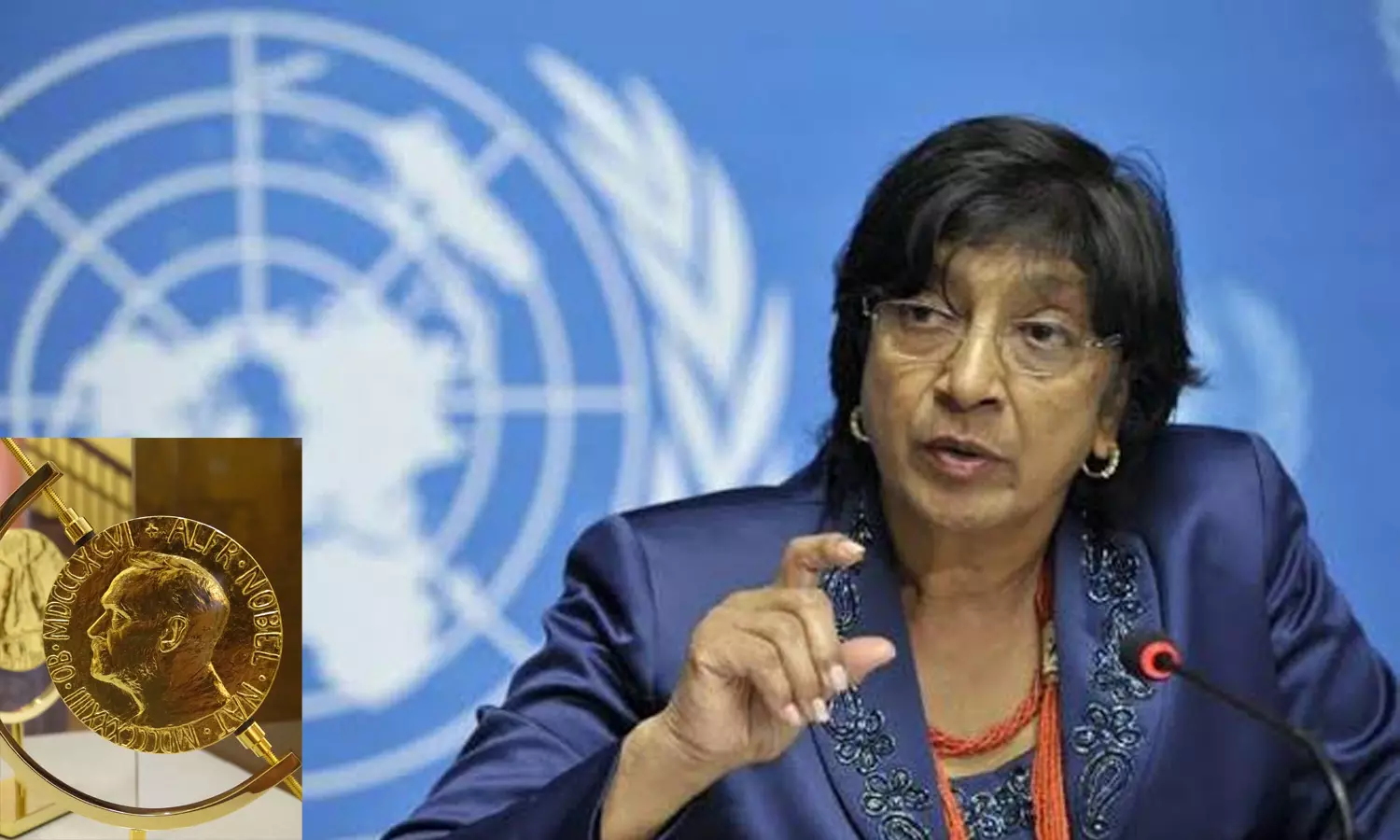
Former United Nations High Commissioner for Human Rights and South African jurist of Indian origin, has been awarded the 2026 Nobel Peace Prize for her contributions to international law, human rights and global justice. The Nobel Prize medal is shown in the inset. (Photo: X)
Former UN Human Rights Chief Honoured for Her Lifelong Fight Against Apartheid, War Crimes and Genocide; Nobel Committee Recognises Her Courage in Upholding Justice and Human Dignity
Key Highlights
- South African jurist of Indian Tamil origin Navanethem “Navi” Pillay awarded the 2026 Nobel Peace Prize.
- Norwegian Nobel Committee recognises her contribution to peace, international law and accountability for crimes against humanity.
- The 85-year-old former UN human rights chief played a pioneering role in international criminal justice.
- Pillay defended anti-apartheid activists, including Nelson Mandela, and became a trailblazer in South Africa’s judiciary.
- Her work on the Rwanda genocide, Myanmar and the Palestinian territories has strengthened international human rights jurisprudence.
- The Nobel Peace Prize ceremony will take place in Oslo on December 10.
South African human rights lawyer and internationally respected jurist Navanethem “Navi” Pillay has been awarded the 2026 Nobel Peace Prize for her lifelong commitment to promoting peace, defending international law and ensuring accountability for war crimes, genocide and crimes against humanity.
The Norwegian Nobel Committee announced the prestigious award on Friday, October 9, recognising the 85-year-old former United Nations High Commissioner for Human Rights for her exceptional contribution to strengthening international legal institutions at a time when the global rules-based order faces mounting challenges.
Born into a family of Indian Tamil origin in Durban, South Africa, Pillay overcame racial discrimination under the apartheid regime to become one of the world’s most influential voices for justice and human dignity.
The Nobel Committee praised her courage, integrity and determination to uphold universal legal principles, describing her career as an example of how international law can protect vulnerable populations and hold powerful individuals accountable.
The award comes against the backdrop of continuing armed conflicts, growing concerns about violations of international humanitarian law and increasing political pressure on institutions responsible for investigating international crimes.
Pillay’s journey from apartheid-era South Africa to the highest institutions of international justice represents an extraordinary chapter in the global struggle for equality.
Born on September 23, 1941, she grew up in a society where racial segregation determined access to education, employment and fundamental rights. Despite these barriers, she pursued legal studies and established her own law practice in Durban in 1967.
At a time when opportunities for women, particularly women of colour, were severely restricted, Pillay challenged discriminatory practices and represented individuals who had little access to legal protection.
Her legal career included defending anti-apartheid activists, among them Nelson Mandela, whose struggle against racial segregation eventually transformed South Africa’s political landscape.
Following the end of apartheid, Pillay was appointed to South Africa’s High Court in 1995, becoming the first non-white woman to hold such a judicial position in the country.
Her appointment marked a significant development in a legal system that had historically excluded large sections of the population from positions of judicial authority.
Pillay subsequently entered international judicial service, where her work helped shape the legal response to some of the most serious human rights violations of the modern era.
Her association with the International Criminal Tribunal for Rwanda proved particularly influential.
The tribunal was established to prosecute those responsible for the 1994 genocide, during which hundreds of thousands of people were killed.
Pillay contributed to landmark judicial developments recognising sexual violence, including rape, as conduct capable of constituting genocide when committed with the required intent.
These legal principles significantly strengthened the international framework for prosecuting atrocities committed during armed conflicts.
Her contribution helped establish that sexual violence was not merely an incidental consequence of war but could constitute a grave international crime requiring prosecution and accountability.
Nobel Peace Prize
Pillay later served as a judge at the International Criminal Court, an institution created to prosecute individuals accused of genocide, crimes against humanity, war crimes and the crime of aggression within its jurisdiction.
Her experience across national and international courts established her reputation as a jurist committed to applying legal principles without discrimination.
Between 2008 and 2014, she served as the United Nations High Commissioner for Human Rights, one of the organisation’s most important positions for monitoring and addressing human rights violations worldwide.
During her tenure, she repeatedly emphasised the responsibility of governments to protect fundamental freedoms, prevent discrimination and ensure accountability for abuses committed by state and non-state actors.
Her work also brought her into direct confrontation with governments and political authorities accused of violating international human rights standards.
Pillay remained an outspoken advocate for the independence of judicial institutions, arguing through her professional work that justice must not be subordinated to political convenience.
More recently, she chaired the United Nations Independent International Commission of Inquiry on the Occupied Palestinian Territory, including East Jerusalem, and Israel.
The commission concluded in 2025 that Israel had committed genocide in Gaza, a finding strongly rejected by the Israeli government.
Israel disputed the commission’s conclusions and accused it of political bias. The commission’s findings are distinct from a final judicial determination by the International Court of Justice.
Pillay has also criticised crimes committed by Hamas, maintaining that violations of international humanitarian law must be examined regardless of the identity of those responsible.
Her involvement in these highly sensitive international investigations demonstrated her continuing commitment to legal accountability even when findings generated intense political controversy.
Pillay also serves as an ad hoc judge at the International Court of Justice in proceedings concerning allegations of genocide against Myanmar’s Rohingya population.
Her judicial responsibilities reflect the continuing importance of international legal institutions in addressing disputes involving states, ethnic communities and allegations of mass atrocities.
Announcing the Nobel Peace Prize, the Norwegian Nobel Committee emphasised that a functioning international legal order remains essential for preventing conflict and resolving disputes through peaceful means.
The committee observed that the international legal system is under considerable pressure as geopolitical rivalries and military conflicts increasingly challenge established principles of justice.
Its decision to honour Pillay is therefore being interpreted as recognition not only of an individual career but also of the institutions and legal principles she has defended.
The award underscores the importance of independent courts, credible investigations and the prosecution of serious international crimes in preserving global peace.
Norwegian Prime Minister Jonas Gahr Støre congratulated Pillay and described the recognition as particularly relevant at a time when international law faces severe challenges.
South African President Cyril Ramaphosa also welcomed the announcement, acknowledging her contribution to justice and her distinguished career in national and international institutions.
Pillay’s Indian ancestry adds another dimension to her remarkable professional journey.
Her family background reflects the history of Indian communities in South Africa, many of whose ancestors arrived during the colonial period and subsequently faced discrimination under apartheid.
Although South African by nationality, Pillay’s Indian Tamil heritage forms an important part of her personal history and the multicultural struggle for equality in the country.
Her achievement also highlights the contribution of women from historically marginalised communities to the development of international legal institutions.
At a time when the world continues to witness conflicts involving civilian casualties, displacement and allegations of grave human rights abuses, Pillay’s recognition carries significance beyond the Nobel ceremony.
It reinforces the principle that lasting peace cannot be achieved solely through political negotiations or military arrangements without justice, accountability and respect for human dignity.
The Nobel Peace Prize, which includes a monetary award of approximately $1.2 million, will be formally presented in Oslo on December 10, the anniversary of Alfred Nobel’s death.
Pillay joins the distinguished group of South African Nobel Peace laureates whose contributions have shaped the international struggle against injustice and oppression.
Her selection also serves as a reminder that the pursuit of peace extends beyond diplomatic agreements and political declarations.
It depends equally on the willingness of individuals and institutions to confront injustice, defend fundamental rights and insist that even the most powerful must remain answerable to the law.
The recognition of Navi Pillay ultimately reinforces a fundamental principle of international justice: peace cannot endure where accountability is absent, and the rule of law must prevail over the exercise of unchecked power.

YOU MAY LIKE THIS