Reg No. - CHHBIL/2010/41479ISSN - 2582-919X

Cyber Awareness Must Become a People’s Movement to Defeat Online Fraud: CM Vishnu Deo Sai
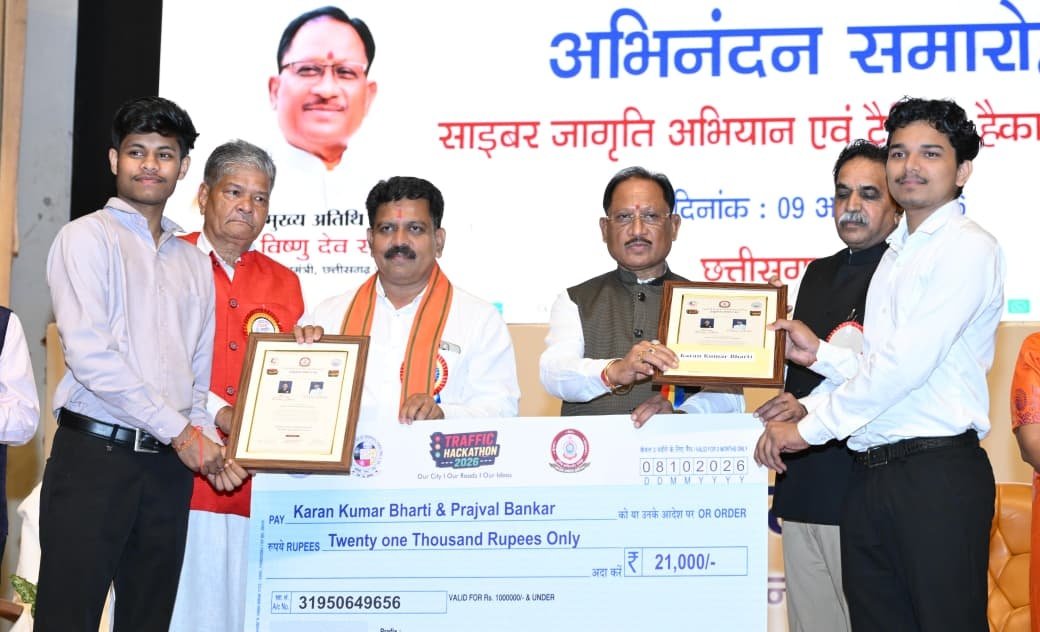
Chief Minister Vishnu Deo Sai, Deputy Chief Minister Vijay Sharma and MLA Rajesh Munat jointly present certificates and a ₹21,000 award to Karan Kumar Bharti and Prajval Bankar during the Traffic Hackathon 2026 felicitation ceremony at Pandit Deendayal Upadhyay Auditorium, Raipur, on Friday, October 9, 2026. Photo:primelookindia.com via CMO
Chief Minister Calls for Collective Vigilance Against Cybercrime as Chhattisgarh Police’s Seven-Week Awareness Campaign Reaches 1.70 Crore People; Government to Consider Innovative Traffic Solutions Proposed by Young Minds
Key Highlights
- Chief Minister Vishnu Deo Sai stresses that cybersecurity is the responsibility of every citizen, not merely the police and government.
- More than five lakh awareness programmes organised across Chhattisgarh, reaching approximately 1.70 crore people.
- Sai declares that the Cyber Jagriti Abhiyan will continue beyond its seven-week campaign period.
- Chief Minister assures serious consideration of practical solutions developed during Traffic Hackathon 2026.
- Deputy Chief Minister Vijay Sharma highlights police action against cybercriminal networks and improved recovery of defrauded money.
- Traffic Hackathon winners honoured with certificates and cash prizes; innovative district initiatives also recognised.
Raipur : Chief Minister Vishnu Deo Sai has called for transforming cybersecurity awareness into a statewide people’s movement, emphasising that protecting citizens against online fraud and digital crime requires collective vigilance, responsible use of technology and active public participation.
Addressing the felicitation ceremony of the Cyber Jagriti Abhiyan and Traffic Hackathon 2026 at Pandit Deendayal Upadhyay Auditorium in Raipur on Friday, October 9, Sai said the rapid expansion of digital services had created unprecedented opportunities while exposing citizens to increasingly sophisticated cyber threats.
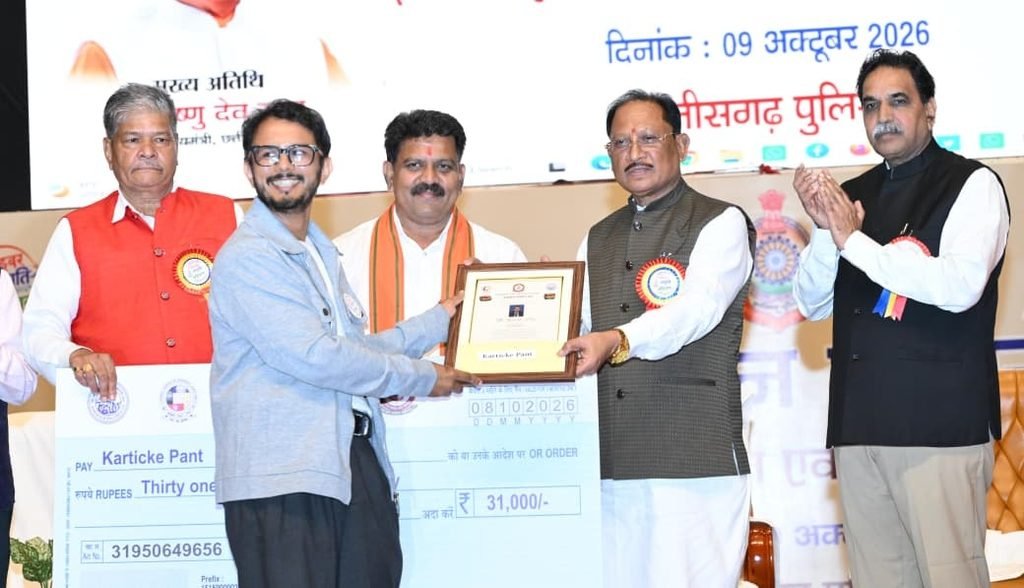
Chief Minister Vishnu Deo Sai, accompanied by Deputy Chief Minister Vijay Sharma and MLA Rajesh Munat, presents a certificate and ₹31,000 award to Traffic Hackathon 2026 overall winner Kartikeya Pant during the felicitation ceremony at Pandit Deendayal Upadhyay Auditorium, Raipur, on Friday, October 9, 2026.Photo:primelookindia.com via CMO
“Cybersecurity is not merely the responsibility of the government and the police. Every citizen must remain alert and aware. Public participation is essential to building a Chhattisgarh free from cyber fraud and digital crime,” the Chief Minister said, emphasising the need to make digital safety a shared social responsibility.
He congratulated Chhattisgarh Police for conducting an extensive seven-week awareness campaign that reached approximately 1.70 crore people through more than five lakh programmes across urban and rural areas.
Sai observed that the Digital India initiative, launched under Prime Minister Narendra Modi’s leadership, had transformed everyday life and brought digital services within the reach of ordinary citizens.
Recalling the initial doubts surrounding the programme, he said many had questioned whether digital transactions could become successful in a country with such a large population and extensive rural communities.
Today, he noted, even villagers in remote areas routinely use mobile phones for financial transactions, communication and accessing essential services.
However, technological progress has also created opportunities for criminals who exploit digital platforms to deceive unsuspecting citizens.
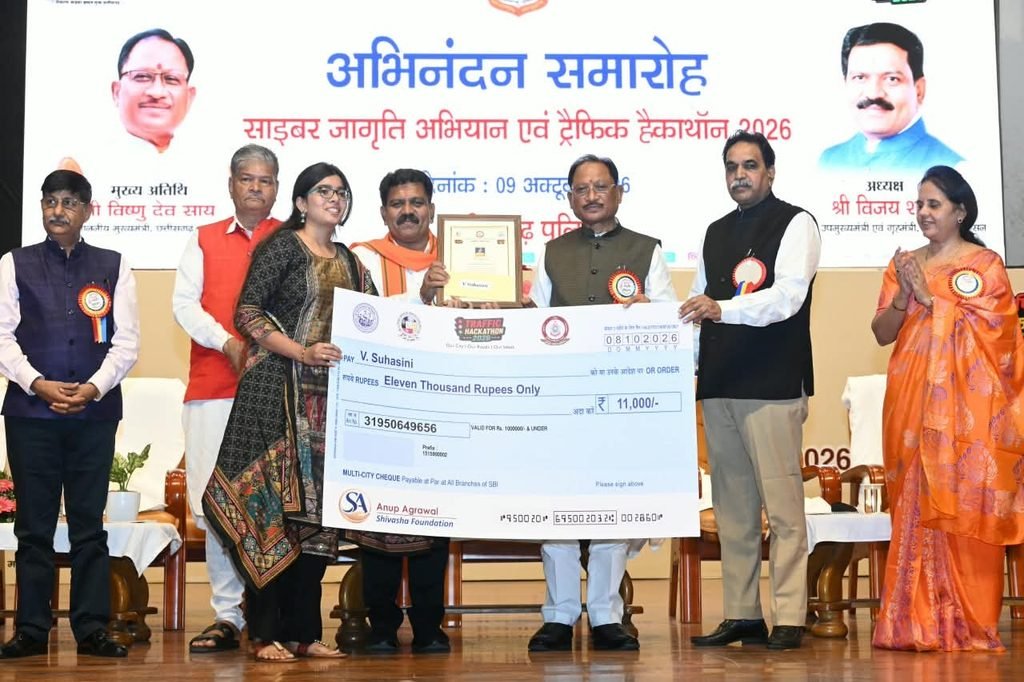
Chief Minister Vishnu Deo Sai presents a certificate and ₹11,000 award to V. Suhasini during the Traffic Hackathon 2026 felicitation ceremony at Pandit Deendayal Upadhyay Auditorium, Raipur, on Friday, October 9, 2026. Deputy Chief Minister Vijay Sharma, MLA Rajesh Munat and Raipur Mayor Meenal Choubey (R) are also present. Photo: primelookindia.com via CMO
The Chief Minister warned that cybercriminals continuously develop new techniques and that even educated and technically proficient individuals can become victims.
“Technology has made our lives easier, but it has also brought new challenges. Awareness of cybercriminals’ methods and the precautions needed to protect ourselves has become essential for everyone,” Sai said.
He appreciated the Cyber Jagriti Abhiyan conducted by Chhattisgarh Police between August 15 and October 2, describing it as an important initiative for taking cybersecurity awareness beyond major cities and into villages, educational institutions and public spaces.
The campaign was conducted in coordination with 34 police units and covered seven weekly themes, including digital security, financial fraud, UPI safety, digital arrest scams, women’s online safety, fraudulent employment offers, data privacy and collective responsibility.
Schools, colleges, universities, gram panchayats, weekly markets, religious gatherings and other public places became centres of awareness activities.
More than five lakh selfies were recorded as part of public participation activities, reflecting the scale of community engagement.
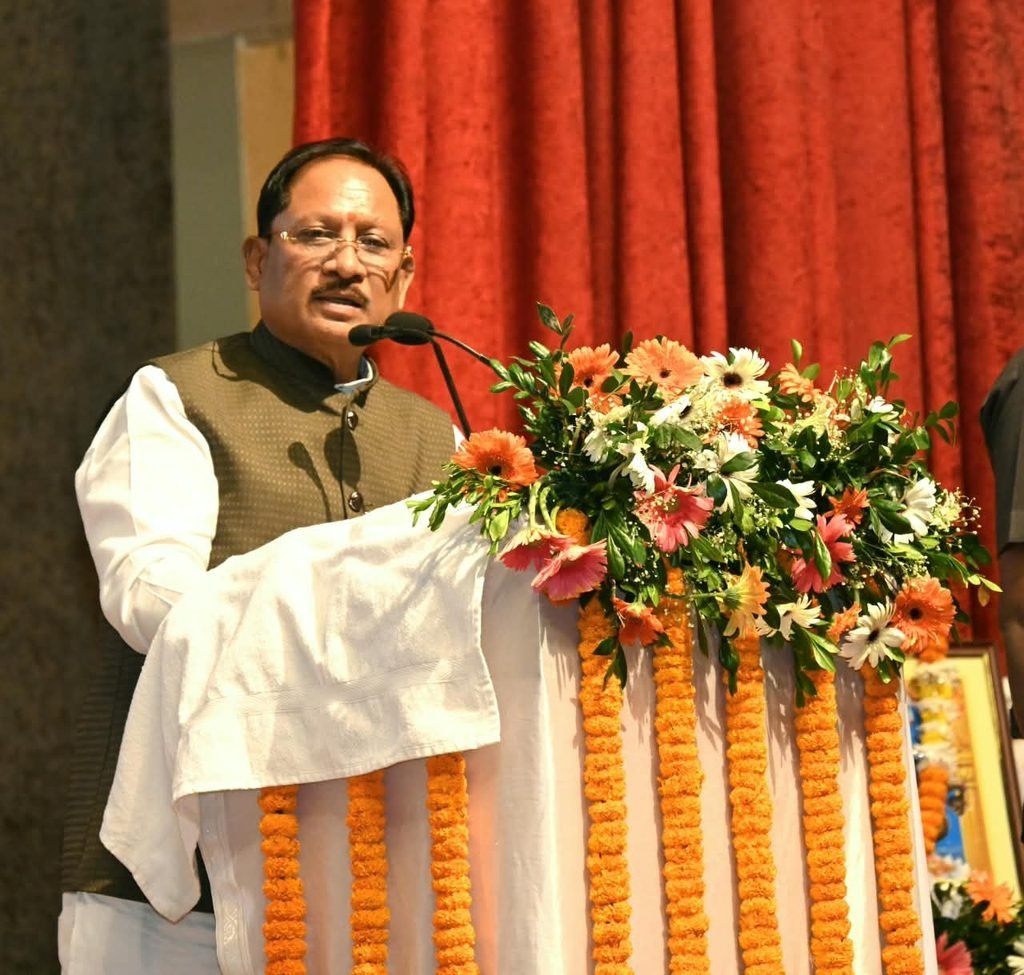
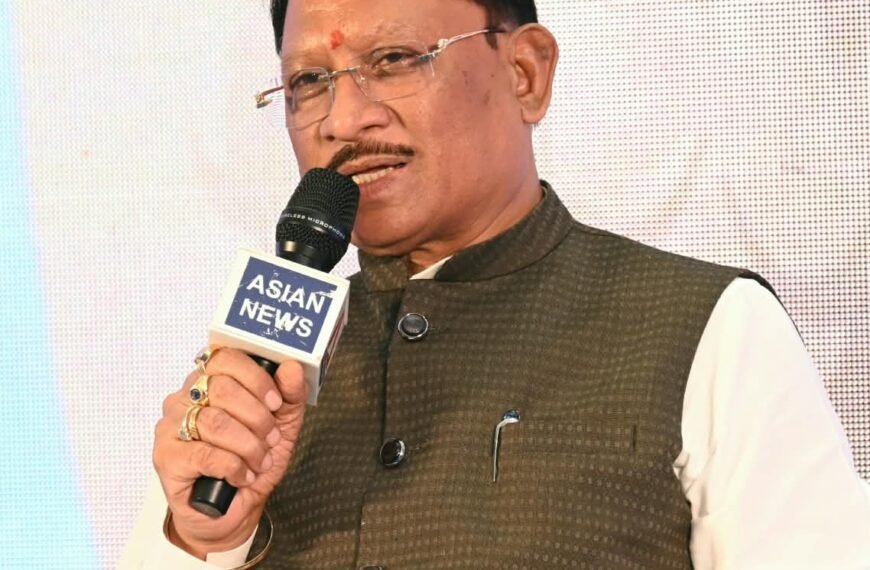
Chief Minister Vishnu Deo Sai addresses the Cyber Jagriti Abhiyan and Traffic Hackathon 2026 felicitation ceremony at Pandit Deendayal Upadhyay Auditorium in Raipur on Friday, October 9, 2026, calling for cybersecurity awareness to become a people’s movement. Photo: primelookindia.com via CMO
Sai said the response demonstrated that cybersecurity could no longer be treated as a specialised technical issue.
“Cybersecurity is now a concern for every family. The participation of such a large number of people shows that awareness is becoming a collective responsibility,” he observed.
The Chief Minister made it clear that the conclusion of the scheduled campaign did not mean an end to the government’s efforts.
“The Cyber Jagriti Abhiyan has not ended. It is only the beginning. Our efforts to spread cyber awareness will continue until every citizen feels safe and secure in the digital environment,” Sai said.
He urged educational institutions, social organisations, youth groups and community representatives to work alongside the police in spreading awareness.
Particular emphasis was placed on young people, whom the Chief Minister encouraged to become ambassadors of cybersecurity and help protect their families and neighbourhoods from online fraud.
Turning to urban development, Sai praised the young participants of Traffic Hackathon 2026 for studying Raipur’s growing traffic problems and proposing innovative solutions.
He acknowledged that the capital’s rapid expansion, increasing population and rising number of vehicles had made traffic management more complex.
The Chief Minister said modern technology, innovation and public participation could help reduce accidents, improve road safety and make traffic movement more convenient.
“The government will seriously consider the innovative suggestions presented by students, technical experts and young participants. Solutions that are practical and beneficial to the public will be examined for implementation,” Sai assured.
The Traffic Hackathon encouraged participants to examine congestion points across Raipur and develop solutions addressing road design, pedestrian safety, parking arrangements and public transport integration.
Among the locations studied were Tatibandh Chowk, Telibandha Marine Drive, Amapara Chowk, Lodhipara Chowk and Shankar Nagar.
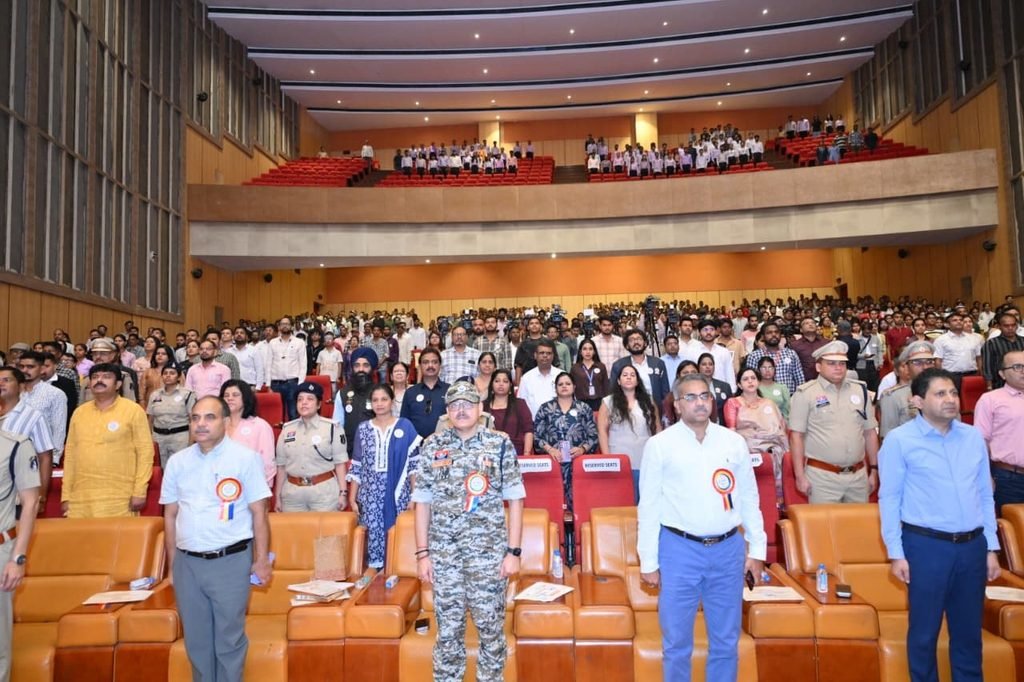
Police officials, public representatives, technical experts, students and other participants attend the Cyber Jagriti Abhiyan and Traffic Hackathon 2026 felicitation ceremony at Pandit Deendayal Upadhyay Auditorium, Raipur, on Friday, October 9, 2026. Photo: primelookindia.com via CMO
The overall winner, Kartikeya Pant, presented a proposal based on Tactical Urbanism for improving traffic movement at the Shankar Nagar turning point.
His recommendations included better utilisation of available road space, clearer lane markings, designated pedestrian areas, organised spaces for street vendors and autorickshaw drivers, and measures to improve traffic flow.
Other participants proposed the use of Artificial Intelligence and the Internet of Things for modern traffic management.
Projects such as Raipur Netra and Drishti explored technology-based monitoring of traffic violations, congestion warnings and the creation of priority green corridors for ambulances and fire engines.
The National Institute of Technology, Raipur, and the Chhattisgarh State Centre of the Institution of Engineers (India) provided technical support for the hackathon.
Experts assessed the proposed solutions in two stages, considering their technical feasibility, practical usefulness and implementation potential.
Shivasha Foundation also supported the initiative.
The Chief Minister also highlighted the government’s efforts to improve public transport connectivity in rural and remote areas through the Mukhyamantri Gramin Bus Seva.
He said the absence of reliable transportation had previously made it difficult for residents of remote villages to reach schools, hospitals, markets and other essential facilities.
The government had therefore introduced bus services on routes that private operators had traditionally avoided because of financial concerns.
More than 100 buses are now operating on such routes, particularly in Bastar and other areas previously affected by Naxalism.
Sai said the government had placed public welfare above commercial considerations and provided compensation for operational losses where necessary.
Recalling his own experience of travelling with villagers on one of these buses, he said he had personally witnessed the convenience and happiness that improved connectivity had brought to rural communities.
Deputy Chief Minister and Home Minister Vijay Sharma, addressing the gathering, highlighted the increasing importance of digital security as India continues to expand its digital economy.
He said approximately half of the world’s digital transactions now take place in India, describing the development as a major achievement of the Digital India initiative.
However, Sharma warned that the growing use of digital financial services had also increased the need for effective protection against cybercrime.
He said Chhattisgarh Police had undertaken extensive public outreach to educate citizens about online fraud and preventive measures.
Police personnel visited schools, colleges, universities, religious gatherings, public squares, gram sabhas and other community locations to explain common methods used by cybercriminals.
Sharma said police action was not limited to awareness campaigns.
Investigations had also targeted networks facilitating online fraud, including individuals allegedly involved in opening mule bank accounts and supplying fraudulent SIM cards.
According to the Deputy Chief Minister, these measures had contributed to a decline in cybercrime-related FIRs and an improvement in the recovery rate of money lost to fraud.
He also emphasised that lasting improvements in traffic management would require cooperation between government agencies and citizens.
The Cyber Jagriti Abhiyan recorded extensive participation through digital platforms as well.
With assistance from the Indian Cyber Crime Coordination Centre (I4C), more than 3,100 awareness posts were shared through Facebook, Instagram, X, YouTube and WhatsApp.
These messages received over 6.02 crore views, substantially expanding the campaign’s reach.
Several districts developed innovative programmes tailored to local needs.
In Mungeli, special gram sabhas helped educate approximately 15,000 villagers about cybersecurity.
Gariaband trained around 493 women, including Mitanins, Anganwadi workers and self-help group members, who subsequently spread awareness within their communities.
In Durg, students reached more than 15,000 people through street plays and public activities under the Surakshit Durg, Cyber Jagruk Durg initiative.
Raipur organised a cyber awareness short-film competition that attracted 162 entries from 35 districts across 11 states. The films were estimated to have reached approximately two lakh people.
Janjgir-Champa’s Ek Rakhi Cyber Jagriti Ke Naam campaign reached around 1.61 lakh citizens, while Bilaspur used an Akashvani phone-in programme to spread cybersecurity messages to approximately eight lakh listeners.
The districts responsible for these initiatives were honoured during the ceremony.
Traffic Hackathon participants were also felicitated for their contributions.
Kartikeya Pant received an award of ₹31,000, while Karan Kumar Bharti and Prajval Bankar were presented with ₹21,000. V. Suhasini received ₹11,000 in recognition of her contribution.
Participants and award recipients were congratulated for applying creativity and technical knowledge to practical public challenges.
Citizens were advised to avoid sharing one-time passwords and banking credentials, refrain from opening suspicious links and remain cautious about fraudulent investment schemes, fake employment opportunities and digital arrest scams.
The campaign also encouraged immediate reporting of suspected cyber fraud through the national cybercrime helpline 1930 and the National Cyber Crime Reporting Portal.
MLA Rajesh Munat emphasised the need for improved coordination among departments responsible for traffic management and urban planning.
He said sustainable solutions would require long-term planning supported by practical measures and effective implementation.
Chhattisgarh Rajakkar Vikas Board Chairman Prahlad Rajak, Raipur Mayor Meenal Choubey, Director General of Police Arun Gautam, Additional Director General of Police Amit Kumar, senior police officers, technical experts, public representatives and students attended the programme.
The ceremony concluded with recognition of the collective efforts of police personnel, educational institutions, volunteers and young innovators who contributed to the awareness campaign and traffic improvement initiatives.
The Chief Minister’s message placed particular emphasis on ensuring that technological advancement is accompanied by public awareness, responsible digital behaviour and effective institutional protection.
The programme also highlighted the growing role of young innovators in addressing public challenges through practical applications of science and technology.
With cyber fraud becoming increasingly sophisticated and urban traffic systems facing mounting pressure, the state government’s initiatives seek to combine administrative action, technological innovation and public participation to build safer digital and physical environments for citizens.

YOU MAY LIKE THIS