Reg No. - CHHBIL/2010/41479ISSN - 2582-919X

Fear Grips Indian Diaspora After Attempted Attack on Hindu Temple in Illinois
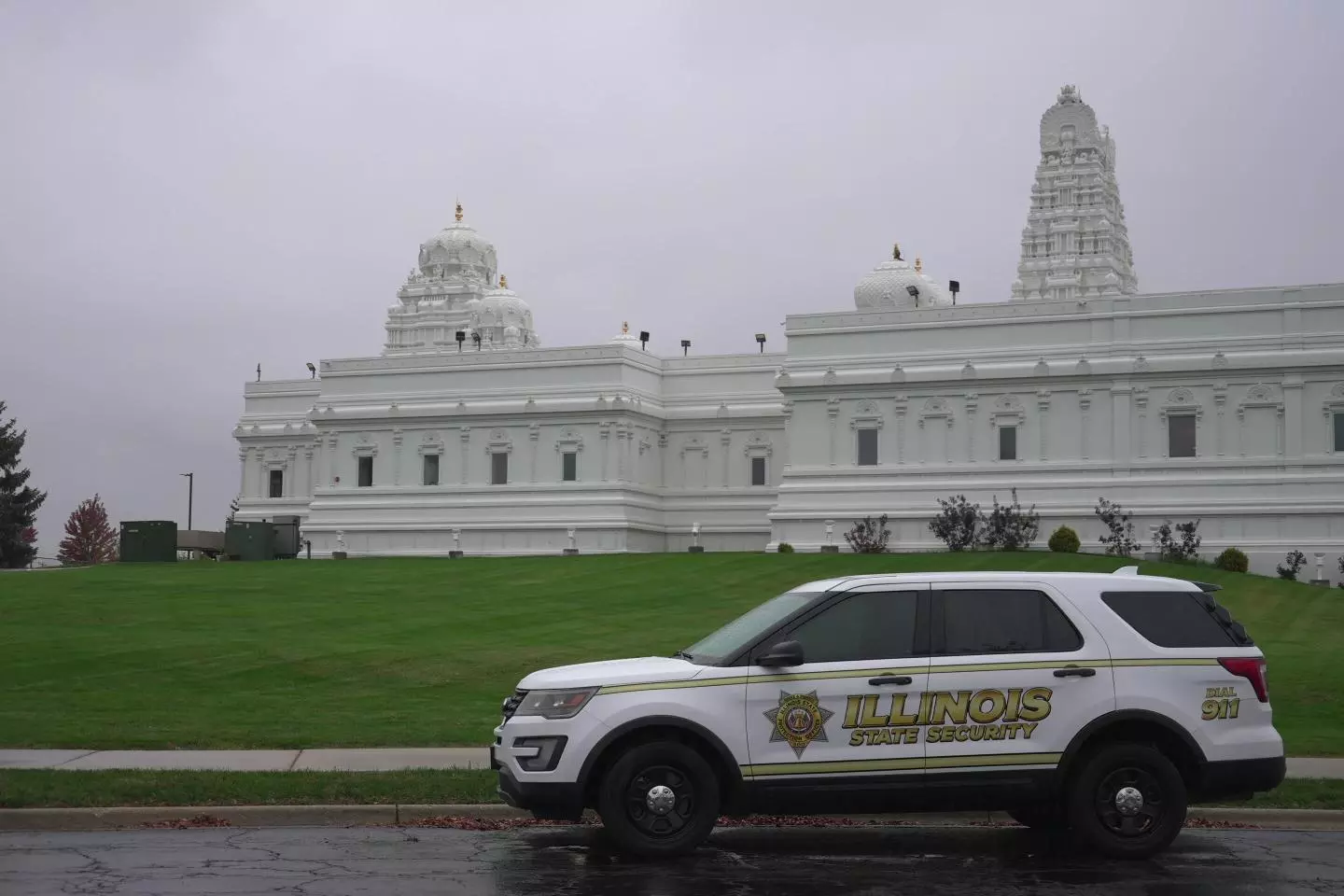
An Illinois State Security vehicle stands outside the Sri Venkateswara Swami (Balaji) Temple in Aurora, Illinois, on Thursday, October 15, 2026, following an alleged attempted mass shooting targeting Indian-Americans. The incident has heightened security concerns among Hindu worshippers and the wider Indian diaspora in the United States.Photo: AP/Laura Bargfeld
Alleged firearm threat at Sri Venkateswara Swami Temple raises concerns over racial hostility, religious security and the growing vulnerability of Indian-Americans in the United States
Key Highlights
- An alleged attempted shooting at a Hindu temple in Aurora, Illinois, has heightened anxiety among Indian-Americans.
- A 19-year-old suspect, identified as Alexandros Paporakis, has been accused of attempting an armed attack.
- Growing anti-Indian hostility on social media has raised fears of discrimination escalating into physical violence.
- Indian-American Congressman Raja Krishnamoorthi recounts a racially offensive remark allegedly directed at him by a Florida elected official.
- The incident renews debate over religious freedom, community safety and the responsibility of American authorities to confront hate-driven threats.
Aurora, Illinois: An alleged attempt to carry out a shooting at a prominent Hindu temple in the American state of Illinois has sent waves of anxiety through the Indian diaspora, intensifying concerns that increasingly hostile rhetoric against Indians on social media may be finding a dangerous expression in the real world. The incident at Sri Venkateswara Swami (Balaji) Temple in Aurora has raised troubling questions about the safety of religious institutions, the vulnerability of immigrant communities and the future of racial tolerance in the United States.
The accused, identified as 19-year-old Alexandros Paporakis, allegedly attempted to attack the temple with a firearm. Although the information available does not establish that a mass shooting occurred, the reported attempt itself has become a source of serious concern among Indian-Americans, particularly those who regularly visit Hindu temples with their families.
For many members of the community, temples represent far more than places of worship. They are centres of cultural identity, social interaction, traditional education and community life, preserving religious and cultural connections across generations.
The possibility of such a sacred institution becoming the target of armed violence has therefore generated fears extending well beyond Illinois.
From Online Hostility to Fears of Physical Violence
The incident comes amid growing concerns about anti-Indian expressions circulating across sections of American social media, where immigration, employment, cultural differences and national identity have increasingly become subjects of heated debate.
Indian-Americans have expressed apprehension that online abuse, racial stereotyping and inflammatory language could contribute to an environment in which threats against particular communities become normalised.
The central concern is not merely the existence of offensive online commentary, but the possibility that persistent hostility may encourage individuals to translate prejudice into acts of intimidation or violence.
However, investigators would need to establish the suspect’s motive before the alleged temple attack could conclusively be classified as a hate-motivated crime.
Congressman Krishnamoorthi Reveals His Own Experience of Racial Abuse
Indian-American Congressman Raja Krishnamoorthi has also drawn attention to the racial hostility encountered by people of Indian origin, including those holding prominent positions in American public life.
Recalling a recent incident involving a Florida elected official, Krishnamoorthi said:
“A Florida elected official, two weeks ago, called for me to be deported and said ‘Take your curry and go home’.”
His account illustrates how racial prejudice can affect even established political representatives who have built their careers within the American democratic system.
The reported remark is particularly disturbing because it challenges an individual’s sense of belonging on the basis of ancestry rather than citizenship, public service or personal achievement.
For the Indian diaspora, such language reinforces concerns that professional success, political participation and decades of residence do not necessarily provide immunity from racial discrimination.
Religious Institutions Face Renewed Security Concerns
The alleged attack has also brought the security of Hindu temples and other minority religious institutions into sharper focus.
Temples across the United States frequently attract large congregations during festivals, religious ceremonies and community gatherings. Many operate with extensive volunteer participation and remain accessible to worshippers throughout the day.
Ensuring their safety without undermining the welcoming character of religious spaces presents a difficult challenge.
The presence of a security vehicle outside the Aurora temple, photographed on Thursday, October 15, reflects the heightened attention surrounding the incident.
The broader challenge for law enforcement is to assess credible threats, protect vulnerable institutions and maintain public confidence without creating unnecessary fear.
The American Dream Confronts an Uncomfortable Reality
For generations, the United States has attracted Indian students, researchers, doctors, engineers, entrepreneurs and other professionals seeking educational opportunities, economic advancement and personal freedom.
Indian-Americans have contributed substantially to American universities, healthcare, technology, business and public administration.
Yet the reported incident in Illinois has renewed an uncomfortable question within parts of the diaspora: can economic and professional success guarantee social acceptance when racial hostility remains a persistent concern?
For families who have spent decades building their lives in the United States, the anxiety is particularly personal. Their children may have been born and educated in America, speak with American accents and identify the country as their only home.
Nevertheless, discriminatory language that treats them as outsiders can undermine that sense of belonging.
Freedom of Religion Must Remain Non-Negotiable
The right to practise one’s religion without intimidation is among the fundamental principles of American constitutional democracy.
An alleged armed threat against a temple therefore raises concerns that go beyond the Indian community. The protection of religious freedom requires that churches, mosques, synagogues, temples and other places of worship remain safe for everyone.
Any investigation into the Illinois incident must establish the facts, determine whether religious or racial prejudice played a role and ensure accountability in accordance with the law.
Equally important is the responsibility of political leaders and public institutions to distinguish legitimate debate over immigration or economic policy from rhetoric that demeans individuals because of their ethnicity or national origin.
A Moment of Concern for Indians Across America
The alleged temple attack has become a disturbing reminder that community security cannot be measured solely through economic prosperity, educational achievement or political representation.
Indian-Americans have become an integral part of American society, but the fears expressed following the Illinois incident indicate that questions of identity, acceptance and personal safety remain significant.
While the precise motive behind the alleged attack must be determined through investigation, the anxiety it has generated deserves serious attention.
The larger issue is whether American institutions, political leaders and civil society can respond effectively to racial hostility before threatening behaviour develops into violence.
For the Indian diaspora, the expectation is neither exceptional treatment nor special privilege. It is the assurance that every individual, irrespective of origin or faith, can live, work and worship without fear.
The incident in Aurora is therefore more than a question of security at one Hindu temple. It is a test of whether the ideals of religious liberty, equal citizenship and cultural coexistence remain strong enough to protect the diverse communities that have helped shape modern America.