Reg No. - CHHBIL/2010/41479ISSN - 2582-919X

Vishnu Bhog Rice Rakhis: When ‘Vocal for Local’ Becomes a Celebration of Rural Creativity-By-Kumar Bahukhandi
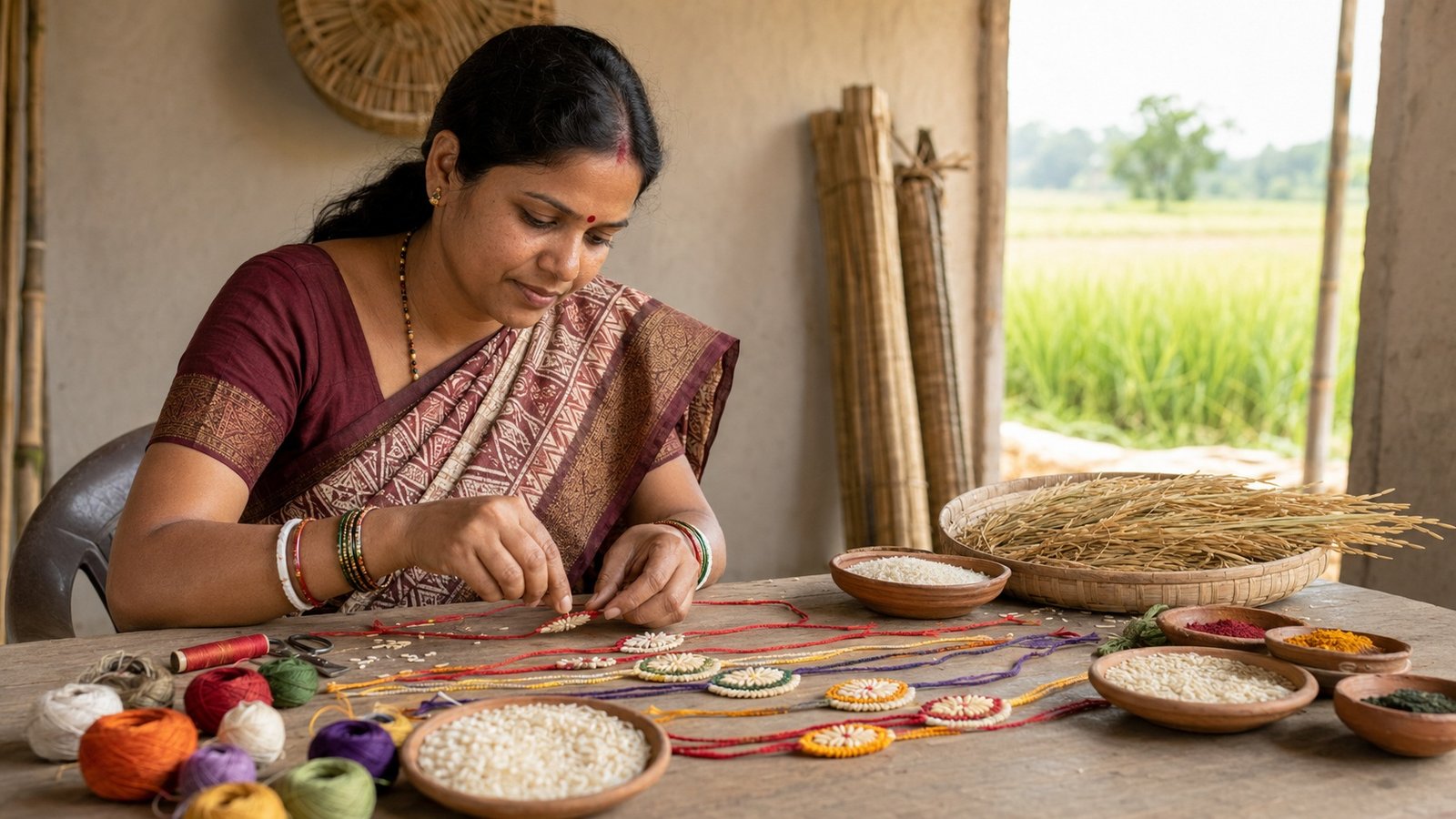
Vocal for Local: A representative visual shows a Chhattisgarh woman crafting colourful rakhis from Vishnu Bhog rice grains, blending rural creativity with women-led self-reliance. (AI-generated image)
By transforming grains of Chhattisgarh’s renowned Vishnu Bhog rice into handcrafted rakhis, women associated with a BIHAN self-help group have given Raksha Bandhan a distinctive local, cultural and economic meaning
Key Highlights
- BIHAN women have crafted decorative rakhis using grains of Chhattisgarh’s Vishnu Bhog rice
- The initiative turns a traditional festival into a platform for rural enterprise and women’s economic empowerment
- Locally made rakhis offer a meaningful alternative to mass-produced and plastic-heavy decorative products
- The innovation reflects the true spirit of ‘Vocal for Local’ by connecting agriculture, culture and livelihoods
- Better branding, packaging and market access can transform such seasonal products into sustainable rural businesses
A rakhi is a small thread carrying an immense emotional meaning. It represents affection, protection, responsibility and the enduring relationship between a sister and her brother. This Raksha Bandhan, women associated with a BIHAN self-help group in Chhattisgarh have added another significant dimension to the festival by making rakhis from grains of Vishnu Bhog rice.
Their initiative deserves attention not merely because the rakhis are attractive or unusual. It is important because it brings together several essential elements of Chhattisgarh’s identity—its rice-growing traditions, the creativity of its rural women, the dignity of local labour and the ambition to build a self-reliant rural economy.
Vishnu Bhog is not simply another agricultural commodity. It is a well-known aromatic rice variety associated with the land, farming knowledge and food culture of Chhattisgarh. By incorporating its grains into rakhis, the women have transformed an agricultural product into an object of cultural expression.
A grain normally seen in a field, market or household kitchen has acquired a new identity through imagination and craftsmanship. This is precisely where the real value of rural innovation lies. Innovation does not always require sophisticated machinery, a large investment or an urban start-up ecosystem. It can emerge when local people look at familiar resources differently and find new ways to create economic and cultural value from them.
The Vishnu Bhog rakhis also give practical expression to the national call for ‘Vocal for Local’. The slogan becomes meaningful only when local products are not merely praised in speeches but purchased, used, gifted and recommended by citizens. Choosing a locally made rakhi may appear to be a small decision, but thousands of such decisions can collectively create meaningful demand for rural producers.
Every Vishnu Bhog rakhi purchased directly supports the hands that made it. The money spent does not disappear into an anonymous industrial supply chain. It reaches women who are working to strengthen their household income, build financial independence and establish their identity as producers and entrepreneurs.
This direct relationship between the customer and the artisan gives the product a value that cannot be measured by price alone. A machine-made rakhi may be visually attractive, but a handmade Vishnu Bhog rakhi carries the story of Chhattisgarh’s farms, its villages and its women.
The initiative is also significant from an environmental perspective. Festival markets are increasingly dominated by products made with plastic, synthetic fibres, glitter and other materials that are difficult to recycle. Such items may be used for only a few hours or days but can remain in the environment for years.
Rakhis made predominantly with grains and other natural materials offer a more responsible alternative. However, the producers and supporting agencies must ensure that the entire product—including its thread, adhesive, decorative elements and packaging—is as environmentally friendly as possible. A rakhi should not be described as completely eco-friendly merely because rice grains have been used in its design. The claim must apply to the complete product.
There is also a legitimate concern about using food grains for decoration when food security remains an important national issue. This concern should not be dismissed. The answer lies in responsible production. If only a very small quantity of rice is used, particularly grains unsuitable for regular sale or consumption, the initiative can create far greater economic value without causing meaningful food wastage.
The groups should clearly explain their production process so that consumers understand how much rice is being used and whether broken, rejected or non-marketable grains are being repurposed. Such transparency would strengthen the credibility of the product and prevent a creative initiative from being misunderstood.
From Seasonal Craft to Sustainable Rural Enterprise
The success of the Vishnu Bhog rakhis should not be measured only by the number sold during one Raksha Bandhan season. The more important question is whether this innovation can become the foundation of a sustainable rural enterprise.
BIHAN, Chhattisgarh’s rural livelihood mission, has helped bring women together through self-help groups and encouraged them to participate in income-generating activities. Yet forming a group or teaching women to make a product is only the beginning. A livelihood becomes sustainable when producers have access to quality materials, professional design support, attractive packaging, digital payments, dependable transport and markets beyond their immediate locality.
Many excellent products made by rural women remain confined to official exhibitions, government functions or short-duration fairs. They receive praise and publicity but often fail to reach ordinary customers throughout the year. If the Vishnu Bhog rakhi initiative is to achieve its full potential, it must move beyond ceremonial display and become genuinely accessible to buyers.
District administrations, government departments, public representatives, schools, colleges, private institutions and business organisations can play an important role by placing advance orders. Local retail outlets can reserve space for products made by self-help groups, while e-commerce platforms and social media can help producers reach customers across Chhattisgarh and outside the state.
Packaging will be especially important. The packet should clearly mention the name of the self-help group, the village and district where the rakhi was made, the materials used, the price and a contact number or digital payment facility. A brief account of Vishnu Bhog rice and the women behind the product would allow buyers to understand its cultural significance.
The rakhis should also be offered in different price categories and designs. Simple, affordable versions can serve the mass market, while premium gift packs containing multiple rakhis, greeting cards and information about Chhattisgarh’s rice heritage could attract urban and corporate customers.
Government support must enable women to compete in an open market rather than make them permanently dependent on official purchases. The objective should be to build their capabilities so that customers choose the product because of its quality, originality and emotional appeal—not merely out of sympathy or administrative encouragement.
Design collaboration with art institutes, universities and professional designers could help the women develop contemporary products while preserving their local identity. Care must be taken, however, to ensure that outside intervention does not erase the character that makes the rakhis distinctive. Professional guidance should refine rural creativity, not replace it.
The initiative can also help promote the identity of Chhattisgarh as the “Rice Bowl of India”. The state grows numerous indigenous rice varieties, each connected to local ecosystems and traditional knowledge. Craft products based on these varieties can introduce consumers to the agricultural diversity of the region and encourage wider interest in conserving traditional seeds.
Vishnu Bhog rakhis could become part of a broader range of festival-based rural products. Self-help groups could design grain art, greeting cards, decorative pieces, wedding favours and culturally themed gifts. The knowledge acquired through one seasonal product can therefore support income-generating activities during other festivals and occasions.
At its heart, this initiative is about much more than rakhi-making. It concerns the economic agency of rural women. When a woman earns from her own skill, she gains not only income but also greater confidence and a stronger voice in family and community decisions. Her children witness the value of creativity and enterprise, while other women are encouraged to recognise their own abilities.
The phrase ‘Vocal for Local’ will remain incomplete if citizens admire local products but continue buying only mass-produced alternatives. Public support must take the form of actual purchases, fair prices and repeat demand. Bargaining aggressively with a rural artisan while readily accepting the fixed price of a branded product contradicts the very spirit of local empowerment.
The Vishnu Bhog rakhis made by BIHAN women offer citizens a simple opportunity to make a conscious choice. By tying one of these rakhis, a family can celebrate a relationship while also honouring Chhattisgarh’s farmers, indigenous agricultural heritage and rural women entrepreneurs.
The initiative proves that tradition and enterprise need not exist separately. A festival can preserve emotion while generating livelihoods. A rice grain can represent both agricultural heritage and artistic imagination. A rural woman can be a custodian of culture as well as an entrepreneur capable of responding to a modern market.
These rakhis carry a message that extends far beyond Raksha Bandhan: local resources acquire greater value when they are combined with creativity, and rural development becomes meaningful when women are recognised not merely as beneficiaries but as producers, innovators and decision-makers.
The thread may be delicate and the grains may be small, but the idea binding them together is powerful. It is the idea of a Chhattisgarh that values its soil, respects the labour of its women and converts cultural identity into sustainable opportunity.

YOU MAY LIKE THIS