Reg No. - CHHBIL/2010/41479ISSN - 2582-919X

When Trust Is Compromised: The Larger Warning Behind the IAF Honey-Trap Case-By-Kumar Bahukhandi (Editorial)
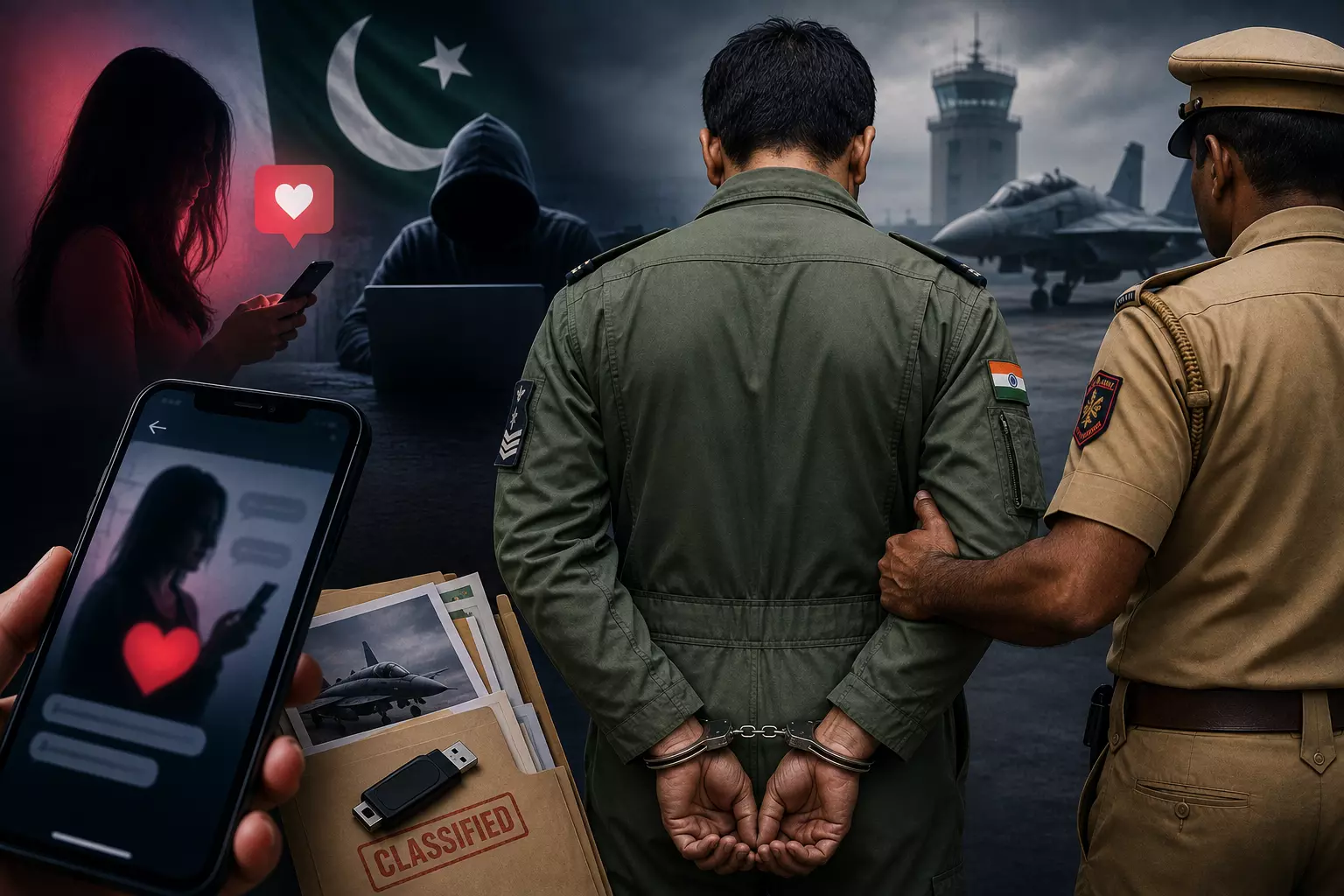
An AI-generated representational image depicting the threat posed by social-media honey traps and alleged leakage of sensitive defence information. The reported arrest of an Indian Air Force Wing Commander has brought renewed attention to digital manipulation, counter-intelligence and protection of classified information. — AI-generated image
The reported arrest of an Indian Air Force Wing Commander for allegedly sharing sensitive defence-related information after being honey-trapped through social media raises a question that India cannot afford to ignore: how does a person entrusted with some of the country’s most sensitive information become vulnerable to manipulation by a hostile intelligence operative?
According to the information available in the case, the officer was under surveillance before being handed over to law-enforcement agencies. He has reportedly been booked under provisions of the Official Secrets Act and is accused of sharing classified information and confidential defence documents.
The allegations go further. Sources have claimed that the officer installed data-stealing software on a colleague’s mobile phone in an alleged attempt to gain control of the device. The investigation is continuing.
It is important to underline that these are allegations under investigation. Guilt must be determined by a court on the basis of evidence. But the circumstances being investigated raise serious questions about human vulnerability in an age when espionage no longer necessarily begins with a secret meeting between spies.
The New Battlefield Is Also on Your Phone
The term “honey trap” may sound familiar, but technology has transformed its reach.
Social-media platforms allow an operative sitting across an international border to establish contact without ever physically meeting the target. A conversation can begin innocently. Friendship can develop gradually. Emotional attachment may follow, and what initially appears to be an ordinary online relationship can eventually become a channel for manipulation.
For defence personnel and others handling classified information, this represents a fundamentally different security challenge.
A fighter aircraft can be protected inside a secure airbase. Classified documents can be kept behind restricted access. Computer networks can be protected by sophisticated cybersecurity systems. But protecting the individual who has access to all of them requires something more — awareness, discipline and judgement.
That human vulnerability deserves as much attention as technological security.
Why Would Someone Risk National Security?
That remains the troubling question.
If an individual knows that certain information could compromise military operations, personnel, equipment or strategic capabilities, what causes that person to cross the line?
There may not be one answer. Emotional manipulation, blackmail, personal vulnerability, ideological influence or other forms of coercion can all potentially be exploited by intelligence agencies.
That is precisely why the present case should not be reduced to sensational discussion about a “honey trap”. The more important issue is how hostile intelligence agencies identify vulnerabilities and how India’s security establishment can prevent those vulnerabilities from being exploited.
Prevention Must Begin Before the Trap Is Set
Counter-intelligence cannot start only after classified information has allegedly been compromised.
Personnel occupying sensitive positions need regular and realistic training about online approaches, fake identities, suspicious friendships, phishing attempts and social engineering. They should know exactly where to report suspicious contact without hesitation.
Security awareness cannot become an annual lecture or a formality completed on paper.
The techniques used by intelligence agencies evolve continuously. Training must evolve just as quickly.
There is another lesson in the reported case. According to the information available, the officer was detected after being kept under active surveillance and was subsequently handed over to law-enforcement authorities. If established, that suggests counter-intelligence mechanisms were able to identify suspicious activity before it went unnoticed indefinitely.
But every such incident must also become an opportunity to examine whether existing safeguards can be strengthened further.
Justice Must Be Swift — But Based on Evidence
Cases involving alleged betrayal of national-security secrets understandably generate anger. The consequences of compromised defence information can potentially extend far beyond the accused individual.
If espionage or deliberate transmission of classified information to a hostile intelligence operative is established through evidence, the law must respond firmly.
At the same time, national security cannot become a reason to abandon due process. Investigation must establish exactly what information was shared, with whom it was shared, how the contact developed and what motivated the alleged conduct.
The accused must receive a fair trial, and guilt must be established by the judiciary.
What India needs is not punishment driven by public anger but credible investigation, timely prosecution and punishment proportionate to the offence when guilt is proved. That is what creates genuine deterrence.
National Security Ultimately Depends on People
India spends enormous resources protecting its borders, strengthening cyber networks, acquiring advanced aircraft and developing sophisticated defence systems.
Yet behind every security system stands a human being.
A password can be protected. A network can be encrypted. A military installation can be guarded.
Human judgement is harder to firewall.
That is perhaps the most important lesson emerging from the allegations surrounding the IAF officer.
India must continue strengthening technology and counter-intelligence capabilities, but it must invest equally in creating a security culture in which every person entrusted with classified information understands that an apparently harmless social-media interaction can sometimes be the beginning of a carefully designed intelligence operation.
If the allegations in this case are ultimately proved, accountability must follow firmly under the law.
But preventing the next person from falling into such a trap would be an even greater victory for national security.

YOU MAY LIKE THIS