Reg No. - CHHBIL/2010/41479ISSN - 2582-919X

What is the story behind the alleged embezzlement of offerings at Ayodhya’s Ram Mandir! Read Full Story
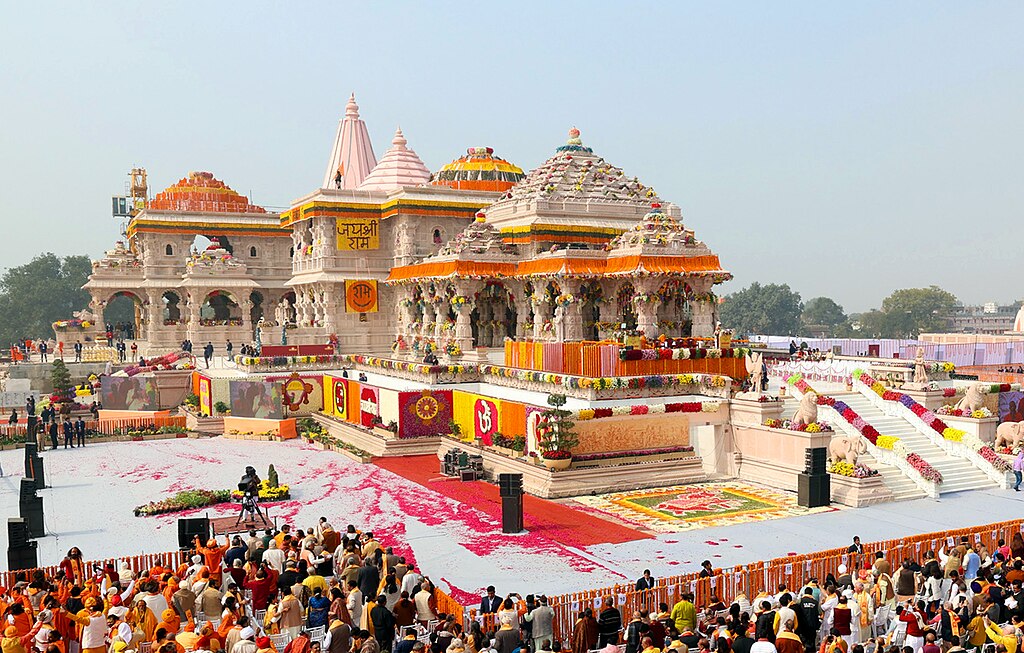
Pran Pratishtha ceremony of Shree Ram Janmaboomi Temple in Ayodhya, Uttar Pradesh on January 22, 2024. Prime Minister Modi presided over the occasion. Via Wikimedia Commons-File Photo-Credit- Internet
The Ayodhya Ram Mandir is currently in the spotlight, driven by allegations of the alleged embezzlement of funds from donation boxes within the temple complex. A Special Investigation Team (SIT), constituted by the Yogi Adityanath government of Uttar Pradesh, has arrived to investigate this alleged embezzlement, and several prominent figures were questioned on June 15 and 16.
Ayodhya,Lucknow,New Delhi : The Ram Mandir in Ayodhya is currently a topic of discussion. Allegations of ’embezzlement’ from the donation boxes within the temple complex are the reason for this. The Uttar Pradesh government has constituted a Special Investigation Team (SIT) to probe the matter.
What exactly is this entire matter? When did it take place! How were crores of rupees allegedly siphoned off from the Ram Mandir’s donation boxes? How did this matter come to light? Who has been accused of involvement in this scam!
First, find out the period during which the embezzlement of Ram Mandir donation funds took place!
It is alleged that this pattern of embezzling Ram Mandir donation money continued unchecked for about fifteen months. The suspects involved in siphoning off the funds were regularly diverting money collected from the donation boxes. On certain occasions, this manipulation reached its peak…
During the Mahakumbh and Magh Mela: When millions of devotees traveled from Prayagraj to Ayodhya for darshan during last year’s Mahakumbh and this year’s Magh Mela, the volume of offerings surged dramatically. This period proved to be a goldmine for the alleged embezzlers; taking advantage of the situation, the staff responsible for counting the money managed to siphon off anywhere between ₹10 lakh and ₹15 lakh in a single day.
Massive embezzlement in the final months: It has also come to light that just before they were caught—specifically during the last few months—these employees had siphoned off enormous sums of money.
This theft of donations, which began during the Mahakumbh, continued unabated for over a year without anyone—including officials and security personnel—getting even a hint of it. Social media reports estimate the embezzled amount to range from ₹200 crore to ₹1,400 crore.
Now, find out: How did such a massive embezzlement occur at the Ram Mandir!
The large-scale embezzlement of donation money from the Ram Mandir was not the work of a single individual; rather, it was a well-orchestrated scheme that exploited nepotism in hiring, major security lapses, and flaws in the counting process.
- Irregularities in hiring and ‘Tinnu’s’ network
The responsibility for counting the daily offerings received by the temple was entrusted to the State Bank of India (SBI).
However, the bank hired the staff responsible for counting donations through an outsourcing agency. The scheme involved ensuring that the agency hired only those individuals for the counting job who had been pre-selected by the Trust.
These individuals were relatives or acquaintances of senior Trust officials. A key figure identified in this operation is a man named ‘Tinnu,’ who leveraged his influence to get approximately 35 to 40 of his own associates hired for the job.
Send feedback
- Siphoning off funds during the counting process
The method of theft was highly cunning. Before counting began, all donation boxes were opened and the entire sum was pooled together, ensuring there was no prior knowledge of the exact total amount. Taking advantage of this, employees would siphon off money while the counting was underway. Only the remaining balance—calculated after the theft—was recorded, allowing the crime to go undetected.
- Unchecked movement of staff
Despite stringent security arrangements within the temple complex, these Trust-appointed employees—wearing ID cards—moved freely and fearlessly across every corner of the premises. A major lapse was that, being Trust employees, they were neither searched nor subjected to background verification. It is alleged that during the Mahakumbh and Magh Mela, when offerings increased manifold, these thieves exploited the lengthy counting process to siphon off between ₹10 lakh and ₹15 lakh in a single day.
- A massive racket under the guise of low wages
The apprehended employees were working for a monthly salary of merely ₹12,000 to ₹18,000. Despite such low pay, they worked long shifts at the temple day and night; the salary was inconsequential to them, as they were siphoning off crores from the offerings.
Since these employees had been hired based on the Trust’s recommendation, bank officials did not question their working methods. Collusion between bank officials and the employees cannot be ruled out in this entire affair.
- Failure of CCTV and surveillance systems
Although CCTV cameras were installed on the premises, the surveillance and audit systems proved completely ineffective. While the CCTV cameras did record the incidents, the lack of real-time monitoring meant the theft was not detected immediately. Now that the SIT investigation has commenced, this CCTV footage has been seized as evidence; it is expected to lead to several crucial revelations in the case.
How the Ram Mandir embezzlement case came to light!
The exposure of this major embezzlement case at the Ram Mandir unfolded primarily in two stages. It is reported that suspicions arose regarding the manipulation of offering funds; consequently, the system was placed under surveillance, leading to the unearthing of the entire scheme. However, after the matter came to light, the Trust initially kept it under wraps with strict confidentiality.
The controversy gained public momentum when Samajwadi Party chief and former Uttar Pradesh Chief Minister Akhilesh Yadav openly alleged that crores of rupees in donations had gone missing. In a post on his X account, he stated that crores of rupees from the offerings were found missing—a situation he described as deeply shameful. He also urged the Supreme Court to take suo motu cognizance of the matter.
This matter began to surface gradually following allegations made by Akhilesh Yadav. Subsequently, a stir erupted—from Ayodhya to the rest of the country—regarding the embezzlement of funds meant for the Ram Mandir, which had been ongoing for over a year. Initially, Trust officials maintained silence. Once the matter came to light, the Trust itself identified and interrogated the suspected employees privately. As the controversy escalated, the Trust wrote to the Chief Minister requesting an investigation. Consequently, the state government constituted a Special Investigation Team (SIT), which is now conducting a thorough probe into the entire scam at the temple site.
Who has been accused of involvement in this scam!
Allegations and suspicions regarding the involvement of individuals at various levels have emerged in the Ram Mandir donation scam.
Five key employees responsible for counting donations: The names of five employees—Lav-Kush Mishra, Avnish, Anukalp, Karun (or Karune), and Ramashankar—have surfaced as the primary individuals who executed this embezzlement. They have confessed to the theft, and based on information provided by them, crores of rupees have been recovered so far. Approximately ₹10–12 lakh was recovered from Lav-Kush’s home, and ₹5 lakh was seized from Avnish’s bank account.
‘Tinnu’ and his trio: A trio comprising Tinnu, his son, and his nephew is emerging as the mastermind behind this entire scheme. Tinnu is a close associate of a senior Trust official; leveraging this influence, he had managed to get about 35–40 of his acquaintances hired for the task of counting donations. Ramashankar, one of the five employees apprehended, is also a relative of Tinnu. Tinnu’s nephew was caught on the very first day the matter came to light.
Relatives of officials and intermediaries: The investigation has also revealed that the nephew of a senior Trust official played an initial role in the manipulation, with others carrying out the theft under his patronage; however, Tinnu later sidelined him. Additionally, the name of Ravi Mishra has surfaced; he is a relative (specifically, a co-in-law) of the accused, Lavkush, and was the one who had secured the temple job for him.
Top Trust Officials: It is not just low-level employees; several senior office-bearers of the Shri Ram Janmabhoomi Teerth Kshetra Trust are also under scrutiny and investigation. Officials such as Champat Rai, Anil Mishra, and Gopal Rao are primarily responsible for managing temple operations and overseeing the counting of offerings. Despite this, the embezzlement of offering funds raises serious questions. All those responsible have remained silent since the incident came to light; not a single official has issued an official statement regarding the matter. The SIT is investigating whether there was any top-level protection or collusion involved in this embezzlement.
Bank Officials and Employees: The role of State Bank of India (SBI) officials and employees is also viewed with suspicion in this entire fraud. The outsourcing company engaged by the bank to hire staff recruited only those individuals designated by the Trust. Bank officials never questioned the work or audits of these recommended employees, making it impossible to rule out their collusion.
What is the amount of money involved in the embezzlement!
No precise or official figure regarding the embezzled amount from the Ram Temple has emerged so far, as the thieves siphoned off the money in a highly cunning manner before the counting took place. Only the amount remaining after the counting was recorded; consequently, accurately estimating the total stolen sum poses a major challenge even for investigative agencies.
However, based on the preliminary investigation and interrogation of the arrested suspects, there are clear indications of financial irregularities exceeding eight crore rupees. Meanwhile, speculation on social media and in public discourse suggests the figure could reach hundreds of crores (approximately 200 crore rupees), though there has been no official confirmation of this.
Shockingly, the theft was not limited to cash alone. Allegations have also surfaced regarding the disappearance of gold and silver jewelry worth crores of rupees received as donations. There is talk that genuine gold ornaments were replaced with fakes; even a two-kilogram gold mace received as a donation is reportedly missing.
How is the investigation into this alleged embezzlement proceeding!
A high-level inquiry into the matter is currently underway. An SIT (Special Investigation Team) has been constituted for this purpose. The team comprises Lucknow Divisional Commissioner Vijay Vishwas Pant, IG (Lucknow Range) Kiran S, and Special Secretary (Finance) Neel Ratan. The government has issued strict instructions to the SIT to submit its preliminary investigation report within seven days and the final report within 15 days.
Current Status of the SIT Investigation
- The team visited the trust’s office within the temple complex and seized crucial records, documents, and financial files related to donation funds.
- The SIT has secured vital CCTV footage related to the incident as evidence.
- The team has also closely examined where donation boxes are kept, the room to which they are moved prior to counting, and the existing surveillance arrangements. In addition to questioning the detained employees suspected of involvement, the SIT has summoned bank officials and staff.
- Bank personnel are specifically being questioned regarding the recruitment process for the counting staff and whose recommendations led to their hiring.
- The investigation is not limited to financial irregularities alone. The SIT is also thoroughly probing whether the embezzlement involved the patronage, collusion, or negligence of any senior office-bearer, trustee, or influential individual.
- It is reported that if the involvement of a trustee or a serious administrative lapse is established, their powers could be curtailed.
- According to Nripendra Misra, Chairman of the Ram Mandir Construction Committee, the investigation has two primary objectives: getting to the bottom of this criminal act and establishing a system to prevent such incidents in the future.

YOU MAY LIKE THIS