Reg No. - CHHBIL/2010/41479ISSN - 2582-919X

Supreme Court Refuses Interim Suspension of CEC Gyanesh Kumar, Seeks ECI Response
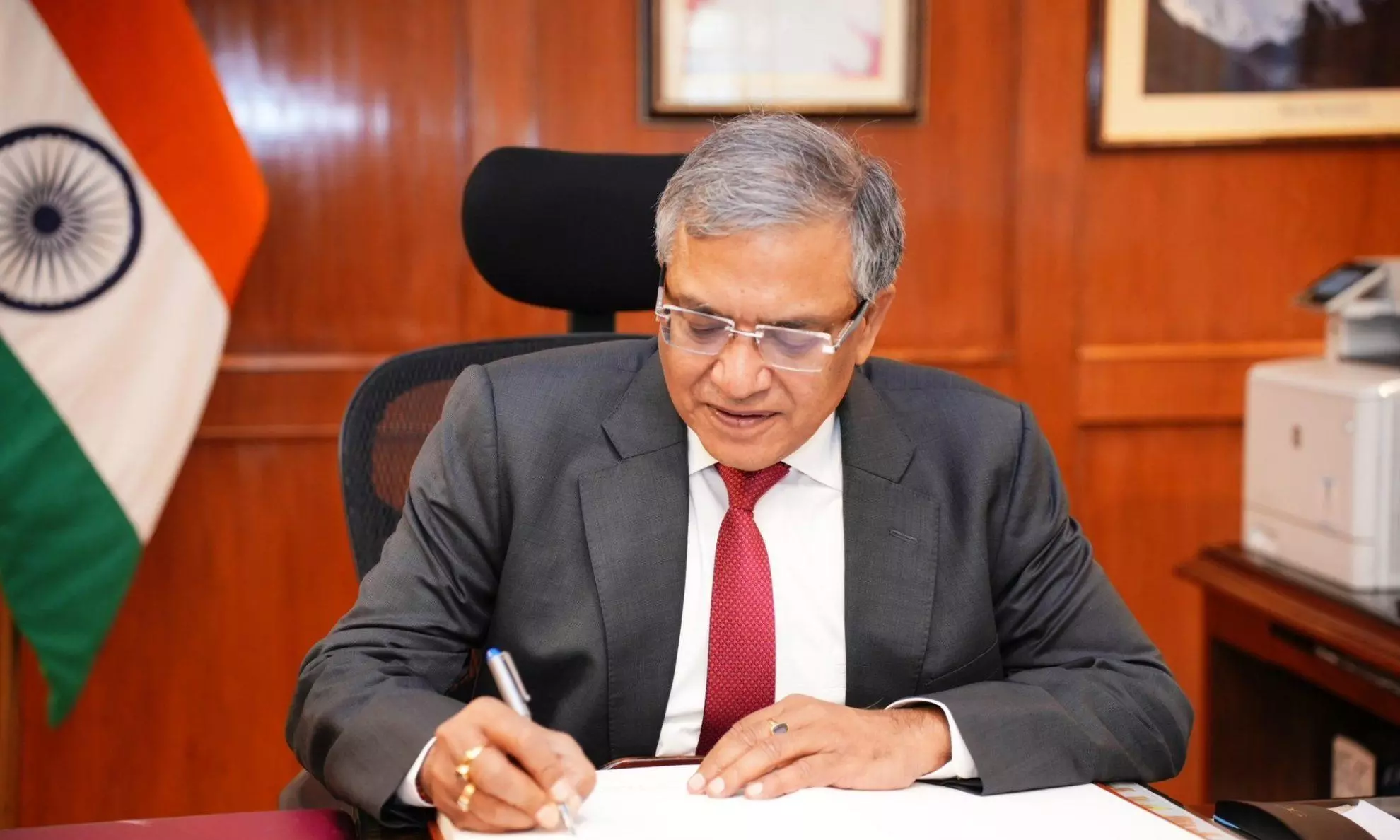
Chief Election Commissioner Gyanesh Kumar. The Supreme Court on Monday, October 5, 2026, declined to pass an interim order suspending him while seeking responses on allegations concerning decision-making within the Election Commission during the Special Intensive Revision of electoral rolls.(File Photo)
Court says it never approved modified Form 6; will examine allegations of unilateral decision-making during Special Intensive Revision of electoral rolls
Key Highlights
- Supreme Court declines to pass an interim order suspending CEC Gyanesh Kumar.
- Bench issues notice and seeks the Election Commission’s response to allegations of unilateral decision-making.
- CJI Surya Kant clarifies that the Supreme Court did not approve modifications to Form 6.
- Court indicates that decisions found to have been taken contrary to the required collective process can be revisited.
- Dispute centres on the Special Intensive Revision (SIR) of electoral rolls and changes linked to voter registration.
- Justice Ujjal Bhuyan separately warned against processes resulting in mass disenfranchisement.
- Opposition leaders have intensified criticism of the CEC, while the ECI has maintained that final SIR decisions were taken collectively.
New Delhi: The Supreme Court on Monday, October 5, 2026 declined to pass an interim order suspending Chief Election Commissioner Gyanesh Kumar while agreeing to examine allegations that certain Election Commission of India decisions were taken without the concurrence required in a multi-member constitutional body.
A three-judge Bench comprising Chief Justice of India Surya Kant and Justices Joymalya Bagchi and V. Mohana issued notice in the matter and sought responses concerning the challenged decisions. The petitions arise against the backdrop of the Election Commission’s Special Intensive Revision (SIR) of electoral rolls.
The proceedings assumed particular significance when the Chief Justice clarified that the Court had not approved modifications to Form 6, the statutory form used by new applicants seeking inclusion in electoral rolls.
“Let’s be very clear. Any modified Form Six has not been approved by us,” CJI Surya Kant said, adding that once the Election Commission’s report was produced, the Court would examine who had modified what.
The clarification came amid controversy over an additional declaration associated with Form 6 during the SIR exercise. Reports have said Election Commissioners Sukhbir Singh Sandhu and Vivek Joshi had raised concerns about aspects of the changes, including questions over whether they could be introduced without amending the Registration of Electors Rules, 1960. The ECI, however, has maintained that its final decisions regarding the SIR schedule were unanimous.
The petition before the Supreme Court raises a broader institutional question: whether powers vested in the Election Commission as a multi-member constitutional body can be exercised by the Chief Election Commissioner without the necessary concurrence of the other Election Commissioners.
The Court indicated that the records would have to be examined before conclusions could be reached. It also made clear that if decisions were ultimately found to have been taken contrary to the legally required decision-making process, those decisions could be set aside.
The judicial scrutiny comes amid a wider political dispute over the SIR exercise.
Separately, Supreme Court Justice Ujjal Bhuyan, speaking at NALSAR University of Law in Hyderabad on Sunday, emphasised the constitutional importance of voting rights and warned against any process resulting in large-scale disenfranchisement.
“If any process results in disenfranchising millions and millions of Indian citizens, making them second-class citizens in their own country in the sense of being citizens without voting rights, such a process is intrinsically arbitrary,” Justice Bhuyan said.
He said such a process would strike at the heart of the Constitution and referred to the protections flowing from Articles 14 and 326. His remarks were delivered at an academic event and were not part of Monday’s proceedings concerning the CEC.
Congress leader Jairam Ramesh subsequently cited Justice Bhuyan’s remarks while demanding Gyanesh Kumar’s resignation. That demand represents the Congress leader’s political position and not a finding of the Supreme Court.
The immediate legal position therefore remains clear: the Supreme Court has not suspended or removed CEC Gyanesh Kumar, nor has it at this stage accepted the allegations against him. It has sought responses and records so that the contested decision-making process can be examined. At the same time, the Court’s clarification that it never approved the modified Form 6 has placed that issue squarely under judicial scrutiny.

YOU MAY LIKE THIS