Reg No. - CHHBIL/2010/41479ISSN - 2582-919X

‘Seva Mera Yogdan’ to Take Service Beyond Campaigns, Chhattisgarh Plans Statewide Participation Drive
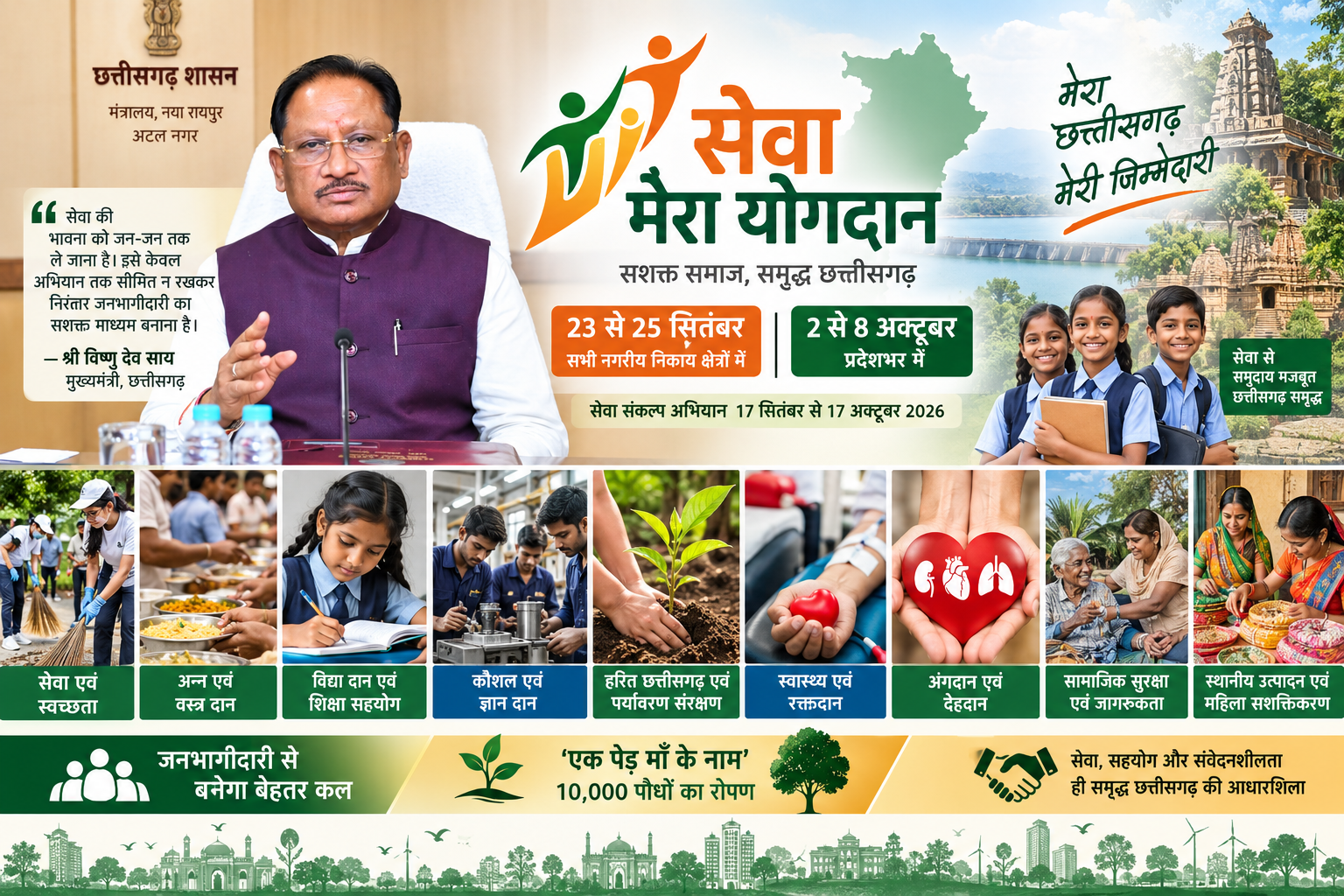
Service as a Shared Responsibility: An AI-generated visual representation of Chhattisgarh’s ‘Seva Mera Yogdan’ initiative brings together the campaign’s major themes — cleanliness, food and clothing donation, educational support, skill-sharing, tree plantation, blood donation, organ and body donation, social awareness and women’s empowerment. Activities are scheduled in urban local body areas from September 23-25, followed by a statewide drive from October 2-8, 2026. (AI-generated representational image)
From organ and body donation to education, blood donation, cleanliness and environmental protection, Chief Secretary Vikas Sheel asks districts to turn public participation into a continuing culture of service
Key Highlights
- ‘Seva Mera Yogdan’ activities to be held in urban local body areas from September 23-25.
- Statewide programme scheduled from October 2-8.
- Families of deceased organ and body donors will be honoured.
- Blood donation, free health camps, food and clothing donation, educational assistance and skill-sharing planned.
- 10,000 indigenous saplings targeted under Harit Chhattisgarh and ‘Ek Ped Maa Ke Naam’.
- NCC, NSS, MY Bharat, SHGs, youth groups and social organisations to participate.
- Seva Setu camps to cover 26 identified Central Government schemes.
- Collectors asked to ensure time-bound disposal of applications and grievances.
- Jal Jeevan Mission, Swachh Bharat Mission and crop Girdawari were also reviewed.
Chhattisgarh is preparing to take the ongoing Seva Sankalp Abhiyan beyond ceremonial activities by bringing citizens, voluntary organisations, students, self-help groups and local institutions together under ‘Seva Mera Yogdan’, an extensive public participation initiative covering service, donation, education, health, environmental protection and social welfare.
The first phase will be organised in urban local body areas across all districts from September 23 to 25, followed by a larger statewide programme from October 2 to 8.
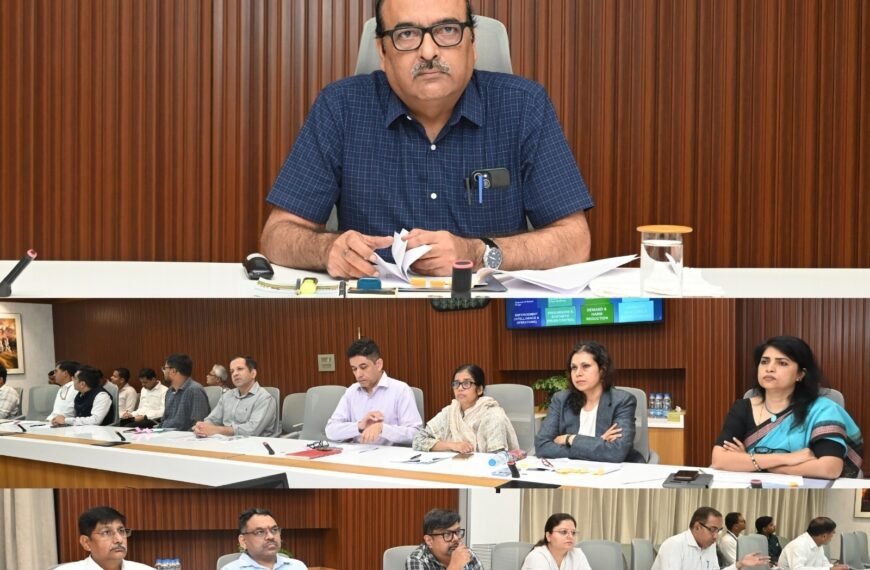
Chief Secretary Vikas Sheel, chairing a video conference with district collectors from Mantralaya Mahanadi Bhawan on Monday, directed administrations to ensure that the programme produces tangible outcomes and does not remain limited to the duration of the campaign.
The broader Seva Sankalp Abhiyan is being conducted from September 17 to October 17, 2026.
From Giving Time to Giving Life
The scope of ‘Seva Mera Yogdan’ extends considerably beyond conventional donation drives. Activities will cover service and cleanliness, food and clothing donation, educational assistance, sharing of skills and knowledge, environmental conservation, health and blood donation, organ and body donation, social security and awareness, promotion of local products and women’s empowerment.
The Chief Secretary directed district administrations to ensure active participation by NCC and NSS volunteers, self-help groups, social organisations, youth organisations, Mera Yuva Bharat and other participating institutions.
Photographs and details of activities have also been directed to be uploaded on the MY Bharat portal.
One of the programme’s most significant elements will be recognition of families whose deceased relatives donated their organs or bodies.
The Chief Secretary asked collectors to honour such families and also involve families of people who benefited from donated organs, allowing their experiences to become part of wider public awareness.
He emphasised that awareness of organ donation should continue beyond the campaign so that more people understand its importance and voluntarily come forward.
A Festival of Service and Giving
The September 23-25 programme will be observed across urban local bodies as a Seva Sankalp and Daan Utsav, before being expanded throughout Chhattisgarh from October 2 to 8.
Large-scale activities are planned around food and clothing donation, educational support, skill-sharing and training. Water sources will be cleaned and water-conservation activities undertaken, while environmental programmes will include action against plastic pollution.
The health component will include mass blood-donation programmes, mega camps and free health check-up camps.
Community initiatives will include a Maha Annadaan Abhiyan, distribution of dignity kits, establishment of book trees, distribution of school kits and educational assistance for disadvantaged children.
The Chief Secretary directed that the benefits of Daan Utsav should reach orphanages, old-age homes and people in need, while social organisations and committees should be actively associated with implementation.
He also asked districts to recognise individuals and institutions making noteworthy contributions at the conclusion of the programme.
10,000 Saplings Under ‘Ek Ped Maa Ke Naam’
Environmental action will form another major component of the campaign.
Under Harit Chhattisgarh, the State has set a target of planting 10,000 saplings of local species in convergence with the ‘Ek Ped Maa Ke Naam’ initiative.
The Chief Secretary called for broad public participation in environmental activities so that plantation and conservation become community efforts rather than one-time administrative exercises.
The larger objective running through the programme is continuity. Districts have been asked to identify activities capable of being sustained and eventually institutionalised instead of allowing them to conclude with the campaign calendar.
Seva Setu Camps to Focus on Results
The review also covered Seva Setu camps, with the Chief Secretary directing officials to systematically collect, scrutinise and dispose of applications received at the camps within stipulated timelines.
Officials were asked to work proactively and make the camps result-oriented.
The camps are to cover 26 identified Central Government schemes, with administrations responsible for ensuring that eligible beneficiaries receive the benefits available to them.
Pending grievances under the Chief Minister’s Helpline and cases falling under the Public Service Guarantee mechanism are also to be reviewed and resolved within prescribed timelines.
Addressing collectors on their responsibility for implementation, the Chief Secretary told them:
“You are the leaders of the district.”
He asked them to personally lead the campaigns in their respective districts and ensure measurable results. Details of activities and achievements are to be systematically recorded through Google Sheets for district-wise monitoring.
Girdawari, Jal Jeevan Mission Also Reviewed
The conference extended beyond the service campaign to important administrative priorities.
Collectors were instructed to ensure accuracy and reliability in crop Girdawari surveys, with continuous monitoring by tehsildars and patwaris.
The Chief Secretary also sought faster implementation of the Jal Jeevan Mission, asking districts to regularly review progress towards the October 15 targets for household tap connections and making existing connections functional.
Where shortages of sub-engineers affect works under tap-water schemes and the Jal Jeevan Mission, sub-engineers from other construction departments may also be assigned duties. Collectors were directed to review the mission every week and coordinate with Public Health Engineering Department officials to resolve problems without delay.
Targets under the Swachh Bharat Mission in both urban and rural areas were also reviewed, with emphasis on strengthening the reporting mechanism.
The Chief Secretary’s larger message to district administrations was that Seva Sankalp should evolve into a lasting platform built around public participation, the spirit of service and social cooperation.
The success of ‘Seva Mera Yogdan’, therefore, will ultimately be measured not merely by the number of programmes organised between September and October, but by how much of that participation continues after the campaign itself has ended.

YOU MAY LIKE THIS