Reg No. - CHHBIL/2010/41479ISSN - 2582-919X

Developed Chhattisgarh Will Help Realise Developed India Vision: Mandaviya Opens Rajyotsav 2026
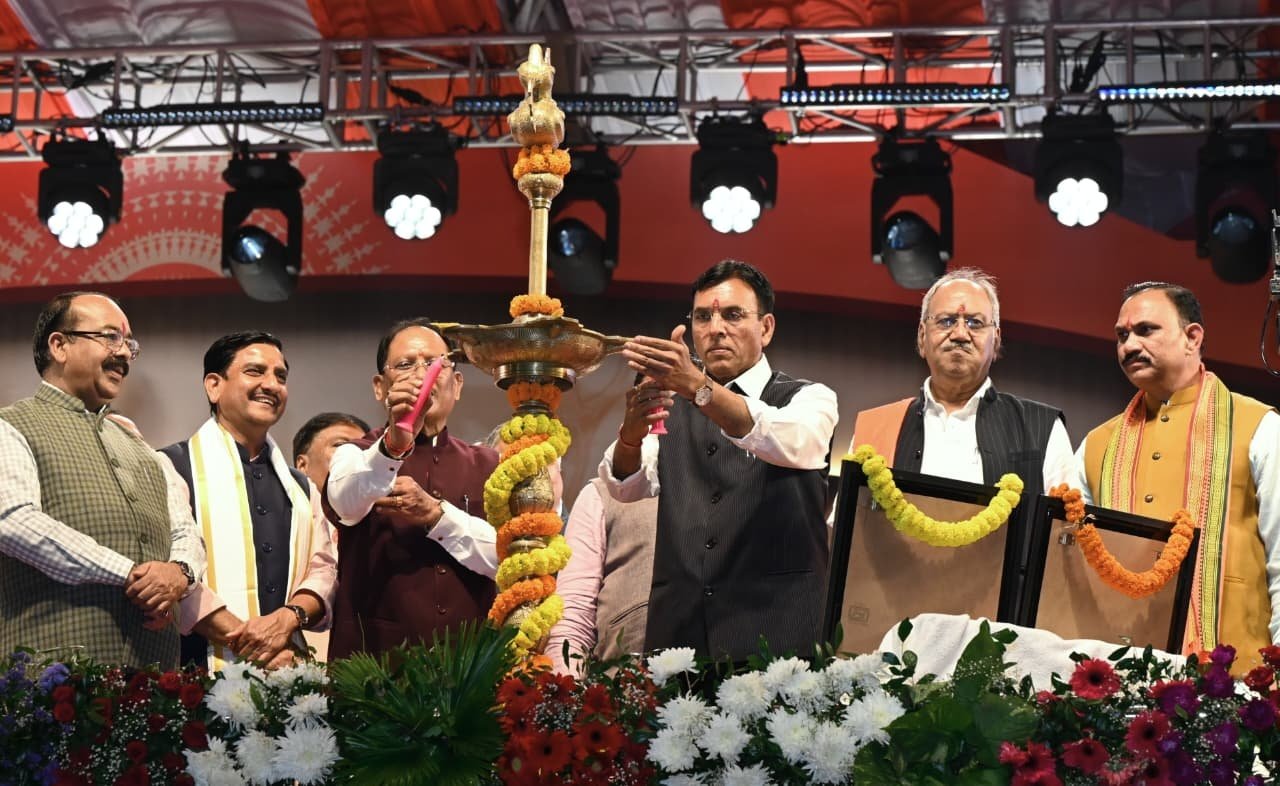
Union Minister for Labour and Employment and Youth Affairs and Sports, and chief guest Dr Mansukh Mandaviya, joins Chief Minister Vishnu Deo Sai in lighting the ceremonial lamp to inaugurate Rajyotsav 2026 in Nava Raipur on Sunday, November 1, 2026. Union Minister of State Tokhan Sahu, Deputy Chief Minister Arun Sao, Raipur MP Brijmohan Agrawal and Health Minister Shyam Bihari Jaiswal are also seen. Photo: primelookindia.com via CG/CMO
build a developed Chhattisgarh will give fresh momentum to the creation of a developed India,” Mandaviya said.
States’ Progress Central to India’s 2047 Goal
The Union Minister said Prime Minister Narendra Modi’s goal of making India a developed nation by 2047 depended on states advancing through their distinctive strengths and resources.
Chhattisgarh, he observed, combined mineral and natural wealth with rich tribal traditions and a hardworking population. These strengths offered opportunities for economic growth alongside the preservation of cultural identity.
“Only when all states develop on the strength of their individual capabilities and resources will the resolve of a developed India be fulfilled,” he said.
Mandaviya emphasised that development should move forward while protecting the traditions and heritage that give each region its character.
Vajpayee’s Statehood Legacy Remembered
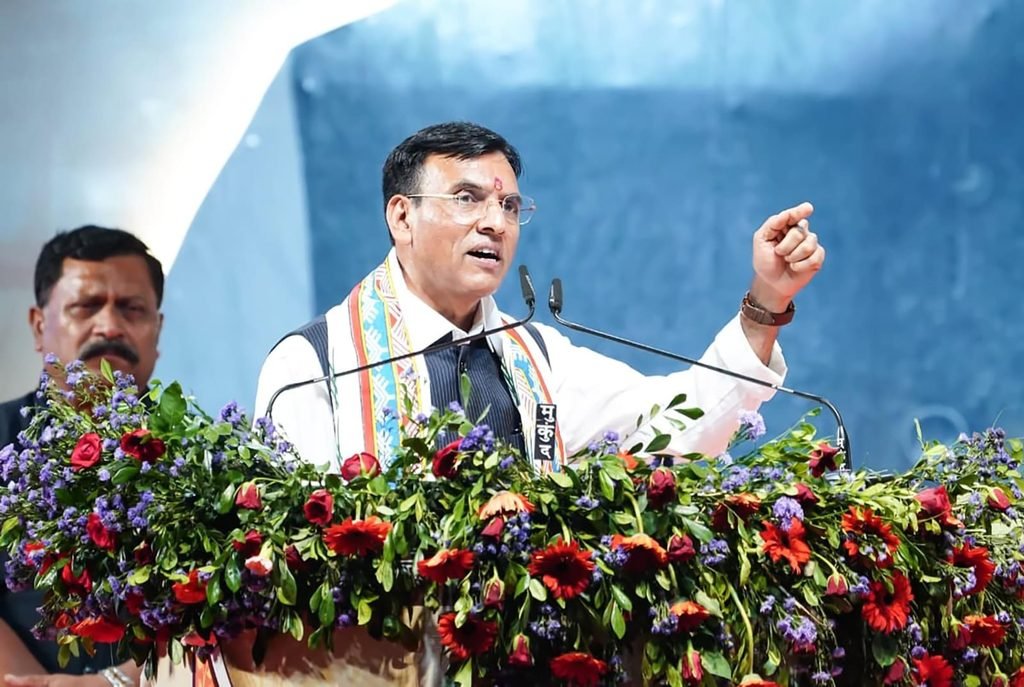
Union Minister Dr Mansukh Mandaviya addresses the inaugural ceremony of the three-day Rajyotsav 2026 in Nava Raipur on Sunday, November 1, 2026. He emphasised Chhattisgarh’s role in achieving the vision of a developed India by 2047. Photo: primelookindia.com via CG/CMO
Recalling former Prime Minister Atal Bihari Vajpayee’s role in creating Chhattisgarh, Mandaviya said statehood had given recognition to local aspirations and laid a foundation for development.
He said the state government was carrying that commitment forward by pursuing new opportunities for its people.
Chief Minister Sai also paid tribute to Vajpayee, recalling that he had fulfilled his promise to the people by creating the separate state on November 1, 2000.
Sai described Foundation Day as an occasion to reflect on Chhattisgarh’s history, cultural heritage and development journey.
He recalled the challenges surrounding roads, electricity, drinking water, education and healthcare at the time of state formation, and said these services had expanded substantially over the years.
The Chief Minister also acknowledged former Chief Minister Dr Raman Singh’s contribution to strengthening the public distribution system and improving access to subsidised foodgrains for poor households.
Bastar Moving Towards Peace and New Opportunities
Both speakers highlighted changes in Bastar, linking improved security with opportunities in sports, tourism, culture and livelihoods.
Mandaviya said a region once discussed predominantly in connection with Naxalism was increasingly being recognised for its talent and development potential. Young people from Bastar, he added, were making their mark at national and international levels.
Sai described Naxalism as a longstanding obstacle that had prevented essential services from reaching many communities despite Bastar’s natural beauty and resource wealth.
He credited Prime Minister Modi’s leadership, Union Home Minister Amit Shah’s guidance, the courage of security forces and cooperation from local residents for the progress achieved.
“Bastar is emerging from the challenge of Naxalism and moving towards a new era of peace, trust and development,” the Chief Minister said.
Sai paid tribute to security personnel for their service and sacrifice. He reiterated the government’s commitment to extending roads, electricity, education, healthcare and communication facilities to the remotest villages.
Education, skills training and employment opportunities for local youth, he said, would remain central to bringing previously affected areas into the development mainstream.
Around 1,600 Houses Completed Daily: Sai
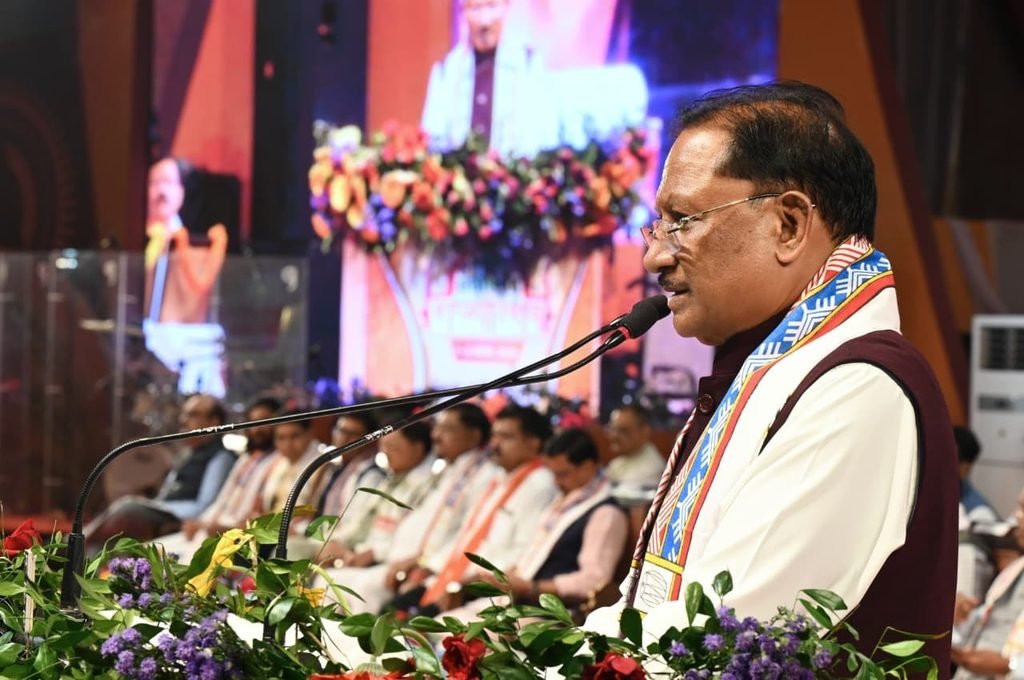
Chief Minister Vishnu Deo Sai addresses the opening ceremony of Rajyotsav 2026 in Nava Raipur on Sunday, November 1, 2026, highlighting welfare initiatives and Bastar’s progress towards peace and development. Photo: primelookindia.com via CG/CMO
Turning to welfare delivery, Sai said his government was working to fulfil the commitments made under “Modi’s guarantees” and ensure that benefits reached the last person.
He stated that approximately 1,600 permanent houses were being completed each day in Chhattisgarh under the Pradhan Mantri Awas Yojana.
“This is not merely the construction of houses; it is a campaign to fulfil poor families’ dreams of dignity, security and a better future,” Sai said.
He described housing as an important part of the government’s effort to improve living conditions for economically vulnerable households.
Paddy Procurement and Support for Rural Families
The Chief Minister said farmers’ prosperity remained a priority and highlighted the state’s arrangements for purchasing paddy.
According to Sai, the government was procuring up to 21 quintals per acre at ₹3,100 per quintal. He also referred to the payment of pending bonuses as the fulfilment of another commitment to cultivators.
Sai said the Charan Paduka Yojana had been restarted and that landless agricultural labourers were being provided ₹10,000 annually in financial assistance.
He linked these measures to the broader objective of strengthening the financial position of poor and disadvantaged rural families.
Mahtari Vandan Supports Over 68 Lakh Women
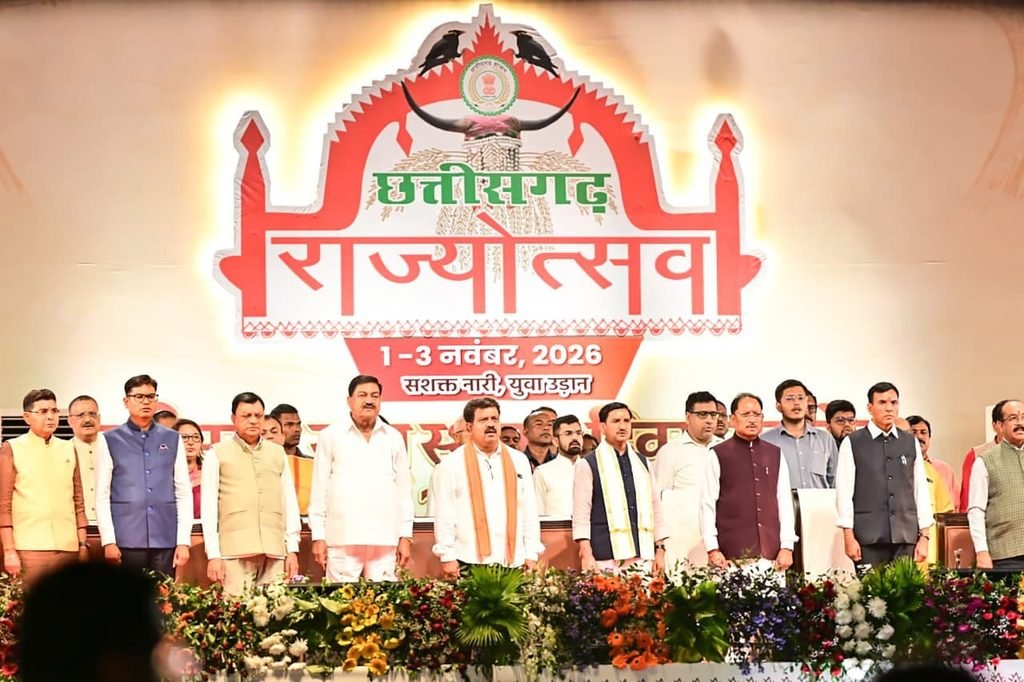
Union Minister Dr Mansukh Mandaviya, Chief Minister Vishnu Deo Sai, Deputy Chief Ministers Arun Sao and Vijay Sharma and state cabinet ministers stand on stage during Rajyotsav 2026’s inaugural ceremony in Nava Raipur on Sunday, November 1, 2026. Photo: primelookindia.com via CG/CMO
Sai described the Mahtari Vandan Yojana as an important instrument of women’s economic empowerment.
More than 68 lakh women, he said, were receiving monthly financial assistance directly into their bank accounts.
The support was helping women meet family needs while increasing their confidence and financial participation.
“Ensuring that government schemes reach the last person in society is our highest priority,” the Chief Minister said.
Over 50,000 Devotees Visit Ayodhya
Referring to Chhattisgarh’s traditional association with Lord Ram as his maternal homeland, Sai said the Shri Ramlala Darshan Yojana had enabled more than 50,000 devotees from the state to visit Ayodhya.
The government, he added, wanted people from financially weaker households to have an opportunity to undertake the pilgrimage.
He also spoke of the enthusiasm surrounding the Ram temple and the consecration of Shri Ramlala in Ayodhya.
Expansion in Medical and Higher Education
Highlighting changes in healthcare education, Sai said Chhattisgarh had only one medical college at the time of its formation, compared with 21 medical colleges across the government and private sectors today.
He described this expansion as a significant development in both professional education and medical services.
The Chief Minister also referred to the establishment of national-level educational institutions and ongoing efforts to improve access to quality education, skills training and competitive examination preparation.
The government’s objective, he said, was to help young people find opportunities suited to their abilities and ambitions.
Folk Arts and Tourism at the Heart of Cultural Growth
Culture Minister Rajesh Agrawal said Chhattisgarh’s folk culture, tribal traditions and historical heritage were central to its identity.
He cited Pandavani, Panthi and Dadariya as examples of the state’s artistic richness and said efforts were being made to preserve these traditions and honour their practitioners.
Agrawal also referred to the introduction of a State Honour in the memory of Pandavani exponent Teejan Bai.
“Chhattisgarh’s rich folk culture, tribal traditions and historical heritage give the state its distinctive identity,” Agrawal said.
Turning to tourism, he identified Chitrakote Waterfall, Sirpur, Rajim, the ancient caves of Ramgarh and Mainpat as destinations with considerable potential to attract visitors.
Tourism development, he said, could generate employment and income for local youth, women, craftspeople and small businesses.
Statehood Celebrations Bring Together Leaders and Citizens
The inauguration brought together the state’s development priorities and cultural traditions, with speakers emphasising opportunities in welfare, education, industry, tourism and employment.
Union Minister of State Tokhan Sahu, Deputy Chief Ministers Arun Sao and Vijay Sharma, state ministers, MPs, MLAs, representatives of corporations, boards and commissions, senior officials and a large number of citizens attended the ceremony.

YOU MAY LIKE THIS