Reg No. - CHHBIL/2010/41479ISSN - 2582-919X

President Murmu Addresses Nation on Eve of 80th Independence Day, Pledges Reforms to Curb Exam Paper Leaks
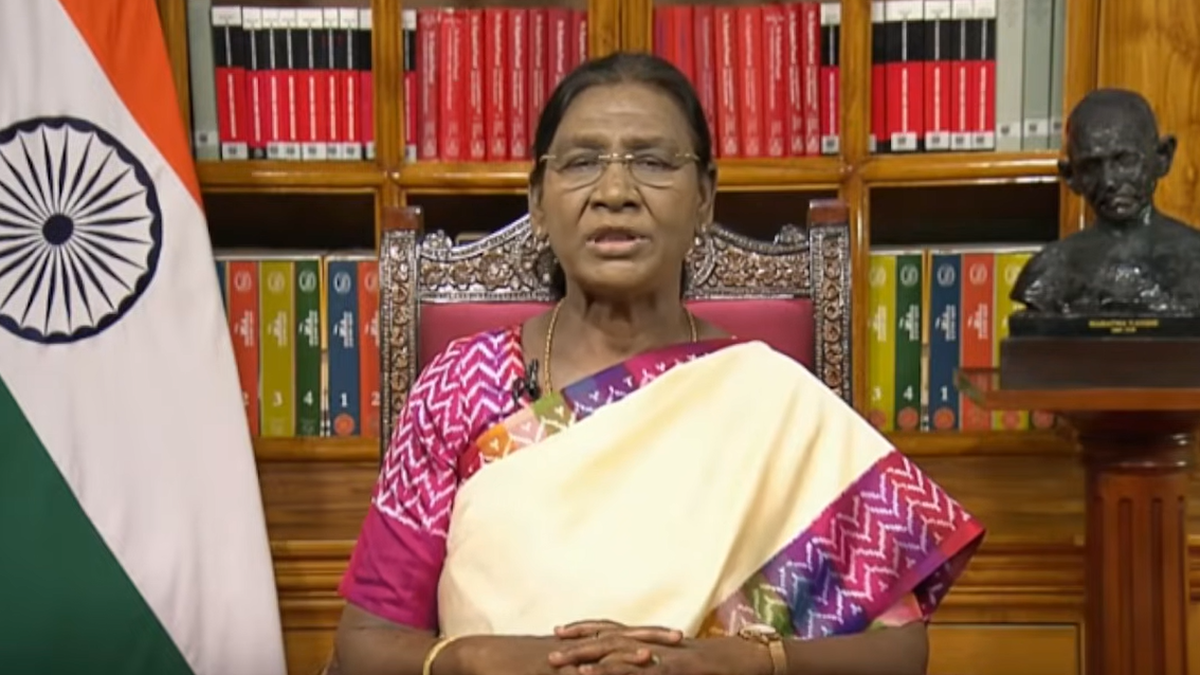
President Droupadi Murmu addresses the nation from New Delhi on Friday, August 14, 2026, on the eve of India’s 80th Independence Day. In her address, the President called for a transparent and secure public examination system while highlighting youth empowerment, national security, women’s participation and India’s journey towards Viksit Bharat by 2047. (Photo: PIB India)
Students are ‘architects of India’s future’, President says; highlights Operation Sindoor, fight against Maoism, women’s empowerment and India’s Viksit Bharat 2047 journey
New Delhi: President Droupadi Murmu addressed the nation on Friday, August 14, on the eve of India’s 80th Independence Day, placing the aspirations and future of the country’s youth at the centre of her message and announcing comprehensive reforms aimed at curbing paper leaks and unfair practices in public examinations.
Her remarks acquire particular significance at a time when the integrity of competitive examinations has become an important concern for students across the country. Describing students as the “architects of India’s future,” the President said protecting their opportunities required a collective commitment from both the government and society.
“Public examinations become gateways to opportunities for our students. The government is undertaking comprehensive steps to reform these examinations,” President Murmu said.
She said the objective was clear: “to completely curb the use of unfair means in public examinations and make the examination system more transparent, more secure, and more trustworthy for the youth.”
The emphasis went beyond administrative reform. The President drew a parallel between safeguarding the country and safeguarding the future of its young citizens, stressing that society as a whole has a responsibility towards students.
The message is especially relevant because an examination paper leak is not merely an administrative lapse. For millions of young Indians preparing for competitive examinations, often after years of study and considerable financial sacrifice by their families, the credibility of the examination system is inseparable from faith in equal opportunity.
Youth at the Centre of India’s Future
President Murmu devoted a substantial part of her address to India’s young population, describing it as the country’s most valuable asset. With about 65 per cent of the population below the age of 35, she presented India’s demographic strength not merely as a statistical advantage but as a force capable of determining the country’s economic and social trajectory.
She also drew attention to a changing attitude towards employment.
“Many of our youth are embracing the culture of job creation as they pursue the path of self-employment,” she said, highlighting the role young entrepreneurs have played in building India’s start-up ecosystem.
The President noted that major international enterprises increasingly recognise the talent and dedication of young Indians and entrust them with leadership responsibilities, enhancing the reputation of India’s youth power globally.
Her focus on young people extended beyond jobs and examinations to physical and mental well-being. Families and society, she said, share responsibility for encouraging young citizens to develop in a healthy and balanced manner.
Sports formed an important part of this vision. Referring to the Khelo India programme, President Murmu said a sporting ecosystem was being developed from the grassroots to the national level and that unprecedented investment in sports was contributing to improved performances by Indian athletes internationally.
The address thus linked several dimensions of youth development — fair examinations, entrepreneurship, employment, health and sport — to the larger ambition of building a developed India by 2047.
Operation Sindoor, Maoism and a Changing Security Landscape
National security was another major theme of the President’s address.
President Murmu paid tribute to the “unmatched valour” of the Indian Armed Forces and referred to Operation Sindoor as a demonstration of India’s capacity to conduct precise counter-terror operations.
“That historic operation against terrorism demonstrated the capability of the Indian Armed Forces to act with precision,” she said.
The operation, she added, had delivered an unequivocal warning to terrorists and their supporters.
“It sent a clear and firm message to terrorists and those who support them that no matter where they hide, they will have to face the consequences of their actions.”
She recalled both Kargil Vijay Diwas on July 26 and the first anniversary of the launch of Operation Sindoor on May 7, placing the country’s contemporary security challenges within the wider tradition of remembering the sacrifices and achievements of the Armed Forces.
The President also referred to the suspension of the Indus Waters Treaty with the country harbouring terror networks as a decisive measure taken in India’s national interest, particularly in the interest of farmers.
For Chhattisgarh, however, another part of her address carried particular resonance.
President Murmu described the progress towards eliminating Maoism as a major national achievement after decades during which Left-Wing Extremism posed a serious internal-security challenge.
“For decades, Naxalism posed a serious challenge to the nation. Making India Naxal free is a major achievement. Today, enthusiasm prevails in the areas once affected by Naxalism,” she said.
She pointed to inclusive development and growing public participation in activities such as the Bastar Olympics and Bastar Pandum as signs of transformation in regions historically affected by Maoist violence.
The observation is significant because the real test of a post-Maoist transition will extend beyond security operations. Roads, schools, healthcare, employment and opportunities for young people will determine whether peace becomes permanent in areas that have lived with violence for decades.
Women, Economy and the Road to Viksit Bharat
President Murmu’s address also presented women’s participation as a central pillar of India’s development.
From rural self-help groups and agriculture to education, entrepreneurship, sport and defence, she highlighted the expanding space occupied by women in national life.
She said the initial goal of creating three crore ‘Lakhpati Didis’ had been achieved and that efforts were now directed towards creating another three crore.
“Our girls are performing exceptionally well in education and diverse sectors, from the Drone Didi enhancing agricultural productivity to the Fighter Combat Leader in the Air Force,” the President said.
She also cited women’s achievements at the Commonwealth Games in Glasgow, noting their contribution to India’s gold-medal tally.
President Murmu referred to the Nari Shakti Vandan Adhiniyam, enacted in 2023 to provide 33 per cent reservation for women in the Lok Sabha and State Legislative Assemblies, saying greater representation would make Indian democracy more inclusive.
Economic resilience featured prominently in her assessment of India’s progress towards Viksit Bharat by 2047.
Despite wars and instability affecting the global economy, she said India continued to advance as the world’s fastest-growing major economy.
“Even in such trying circumstances, our economy is moving ahead as the fastest-growing major economy in the world,” she said, adding that economic projections placed India’s growth rate at more than twice the global average.
She credited the Atmanirbhar Bharat Abhiyan with strengthening both economic progress and national security.
The President also highlighted the expansion of welfare and financial inclusion. More than 25 crore people, she said, had emerged from poverty, while nearly 59 crore account holders had entered the banking system through the Pradhan Mantri Jan Dhan Yojana, including more than 32 crore women. Free foodgrain support, she noted, was reaching more than 80 crore people.
India’s digital transformation was another achievement she underlined, saying the country had developed the world’s largest digital infrastructure and accounted for more than half of global real-time digital transactions.
At the same time, President Murmu reminded the country that development cannot be judged only by economic growth or technology.
She spoke about India’s growing population of senior citizens and the responsibility of society to ensure their dignity. Around six crore people aged 70 and above, she said, could now access healthcare cover of up to ₹5 lakh annually under government initiatives.
Environmental responsibility, too, formed part of her vision. Referring to India’s progress on Sustainable Development Goals and initiatives such as ‘Ek Ped Maa Ke Naam’ and Lifestyle for Environment (LiFE), she called for individual participation in protecting nature.
Drawing upon India’s cultural diversity, the President recited lines from a Santali poem by Pandit Raghunath Murmu and also celebrated the inclusion of Sarnath — the site associated with Lord Buddha’s first sermon — in the UNESCO World Heritage List.
She said India’s international engagement continued to be guided by peace, dialogue, cooperation and the civilisational principle of ‘Vasudhaiva Kutumbakam’ — the world is one family. India, she added, remained committed to a rules-based international order and more appropriate representation for the global community in the United Nations and other multilateral institutions.
As the country prepared to celebrate Independence Day, President Murmu also remembered the freedom fighters who made independence possible and invoked the contributions of Mahatma Gandhi, B.R. Ambedkar and Sardar Vallabhbhai Patel.
On Partition Horrors Remembrance Day, observed on August 14, she paid homage to those who lost their lives or were uprooted during Partition.
Towards the conclusion of an address that travelled from examinations and entrepreneurship to national security, poverty reduction, women’s empowerment, culture and the environment, President Murmu invoked the words of Telugu writer Gurajada Apparao — “A nation is not just its land, a nation is all its people.”
That thought brought the different strands of her address together.
India’s ambition to become a developed nation by 2047, her message suggested, ultimately rests not merely on economic statistics, military strength or technological achievements, but on the opportunities available to its people.
And among those responsibilities, ensuring that a young student can enter a public examination believing that hard work — rather than a leaked question paper or unfair means — will determine the outcome may be one of the most fundamental.

YOU MAY LIKE THIS