Reg No. - CHHBIL/2010/41479ISSN - 2582-919X

BRICS Day 2: New Delhi Summit Turns to Resilience, Innovation and Inclusive Global Growth
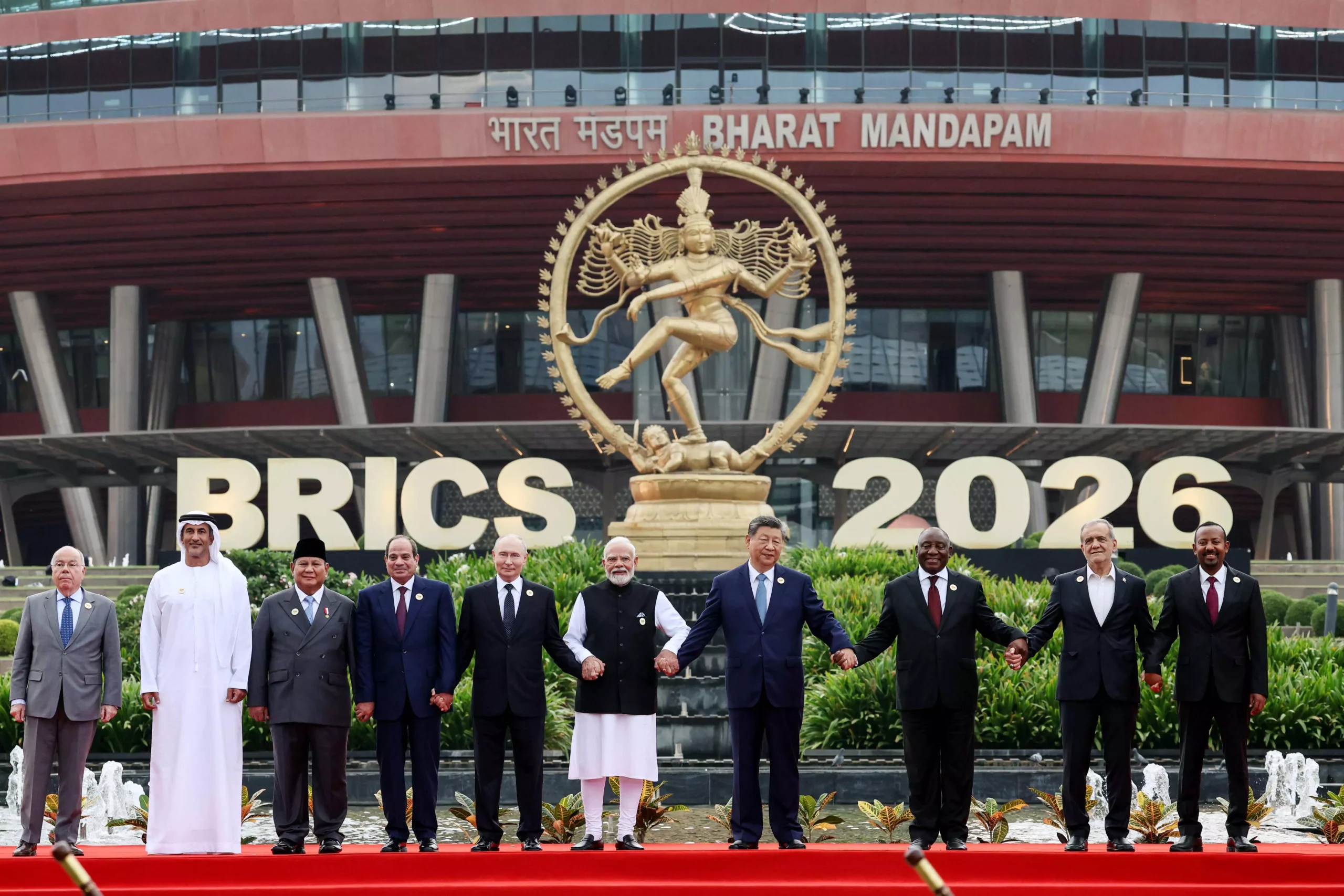
Prime Minister Narendra Modi joins BRICS leaders and representatives for the family photograph at Bharat Mandapam in New Delhi during the 18th BRICS Summit. The summit enters its second day on Sunday, September 13, 2026, with discussions focused on resilience, innovation, cooperation, sustainability and inclusive global growth. Photo: AFP
Leaders of expanded grouping to focus on practical cooperation, emerging technologies, sustainability and a stronger collective voice for developing economies
Key Highlights
- BRICS Summit enters its second and concluding day in New Delhi.
- Open session focuses on resilience, innovation, cooperation and sustainability.
- Leaders adopted the New Delhi Declaration 2026 on Saturday.
- India seeks practical, development-oriented cooperation within the expanded grouping.
- AI, digital infrastructure, trade, development finance, climate action and global governance are key areas of engagement.
- Expanded BRICS comprises 11 full members and a wider network of partner countries.
- Grouping represents nearly half of the world’s population and around 40 per cent of global GDP.
New Delhi: The 18th BRICS Summit enters its second and concluding day on Sunday with leaders turning their attention to how an expanded grouping can translate its growing global influence into practical cooperation on economic resilience, innovation, sustainable development and inclusive growth.
The day’s principal open session at Bharat Mandapam, titled “Resilience, Innovation, Cooperation and Sustainability: Shaping the Future for Inclusive Global Growth,” brings together BRICS leaders for deliberations on common priorities and the future direction of the grouping.
India is hosting the September 12–13 summit under its 2026 chairship theme, “Building for Resilience, Innovation, Cooperation and Sustainability.”
The discussions come a day after BRICS leaders adopted the New Delhi Declaration 2026, providing a political and policy framework for cooperation among member countries.
Prime Minister Narendra Modi described the outcome as reflecting a BRICS that is “wider in reach and stronger in purpose”, while emphasising innovation, sustainability and stronger people-to-people connections.
From Expansion to Effective Cooperation
The significance of Sunday’s deliberations extends beyond the four words forming India’s chairship theme.
As BRICS expands its geographical and economic footprint, a central challenge before the grouping is how to turn diversity into workable cooperation. Its members have different political systems, economic structures and strategic priorities, but share an interest in strengthening the representation of emerging and developing economies in global institutions.
Resilience, therefore, is expected to be viewed not merely in terms of economic strength but also as the capacity of countries to withstand supply-chain disruptions, health emergencies, climate-related challenges and other global uncertainties.
Innovation provides another important bridge between development and cooperation.
Artificial intelligence, digital public infrastructure, fintech and emerging technologies increasingly influence economic growth and public-service delivery. Cooperation in these areas could allow BRICS countries to exchange experience and technological capabilities while ensuring that developing economies are not left behind by rapid digital transformation.
The cooperation pillar seeks to deepen engagement in areas including trade facilitation, development finance, policy coordination and reform of multilateral institutions. The emphasis is increasingly on producing tangible outcomes that can directly benefit economies and people rather than limiting BRICS engagement to diplomatic declarations.
Sustainability, meanwhile, places climate action, green finance, energy transition and sustainable development alongside the individual developmental requirements of member countries.
An Expanded Voice of the Global South
BRICS now comprises 11 full members — Brazil, Russia, India, China, South Africa, Egypt, Ethiopia, Indonesia, Iran, Saudi Arabia and the United Arab Emirates.
A partner-country framework has further widened the grouping’s reach, bringing Belarus, Bolivia, Cuba, Kazakhstan, Malaysia, Nigeria, Thailand, Uganda, Uzbekistan and Vietnam into its broader institutional engagement.
Together, the expanded grouping represents approximately 49.5 per cent of the world’s population, 40 per cent of global GDP and 26 per cent of international trade, giving decisions and initiatives emerging from BRICS increasing international significance.
Yet numbers alone will not determine the grouping’s influence.
Its longer-term relevance will depend on whether countries with diverse interests can identify sufficient common ground to cooperate on development, finance, technology, trade and reform of international governance.
That makes the second day’s discussions particularly important.
India’s presidency has sought to place a human-centric approach at the centre of the BRICS agenda — connecting large questions of global governance with issues that ultimately affect ordinary people: economic opportunity, technological access, sustainable development and resilience against crises.
As leaders return to the Summit Hall at Bharat Mandapam, the focus consequently shifts from the symbolism of gathering together to the harder task of determining what an expanded BRICS can accomplish together.
For New Delhi, the concluding discussions also provide an opportunity to reinforce India’s effort to position the concerns and aspirations of the Global South more prominently in international decision-making.

YOU MAY LIKE THIS