Reg No. - CHHBIL/2010/41479ISSN - 2582-919X

Hareli Brings Chhattisgarh’s Rural Soul Alive at CM Residence
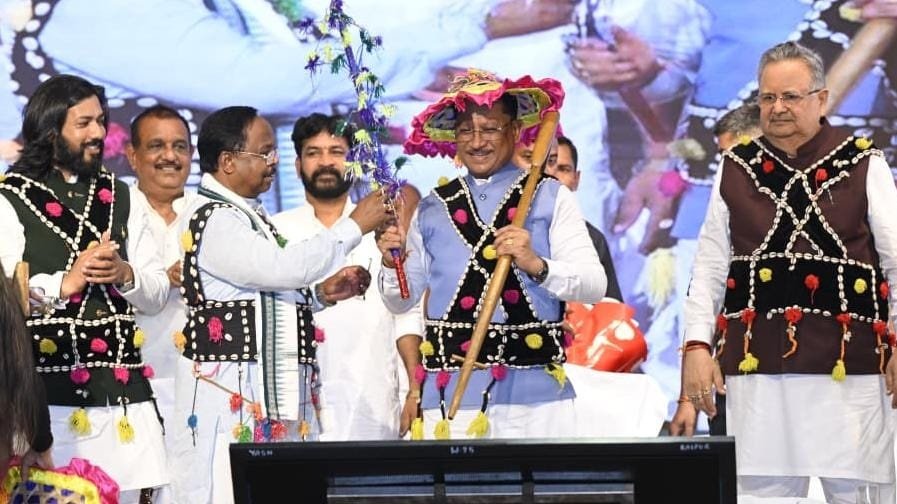
Chief Minister Vishnu Deo Sai, Chhattisgarh Assembly Speaker and former Chief Minister Dr Raman Singh, Agriculture Minister Ramvichar Netam and Minister Guru Khushwant Saheb, all in traditional attire, participate in the colourful Hareli Tihar celebrations at the Chief Minister’s residence in Nava Raipur on Wednesday, August 12, 2026.-Photo Credit:primelookindia.com via CMO
Sai worships farm implements and cattle, celebrates with folk artistes and stresses the enduring bond between agriculture, nature and Chhattisgarh’s cultural identity
Chhattisgarh’s first major folk festival of the agricultural calendar, Hareli Tihar, transformed the Chief Minister’s residence in Nava Raipur into a colourful celebration of rural life on Wednesday August 12, 2026 , with traditional music, folk dances, agricultural customs and local cuisine bringing the State’s cultural heritage to life.
Chief Minister Vishnu Deo Sai, dressed in traditional attire, performed rituals associated with Hareli, worshipping Lord Shiva, cattle and agricultural implements while praying for good rainfall, a bountiful harvest and prosperity for farmers and families across the State.
Chhattisgarh Assembly Speaker Dr Raman Singh, Agriculture Minister Ramvichar Netam, other ministers, public representatives, farmers and citizens joined the celebrations.
“Hareli is a celebration of the intimate relationship between Chhattisgarh’s agricultural culture, nature and rural life. It gives us an opportunity to express gratitude to our land, livestock, agricultural implements and nature,” Sai said.
The Chief Minister said Chhattisgarh’s identity as the country’s Dhan ka Katora — the Rice Bowl — was inseparable from its farmers and villages.
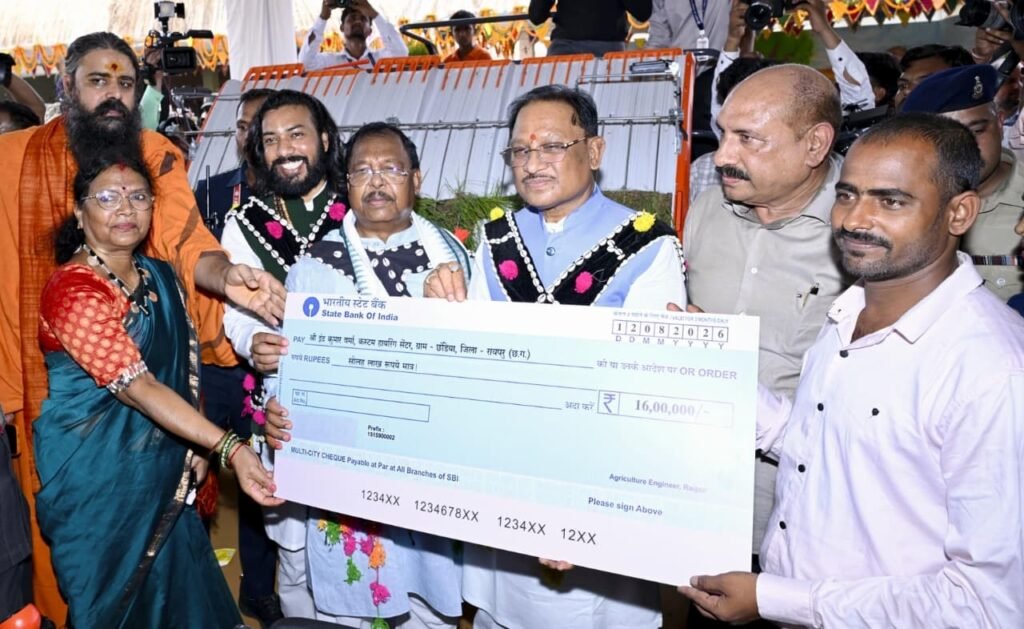
Chief Minister Vishnu Deo Sai presents a ₹16-lakh harvester subsidy cheque to farmer Indra Kumar Verma during Hareli Tihar celebrations at the Chief Minister’s residence in Nava Raipur on Wednesday, August 12, 2026, highlighting the festival’s close association with agriculture and farmers-Photo Credit:primelookindia.com via CMO
“Farmers’ prosperity is the strong foundation of the happiness of our villages and the State,” he said.
Sai, Raman Singh arrive in traditional style
Adding a distinctive local flavour to the celebrations, Sai and Raman Singh, both dressed in traditional attire, travelled from the Chief Minister’s residence complex to the programme venue in a pink autorickshaw driven by woman driver Sangeeta Yadav.
The religious ceremonies began with worship of Gauri-Ganesh and the Navagrahas. Sai performed abhishek of a Shivling before offering prayers to traditional agricultural implements, including the plough, spade and shovel.
He also paid respects to the statue of Chhattisgarh Mahtari.
Sai said Hareli traditionally arrives after farmers have completed several important stages of agricultural work, providing them an occasion to worship nature and the implements on which their livelihood depends.
According to him, the tradition reflects the deep understanding and respect for nature inherited from earlier generations.
Cattle worship underlines Hareli’s agricultural roots
At the gaushala within the Chief Minister’s residence complex, Sai performed aarti and worshipped cattle before feeding cows and calves green fodder, gram and jaggery as well as the traditional londi associated with Hareli.
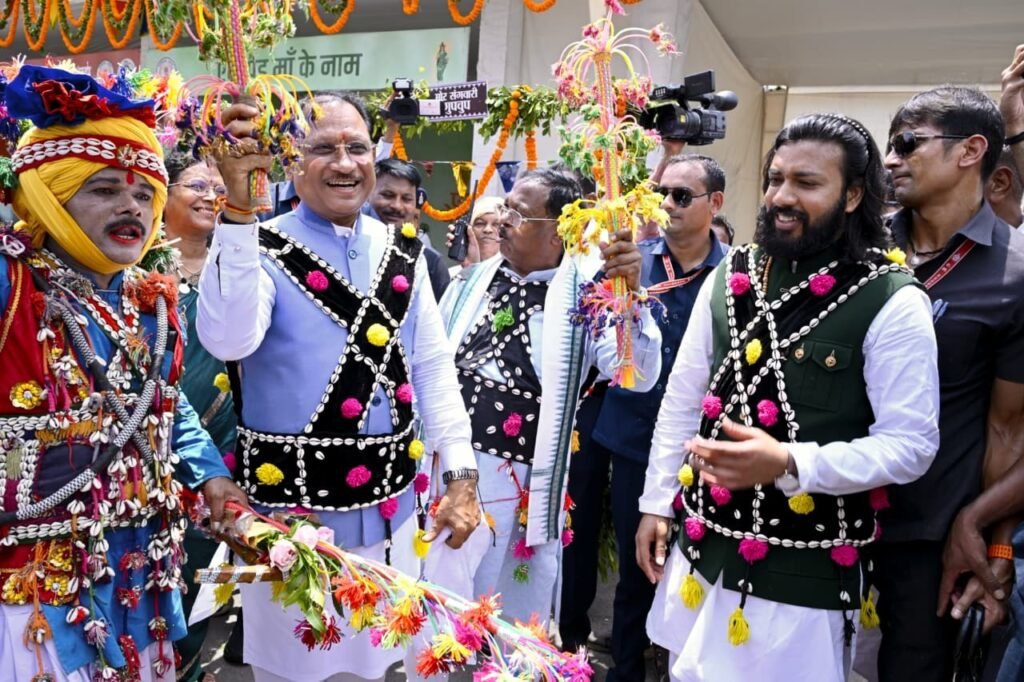
Chief Minister Vishnu Deo Sai, accompanied by Minister Guru Khushwant Saheb, joins folk artistes during Hareli Tihar celebrations at the Chief Minister’s residence in Nava Raipur on Wednesday, August 12, 2026, as traditional attire, music and rural customs bring alive Chhattisgarh’s cultural heritage-Photo Credit:primelookindia.com via CMO
“Our folk culture teaches us sensitivity, respect and protection towards animals. Along with modernity, it is our responsibility to pass these useful and nature-friendly traditions on to the new generation,” the Chief Minister said.
The ritual highlighted an essential aspect of Hareli: the festival celebrates not merely greenery but the relationship between farmers, livestock, agricultural tools and the natural environment.
Folk artistes bring village festivities to Nava Raipur
The celebrations acquired their most vibrant character as folk artistes performed to the beats of mandar, drums and other traditional instruments.
Sai joined the performers and participated in the festivities, while traditional games such as gedi, billas, goti and bati recreated the atmosphere of a Chhattisgarhi village fair.
The Chief Minister’s residence was decorated with neem and mango leaves, marigold flowers and traditional rural motifs.
Stalls serving Chhattisgarhi delicacies, including thethri, khurmi and bada, added another dimension to the celebration, while folk performers in traditional costumes showcased the State’s cultural diversity.
₹16-lakh harvester subsidy handed to farmer
The festival also provided a platform to connect Chhattisgarh’s agricultural traditions with modern farming technology.
Sai visited stalls established by the Agriculture Department and other government departments and examined modern agricultural machinery and its applications.
The Chief Minister presented a ₹16-lakh subsidy cheque to Raipur farmer Indra Kumar Verma towards the purchase of a harvester.
Sai said greater mechanisation and adoption of modern technology could help farmers reduce labour and cultivation costs while increasing productivity.
He also referred to measures aimed at strengthening farmers economically, including access to interest-free cooperative agricultural credit, crop insurance, irrigation facilities and modern agricultural technology.
The Chief Minister said the State Government was procuring up to 21 quintals of paddy per acre at ₹3,100 per quintal, benefiting farming families across Chhattisgarh.
‘Drone Didi’ demonstrates technology-led rural enterprise
Another focus of the programme was the growing role of women in technology-driven agriculture.
Sai interacted with Drone Didi Chandrakali Verma, who uses drones to spray nano urea, nano DAP and pesticides over agricultural fields.
She informed the Chief Minister that she earns ₹300 per acre for drone spraying and has covered more than 2,500 acres, earning around ₹7 lakh during the past two years.
Sai praised her achievement, saying technology in agriculture was creating new avenues of income and self-reliance for women.
“Drone Didis are becoming an inspiring link between modern agriculture and women’s empowerment,” he said.
The Chief Minister also distributed mini-kits of arhar and urad pulses to farmers at the National Mission on Natural Farming stall and interacted with agricultural workers displaying natural farming products.
Hareli carries a message of conservation
Nature conservation formed another important part of the celebration.
Sai planted a Parijat sapling on the Chief Minister’s residence premises, while Raman Singh also planted a Parijat sapling. Ministers and representatives of various boards and commissions joined the plantation initiative.
“Hareli teaches us not only to take from nature but also to preserve it and give back to it,” Sai said, stressing that planting saplings must be accompanied by protecting them until they grow into trees.
‘Farmer’s prosperity is Chhattisgarh’s prosperity’
Raman Singh described Hareli as an important festival connecting Chhattisgarh’s agricultural traditions, culture and relationship with nature.
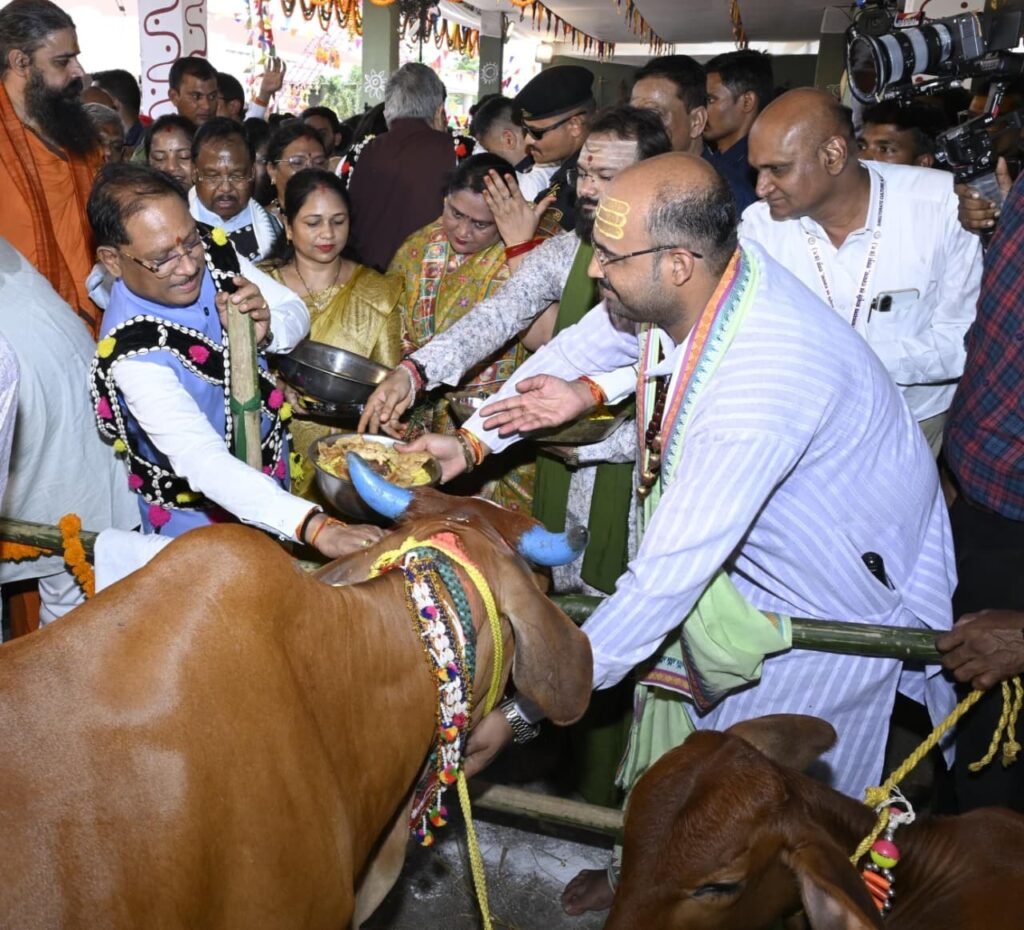
Chief Minister Vishnu Deo Sai feeds traditionally prepared londi to cattle after performing Gau Puja during Hareli Tihar celebrations at the Chief Minister’s residence in Nava Raipur on Wednesday, August 12, 2026, highlighting the festival’s tradition of respecting and caring for livestock-Photo Credit:primelookindia.com via CMO
“The worship of agricultural implements, cattle and nature expresses our culture of gratitude,” he said.
He said strengthening farming families and villages was essential to the State’s wider development.
“When the farmer’s home is prosperous and the village is strong, the path towards Chhattisgarh’s prosperity will become stronger,” Raman Singh said.
Agriculture Minister Ramvichar Netam described Hareli as a festival celebrating farming, greenery and reverence for nature.
“Our culture conveys the message of protecting nature, respecting livestock and honouring the labour of the annadata. If the farmer prospers, the State and the country will prosper,” Netam said.
Concluding his message, Sai described Hareli as a celebration of Chhattisgarh’s folk identity and cultural roots, saying that preserving traditional knowledge, rural games, folk arts, food and customs was a collective responsibility even as the State moved ahead on the path of modern development.
The celebrations brought together an old agricultural tradition and the aspirations of a changing rural economy — with the plough and cattle representing Chhattisgarh’s farming heritage, and drones and modern harvesters pointing towards its technological future.

YOU MAY LIKE THIS