Reg No. - CHHBIL/2010/41479ISSN - 2582-919X

Chhattisgarh’s Railway Renaissance: Tracks of Growth, Not Just Transport
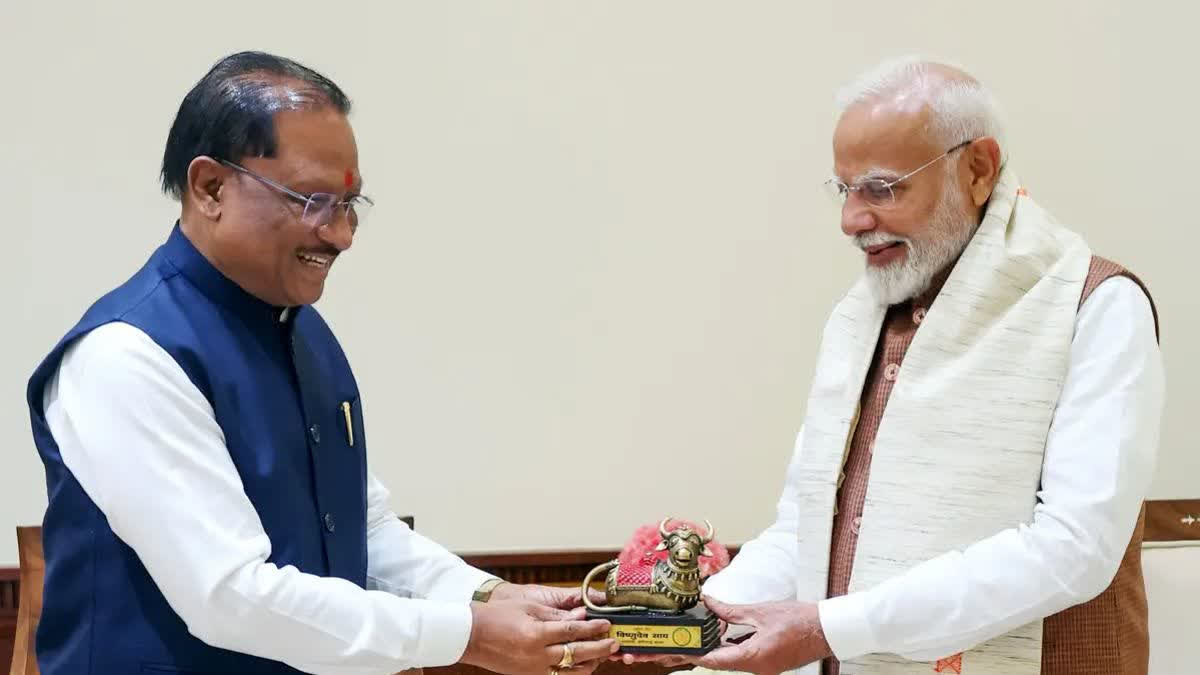
Prime Minister Narendra Modi and Chhattisgarh Chief Minister Vishnu Deo Sai during a meeting in New Delhi. The Centre–State partnership has accelerated railway infrastructure in Chhattisgarh, with projects worth over ₹51,000 crore positioning the state as an emerging rail and logistics hub of Central India.-Photo Credit-primelookindia.com via Internet
Key Factors
- Railway investment in Chhattisgarh has reached a historic high of ₹51,000 crore+.
- Annual railway allocation has increased 24-fold over the past decade.
- Infrastructure is driving industrial growth, employment, logistics, and regional integration.
- Remote tribal regions are being connected to the national development mainstream.
- Modern stations, freight corridors, and electrification are transforming mobility.
- Timely execution, environmental balance, and inclusive development remain the keys to long-term success.
With record investments crossing ₹51,000 crore, the state’s railway transformation is reshaping industry, connectivity, logistics, and regional development—bringing the vision of Viksit Bharat closer to reality.
For decades, Chhattisgarh has been known as India’s mineral powerhouse—a land rich in coal, iron ore, forests, and industrial potential. Yet, despite its strategic location in the heart of the country, inadequate railway connectivity often remained one of the biggest constraints on realizing its full economic potential. That narrative is now undergoing a dramatic transformation.
The railway revolution unfolding across Chhattisgarh is not merely about laying new tracks or introducing new trains. It represents a comprehensive development strategy where infrastructure becomes the engine driving industrial growth, investment, employment, regional integration, and social inclusion.
The figures themselves tell an extraordinary story.
Before 2014, Chhattisgarh received an average annual railway allocation of around ₹300 crore. Today, the allocation has surged to ₹7,470 crore for 2026–27—an increase of nearly 24 times. Simultaneously, railway projects worth more than ₹51,000 crore are under implementation, marking the largest railway investment in the state’s history.
This transformation reflects a decisive shift in national infrastructure priorities under Prime Minister Narendra Modi’s government, supported by the coordinated efforts of the Chhattisgarh government led by Chief Minister Vishnu Deo Sai.
Railways: The New Economic Multiplier
Modern economies are built on connectivity. Roads, ports, airports, and railways determine how efficiently goods, people, and investments move.
For Chhattisgarh, railways are especially critical.
The state contributes significantly to India’s steel production, coal mining, power generation, cement manufacturing, and aluminium industry. Every tonne of coal transported more efficiently reduces energy costs. Every additional freight corridor strengthens industrial competitiveness. Every new railway line connecting remote districts creates opportunities that extend far beyond transportation.
Rail infrastructure today is no longer merely a public utility—it is economic infrastructure.
The Kharsia–Nava Raipur–Parmalakasa Rail Corridor, approved at ₹8,741 crore, illustrates this new thinking. The 278-kilometre corridor is expected to emerge as an alternative freight route between Kolkata and Mumbai while reducing logistics costs by an estimated ₹2,520 crore annually.
Such savings translate directly into increased industrial productivity, greater investor confidence, and enhanced competitiveness for Chhattisgarh’s manufacturing sector.
Development Reaches the Last Mile
Perhaps the most significant aspect of the railway expansion is its social impact.
For years, districts like Bastar, Sukma, Bijapur, Narayanpur, and Jashpur remained geographically isolated despite their strategic importance. Limited connectivity restricted healthcare, education, employment, and market access.
Projects like the Ravghat Rail Line, Dongargarh–Kawardha–Katghora, Korba–Ambikapur, Raoghat–Jagdalpur, and the proposed Dharamjaigarh–Pathalgaon–Lohardaga line are gradually changing that reality.
For many villages, the arrival of a railway line represents the arrival of opportunity itself.
It means easier access to hospitals, universities, markets, tourism, government services, and employment. It encourages private investment while strengthening national integration in previously underserved regions.
Railways Fuel Industrial Confidence
Infrastructure, therefore, becomes an instrument of social justice.Industrial growth depends upon predictable logistics.
Steel plants require uninterrupted iron ore supply.
Power stations require reliable coal movement.
Manufacturing units require efficient freight services.
Exporters require faster turnaround.
The ongoing railway expansion directly addresses each of these challenges.
The approval of the third rail line between Champa and Korba, expansion of freight capacity, complete railway electrification, advanced signalling systems, and multi-tracking projects together create an ecosystem capable of supporting Chhattisgarh’s rapidly expanding industrial ambitions.
The recent approval of additional electric locomotive homing facilities in Raipur further demonstrates that railway planning is now looking decades ahead rather than merely addressing present-day needs.
Modern Stations, Modern Aspirations
Infrastructure is also about the passenger experience.
Under the Amrit Bharat Station Scheme, 32 railway stations across Chhattisgarh are being redeveloped into modern transport hubs equipped with improved passenger amenities, digital systems, better accessibility, and enhanced urban integration.
The expansion of Vande Bharat Express, Amrit Bharat Express, and MEMU services further signals a transition from conventional rail travel to modern, efficient mobility.
For ordinary passengers, railway modernization means reduced travel time, improved comfort, better safety, and greater convenience.
The Logistics Hub of Central India
Geography has always favoured Chhattisgarh.
Located at the heart of India, the state naturally serves as a bridge between eastern ports, western industrial centres, and southern manufacturing corridors.
The emerging railway network is converting this geographical advantage into an economic one.
As freight corridors expand and logistics costs decline, Chhattisgarh is increasingly positioned to become one of India’s most important logistics and distribution hubs.
Such transformation has implications extending beyond the state’s borders.
Lower logistics costs contribute to national competitiveness.
Improved freight movement strengthens supply chains.
Better connectivity supports India’s manufacturing ambitions under the “Make in India” initiative.
Challenges That Remain
While the achievements deserve recognition, execution remains equally important.
Large infrastructure projects frequently face delays arising from land acquisition, environmental clearances, rehabilitation concerns, and funding schedules.
Projects involving ecologically sensitive and tribal regions require particular care to ensure that development remains sustainable, inclusive, and environmentally responsible.
Railway expansion must therefore proceed alongside transparent rehabilitation, ecological safeguards, and meaningful community participation.
Only then will development remain both rapid and equitable.
A Journey Towards Viksit Bharat
The railway transformation currently underway in Chhattisgarh is about far more than trains.
It is about connecting aspirations.
It is about linking industries with markets, farmers with opportunities, students with education, patients with healthcare, tourists with destinations, and remote communities with the national mainstream.
The tracks being laid today will carry not only freight and passengers but also investment, employment, confidence, and hope.
If implemented efficiently and completed on schedule, these projects will reshape Chhattisgarh’s economic geography for generations.
Railways have always symbolized movement.
For Chhattisgarh, they now symbolise momentum.
And in that momentum lies the promise of a stronger economy, balanced regional development, and a decisive step towards the vision of Viksit Bharat 2047.

YOU MAY LIKE THIS