Reg No. - CHHBIL/2010/41479ISSN - 2582-919X

Balancing Old Partnerships, Rebuilding Ties With China and Asserting Strategic Autonomy (Editorial)
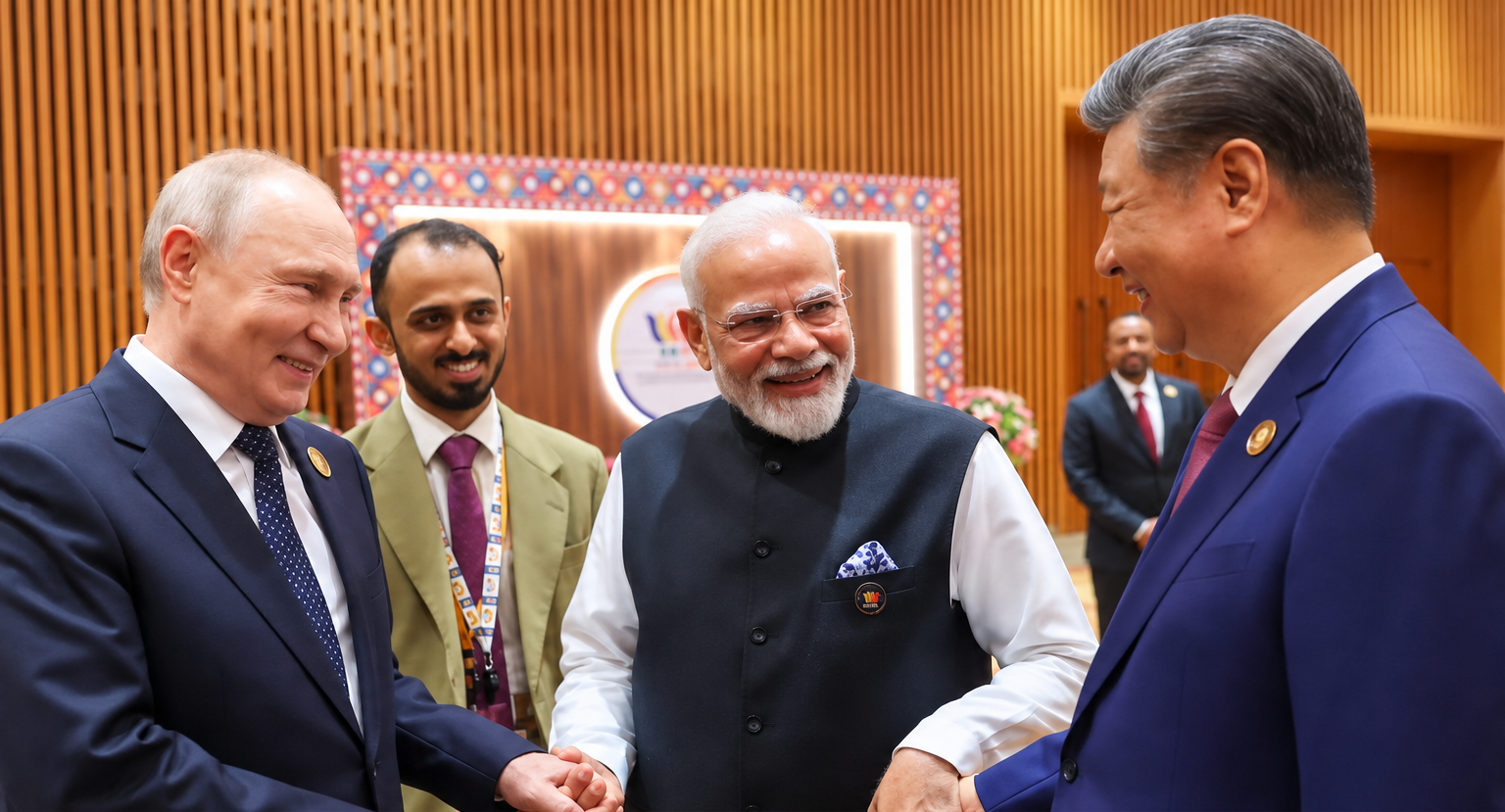
Narendra Modi, Vladimir Putin and Xi Jinping share a light moment at the BRICS Summit in New Delhi — a striking frame of diplomacy as India navigates old partnerships, difficult relationships and its strategic autonomy. Photo: Courtesy Rajiv Dhoundiyal/Facebook.
Beyond the Optics: Modi Navigates Russia Ties, a China Reset and India’s Strategic Autonomy
By Kumar Bahukhandi
New Delhi: The sight of Prime Minister Narendra Modi sharing an animated moment with Russian President Vladimir Putin and Chinese President Xi Jinping at the BRICS Summit in New Delhi inevitably invites a larger question: what does it mean when the leaders of India, Russia and China appear together, relaxed and engaged, at a time when the international order is under extraordinary strain?
It would be speculation to claim what the three leaders were actually discussing in an informal moment. But the diplomatic context surrounding that photograph tells a compelling story of its own.
Xi’s presence in New Delhi was particularly significant. His September 2026 trip marked his first visit to India in seven years, coming after India-China relations had passed through their most difficult phase in decades following the deadly 2020 border confrontation.
Modi and Xi held bilateral talks on September 12 on the sidelines of the 18th BRICS Summit. The two leaders agreed that India and China should view their relationship from a strategic and long-term perspective and that differences should not become disputes. Modi stressed the importance of “mutual respect, mutual sensitivity and mutual interest”.
Their discussions also touched upon some of the most consequential issues in the relationship — peace along the border, the unresolved boundary question, trade imbalance, supply chains and greater people-to-people contacts.
That makes the warmth visible around the summit more consequential than an ordinary diplomatic photograph.
Three Leaders, Three Relationships — and One Changing World
For India, Russia remains a longstanding strategic partner. Modi and Putin used their New Delhi meeting to review a relationship extending across trade, defence, energy, space and other areas of cooperation, demonstrating that Moscow continues to occupy an important place in India’s foreign-policy calculations even as the global geopolitical environment changes.
China presents a much more complicated equation.
India and China are neighbours, major economies and simultaneously partners and competitors across several geopolitical arenas. The unresolved boundary question remains central to their relationship, while trade imbalances, market access and supply-chain concerns continue to demand attention.
During their New Delhi talks, Modi and Xi acknowledged progress in bilateral relations and discussed the need for peace along the border, a mutually acceptable resolution of the boundary question, greater mobility and cultural exchanges, and concerns surrounding trade and supply chains.
Beijing’s account of the meeting similarly said the two sides should approach their relationship from a strategic and long-term perspective, describing the recent improvement in ties as something that should be preserved.
This does not mean the disagreements have disappeared. Far from it.
But diplomacy is rarely about waiting until every disagreement is resolved before talking. Sometimes the conversation itself is what prevents disagreement from becoming confrontation.
And that is where the photograph of Modi, Putin and Xi acquires its political weight.
India is demonstrating that engagement with one major power need not automatically require disengagement from another.
New Delhi can maintain its relationship with Moscow, seek a workable relationship with Beijing, cooperate with Western countries and still insist on making decisions according to its own interests.
That is strategic autonomy in practice rather than merely as a foreign-policy slogan.
What Might the Smiles Symbolise?
Not an alliance.
Not the disappearance of India-China differences.
And certainly not proof that the three men were privately agreeing on every major international question.
The three-way visual is better understood as a diplomatic moment than as evidence of an emerging India-Russia-China alliance.
Instead, it can reasonably be read as an illustration of something BRICS increasingly seeks to represent: major powers with very different national interests retaining the ability to occupy the same diplomatic space and search for common ground.
The 2026 summit itself reflected that ambition. Its agenda extended from reform of global institutions and economic cooperation to technology, trade and the increasingly difficult geopolitical environment confronting emerging economies.
For Putin, BRICS provides Russia with an important multilateral platform at a time when its relationship with much of the West remains deeply strained.
For Xi, New Delhi offered both a BRICS stage and an opportunity to continue the cautious rebuilding of relations with India.
For Modi, hosting both leaders — while maintaining India’s partnerships elsewhere — reinforced New Delhi’s determination not to allow the world’s competing power centres to dictate the boundaries of Indian diplomacy.
The smiles, therefore, should neither be exaggerated nor dismissed.
Three leaders may share a light moment for a few seconds. Behind those smiles, however, stand three nations carrying enormous economic weight, unresolved differences and competing visions of the future — yet still choosing conversation over distance.

YOU MAY LIKE THIS