Reg No. - CHHBIL/2010/41479ISSN - 2582-919X

“Caught in the wrong place at the wrong time…” Jaishankar said on the sinking of the Iranian ship in the US attack
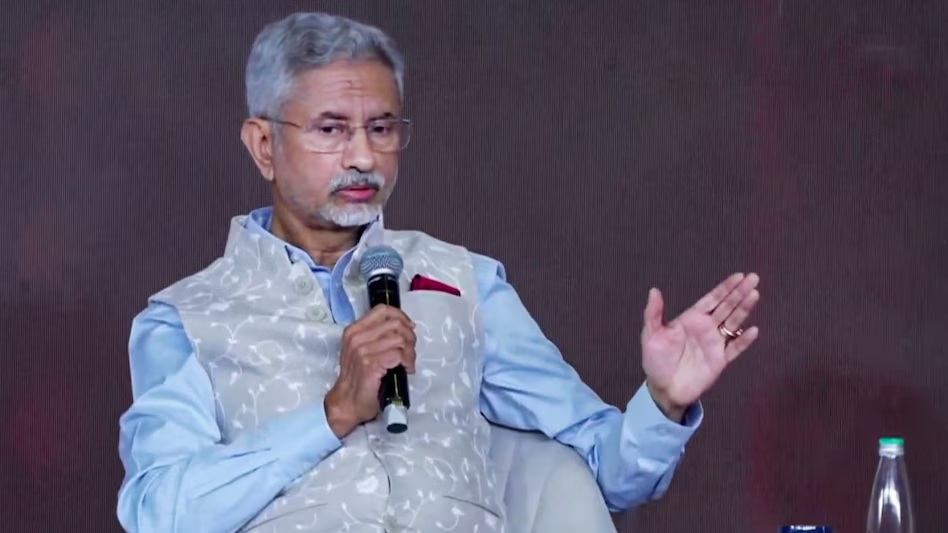
Foreign Minister Jaishankar spoke on the Iranian ship sunk by the US attack. (Photo: ITG)
Foreign Minister S. Jaishankar clarified India’s position on the Iranian ship “Iris Dena,” which was hit by a US torpedo attack in the Indian Ocean. During the Raisina Dialogue, he explained why India allowed the damaged ship to dock in Kochi on humanitarian grounds.
During the Raisina Dialogue 2026, Foreign Minister Dr. S. Jaishankar clarified India’s position on the issue of the torpedo attack by a US submarine on the Iranian ship “Iris Dena.” He stated that India supports UNCLOS (United Nations Convention on the Law of the Sea) and international law, but the decision to grant asylum to the Iranian ship on humanitarian grounds was correct, but it was caught in the wrong place at the wrong time. He also emphasized India’s responsibility to understand the geopolitical complexities of the Indian Ocean and fulfill its obligations.
Speaking at the dialogue, Jaishankar said, “We received a message from Iran that a ship, which was closest to India’s borders at the time, was wishing to dock. The ship had a technical problem. India granted permission on March 1, and a few days later, the ship docked in Kochi. Several young cadets were on board.”
“We took the right step”
He clarified that the situation was completely different when the ships departed and when they arrived. They were coming for a fleet review and then somehow got caught on the wrong side of events. One of the other ships was in a similar situation in Sri Lanka, where unfortunately, the ship could not be rescued. Jaishankar said, “We looked at the situation from a humanitarian perspective and I am confident that we took the right step.”
Development of Hambantota for the sake of it
Responding to the ongoing debate on social media, the Foreign Minister advised understanding the geopolitical realities of the Indian Ocean. He recalled that Diego Garcia has been present in the Indian Ocean for the past five decades. Similarly, Djibouti became a base for foreign forces in the early part of the first decade of this century, and Hambantota was developed during this period. Jaishankar emphasized that India is fulfilling its responsibilities while understanding the complexities of the region.
More than 80 people killed in attack
On March 4, a torpedo fired from a US submarine hit the Iranian frigate IRIS Dena in international waters near Galle, about 40 nautical miles off the southern coast of Sri Lanka. The ship sank as a result. Reports indicate that between 80 and 87 people were killed in the accident.
Sri Lankan authorities recovered 87 bodies, while 32 on board were rescued alive and taken to Galle for medical treatment. Dozens are still missing.
US Confirms Attack
US Defense Secretary Pete Hague confirmed the attack in Washington. He said, “An American submarine sank an Iranian warship that was believing itself to be safe in international waters. But it was sunk by a torpedo.”
He added that this was the first time since World War II that the United States had sunk an enemy ship using torpedoes.
Ship Arrived to Participate in Naval Exercises
The Iranian ship, IRIS Dena, was returning from a naval exercise in Visakhapatnam. Another Iranian vessel, IRIS Lavan, had requested emergency docking permission from India after reporting a technical problem. This request was received on February 28, and India approved it on March 1. The ship docked in Kochi on March 4, the same day the Dena sank. The ship remains anchored in Kochi while the technical problem is assessed.
(Source-AP)

YOU MAY LIKE THIS