Reg No. - CHHBIL/2010/41479ISSN - 2582-919X

Musk Promises Affordable Starlink Internet in India as Reliance Jio Prepares Record IPO
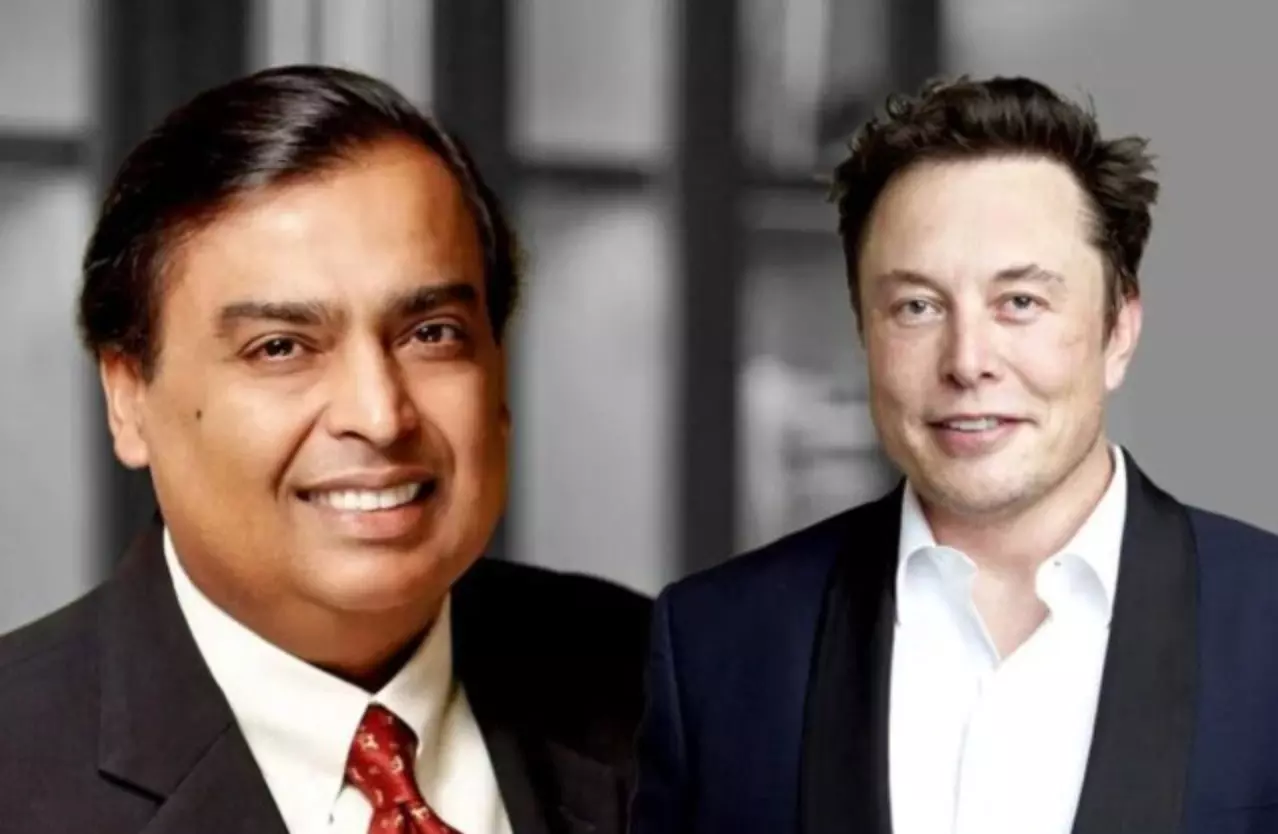
Reliance Industries Chairman Mukesh Ambani (left) and SpaceX chief Elon Musk (right), whose competing ambitions in India’s satellite broadband market have drawn attention amid Starlink’s pending security clearance and Jio Platforms’ proposed IPO.Photo:Reuters
SpaceX chief intensifies criticism of regulatory delays and alleged preferential treatment towards Mukesh Ambani’s Reliance Jio; both companies await final security clearance for satellite broadband services
Key Highlights
- Elon Musk says Starlink will offer competitively priced satellite internet services in India.
- Musk accuses the Indian government and Mukesh Ambani of delaying Starlink’s entry to favour Reliance Jio.
- Jio Platforms is reportedly targeting a valuation of approximately $106 billion in its proposed IPO.
- Both Starlink and Jio’s satellite broadband venture are awaiting final security clearance, according to the report.
- The dispute highlights competition, regulatory transparency and the future of satellite connectivity in India.
Bengaluru: Elon Musk has promised to make Starlink’s satellite internet service affordable for Indian consumers, setting the stage for a potentially significant challenge to Mukesh Ambani’s Reliance Jio at a time when Jio Platforms is preparing for what could become India’s largest initial public offering (IPO). The SpaceX chief’s remarks have intensified a public dispute over regulatory approvals, competition and alleged preferential treatment in India’s telecommunications market. However, the Indian government has rejected accusations of discrimination, maintaining that satellite service providers are subject to the same security clearance requirements.
Musk Says Starlink Must Be Affordable to Succeed in India
Musk acknowledged that Starlink would have to compete in a market where mobile internet services are already among the cheapest in the world.
Writing on his social media platform X on Saturday, October 10, Musk said:
“Obviously, if Starlink is too expensive in India, no one will buy it, so SpaceX will need to make pricing affordable.”
He did not disclose any proposed subscription charges, installation costs or launch date for the Indian market.
India’s average mobile data cost was reported at approximately eight US cents per gigabyte, illustrating the pricing challenge Starlink would face against established telecommunications operators.
Unlike conventional mobile networks, Starlink uses satellites to provide broadband connectivity, making it potentially useful in areas where terrestrial telecommunications infrastructure is limited.
Musk Accuses Ambani of Seeking to Restrict Competition
The pricing announcement followed several increasingly confrontational exchanges in which Musk accused influential business interests of obstructing Starlink’s entry into India.
He alleged that the Indian government and Ambani were delaying regulatory approvals to protect Jio’s position in the domestic telecommunications market.
In one particularly pointed exchange, Musk sarcastically referred to Ambani as “Prime Minister Ambani”, suggesting that the Reliance chairman exercised excessive influence over the approval process.
The allegations have not been independently established, and the Indian government has denied favouring any particular operator.
Musk also argued that additional competition would give Indian consumers more choices, even if it reduced the profitability of established companies.
Government Rejects Allegations of Preferential Treatment
India’s Ministry of Communications has maintained that its regulatory framework for satellite communications is fair and non-discriminatory.
According to the government’s position, three satellite communications ventures, including Starlink and Jio’s satellite operation, are awaiting final security clearance.
Authorities have emphasised that commercial operations cannot begin until the required security conditions have been satisfied.
The government’s response is significant because satellite communications involve regulatory considerations different from conventional mobile services, including national security and network oversight.
While Musk has portrayed the delays as an obstacle to competition, the government maintains that the approval process is being applied uniformly.
Jio’s Proposed $106 Billion Valuation Adds to Commercial Stakes
The dispute comes as Jio Platforms prepares for a major public listing.
The company, which houses Reliance’s telecommunications business and other digital operations, is reportedly targeting a valuation of approximately $106 billion.
The proposed IPO is expected to attract considerable investor attention, reflecting Jio’s position in India’s telecommunications and digital services markets.
Reliance Jio built much of its market strength by offering inexpensive mobile data and expanding access to digital services.
Starlink’s entry would introduce another form of broadband competition, although satellite connectivity and conventional mobile services have different infrastructure requirements and operating costs.
The proposed valuation is a target associated with the offering, not a completed market valuation or confirmed IPO outcome.
Starlink and Jio Have Also Explored Commercial Cooperation
Despite the increasingly public disagreement between Musk and Ambani, the relationship between their businesses is not entirely adversarial.
Starlink has previously reached distribution arrangements involving Reliance Jio and Bharti Airtel in India.
Jio has also been developing satellite broadband capabilities through its own partnerships.
This means the Indian satellite internet market could involve both competition and commercial cooperation among major telecommunications providers.
However, distribution arrangements do not replace regulatory approval, and Starlink cannot commercially launch its service merely because it has secured potential business partners.
Satellite Broadband Could Benefit Remote and Underserved Regions
Beyond the commercial rivalry, Starlink’s proposed entry has implications for internet connectivity in rural and geographically difficult regions.
Satellite broadband could offer an alternative in places where laying optical fibre or constructing conventional telecommunications infrastructure is challenging.
Such connectivity could support education, healthcare, emergency communications and small businesses.
However, the extent of these benefits would depend on affordability, reliable service, equipment costs and compliance with Indian regulations.
Starlink’s potential advantages in remote regions do not automatically mean that it would replace conventional mobile networks in densely populated cities.
Security Clearance Remains the Decisive Requirement
The immediate question is not simply whether Starlink can compete with Jio on price, but when it will be permitted to begin commercial operations.
Both companies’ satellite ventures remain subject to final regulatory and security requirements.
Musk’s latest remarks have brought greater public attention to the approval process, while the government’s response has placed equal emphasis on regulatory consistency and national security.
For Indian consumers, the eventual outcome could influence the availability, affordability and range of broadband services, particularly in areas where conventional connectivity remains inadequate.
For now, Starlink’s Indian pricing, commercial launch date and final regulatory clearance remain unconfirmed.

YOU MAY LIKE THIS