Reg No. - CHHBIL/2010/41479ISSN - 2582-919X

Indian team reaches Dhaka for Ganga water talks as 30-year treaty nears expiry
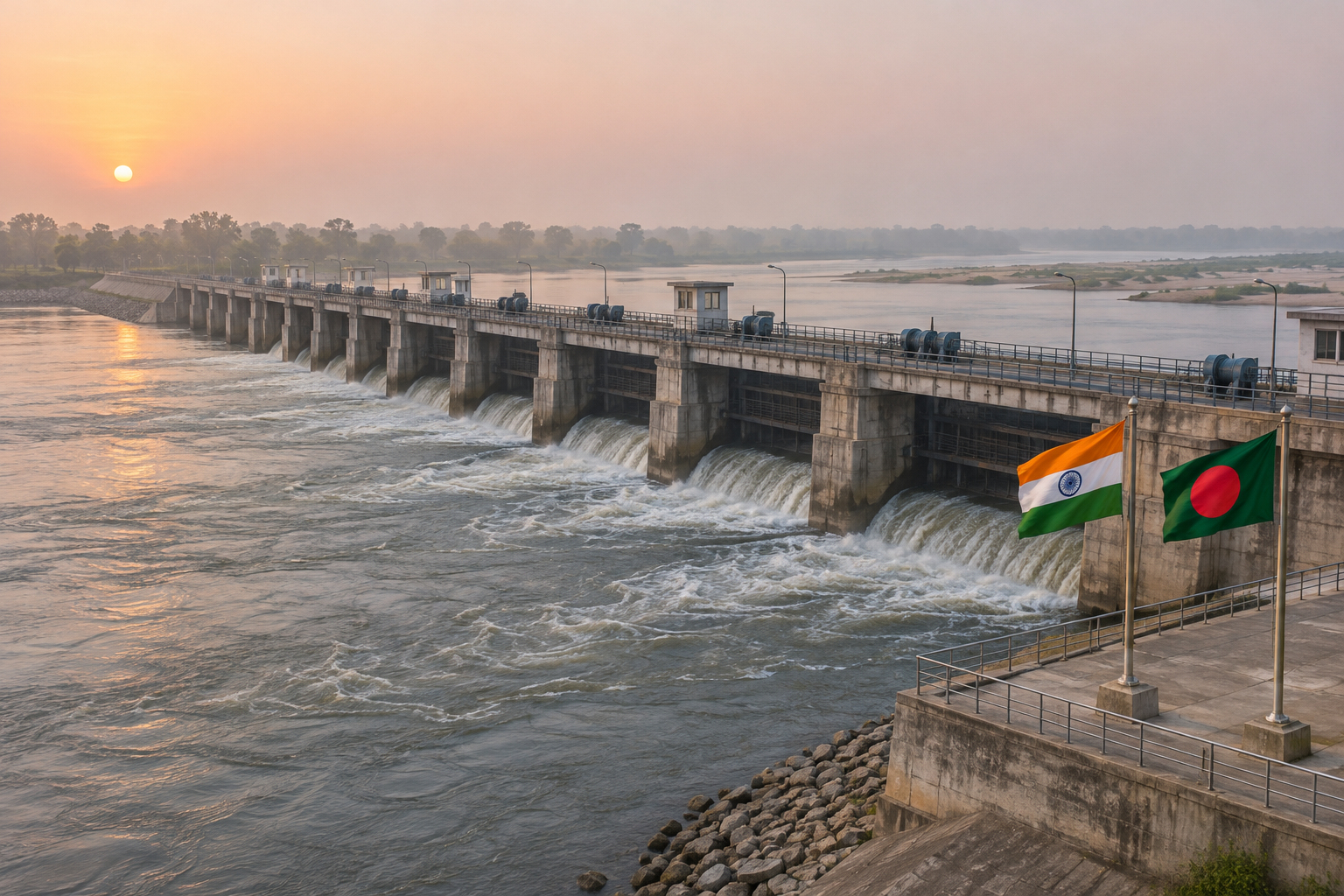
The flags of India and Bangladesh beside an imagined river barrage illustrate the two countries’ dry-season Ganga water-sharing arrangements. Image credit: AI-generated illustration for Prime Look.
xpire on 12 December, and any renewal requires both governments’ consent.
Key Highlights
- India’s Ministry of Jal Shakti named four officials for the Dhaka visit, including delegation leader Sharad Chandra and Central Water Commission Chief Engineer Sanjay Kumar Gangwar.
- The Joint Committee monitors implementation of the treaty. Renewal is reported to be outside the formal agenda for the Dhaka meeting.
- The pact governs dry-season water sharing at Farakka from 1 January to 31 May each year. Bangladesh has sought stronger safeguards for its share when river flows are low.
Dhaka: An Indian delegation reached Bangladesh on Saturday, 21 November, for the 91st meeting of the India–Bangladesh Joint Committee on Ganga water sharing. The talks on 22–23 November come three weeks before the 1996 treaty is due to expire, with the two governments yet to announce what will follow the 30-year agreement. The Ministry of Jal Shakti’s travel order covers 21–23 November, including travel time.
Who travelled to Dhaka
The Ministry of Jal Shakti’s 17 November order named Sharad Chandra, Commissioner for Flood Management in the Department of Water Resources, as delegation leader. It also named Sanjay Kumar Gangwar, Chief Engineer at the Central Water Commission, Ramesh Raj Sambharia, Senior Joint Commissioner for Flood Management, and Kanneluru Gautam, Under Secretary in the department’s Integrated Finance Division.
Northeast News separately reported that Renjina Mary Varghese, an Under Secretary in the Ministry of External Affairs, also travelled with the team. The Jal Shakti Ministry’s order lists the four water-resources officials.
Technical talks ahead of a decision on renewal
The Joint Committee was established under the treaty to monitor its implementation. Its work includes observing river flows and recording releases. The Dhaka meeting is expected to focus on how the existing arrangements are working. Article XII makes renewal subject to mutual consent, leaving the decision on an extension or a successor agreement with the two governments.
India and Bangladesh signed the treaty in New Delhi on 12 December 1996. It sets out how the flow available at Farakka in West Bengal is divided during the dry season, using allocations calculated in 10-day periods. Bangladesh has sought a new agreement with stronger safeguards for its share during low-flow periods.
Separately, Indian High Commissioner Dinesh Trivedi met Bangladesh Foreign Minister Khalilur Rahman on Saturday, following an earlier meeting on 19 November. The agenda of Saturday’s meeting was not publicly disclosed

YOU MAY LIKE THIS