Reg No. - CHHBIL/2010/41479ISSN - 2582-919X

From Security Camps to Service Centres: Bastar’s Story of Change Takes Shape in Gundadhur’s Homeland-By Dhananjay Rathore
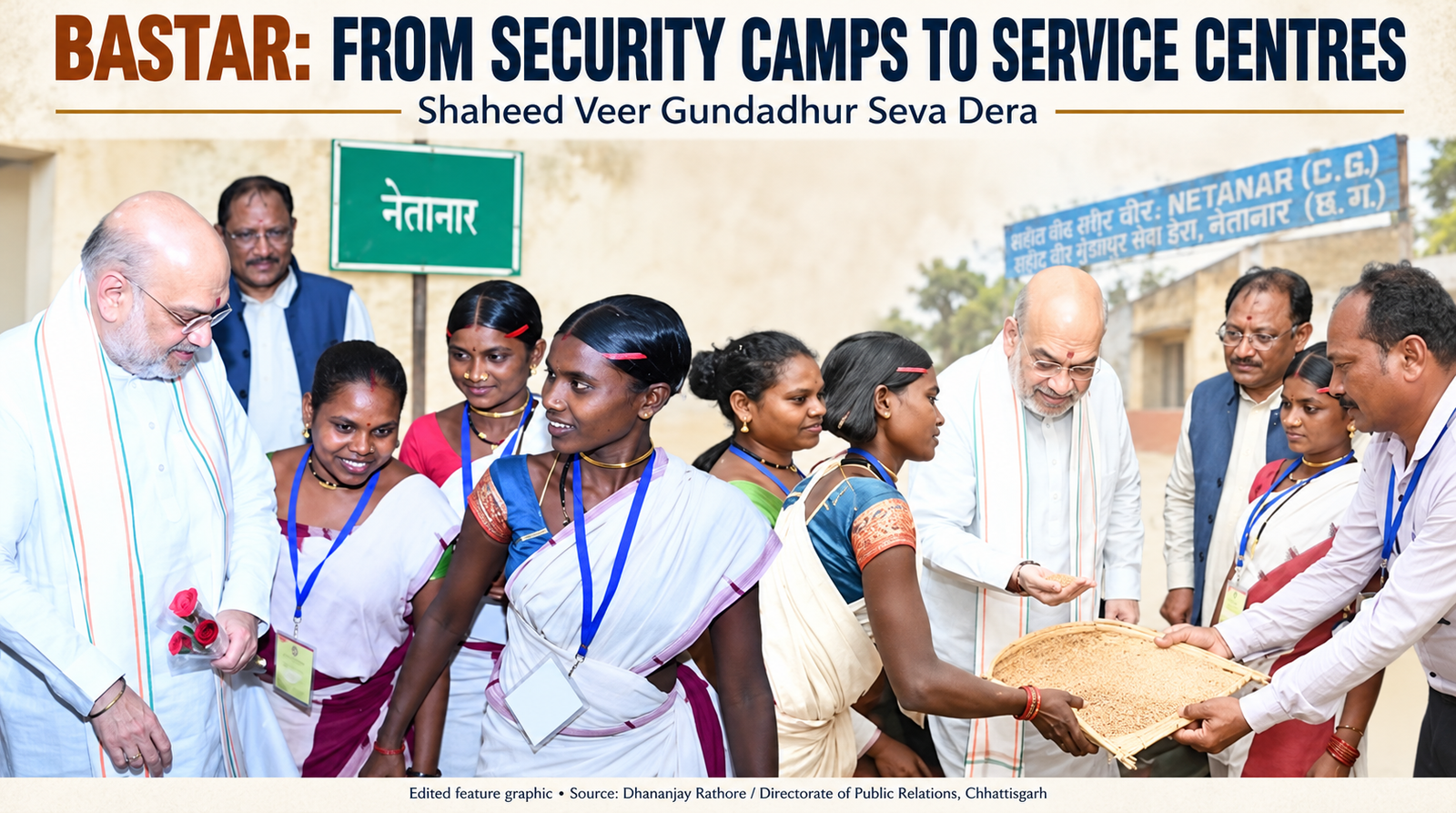
Union Home and Cooperation Minister Amit Shah interacts with local women alongside Chief Minister Vishnu Deo Sai at Netanar in Bastar district in this edited feature graphic illustrating the Shaheed Veer Gundadhur Seva Dera initiative;Photo :primelookindia.comm Courtesy Dhananjay Rathore / CG/DPR.
Shaheed Veer Gundadhur Seva Deras bring digital services, banking, skills training and livelihood opportunities closer to remote tribal communities.
A new chapter of development and public service is taking shape in Bastar’s villages, where Naxal violence and difficult terrain have long restricted access to basic facilities. Security camps are acquiring an additional role as centres of governance and livelihood support, with around 200 camps proposed to be developed as Shaheed Veer Gundadhur Seva Deras. In the first phase, 70 camps are being transformed into centres offering digital services, banking assistance, skills training and opportunities for self-employment.
For residents of remote settlements, the initiative brings essential services closer to home. Tasks that once required long journeys—obtaining an Aadhaar card, opening a bank account or applying for certificates—can increasingly be completed locally.
Alongside administrative assistance, the centres are creating opportunities for women’s groups to process local produce, preserve traditional skills and develop income-generating activities.
Bringing Development Closer to Remote Communities
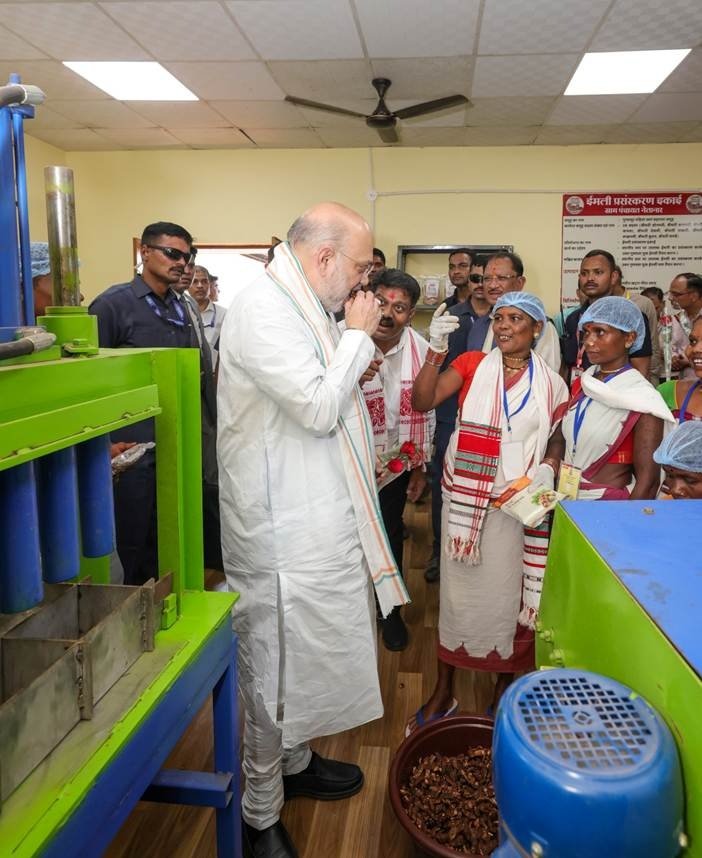
Union Home and Cooperation Minister Amit Shah interacts with women engaged in tamarind processing as Chief Minister Vishnu Deo Sai looks on during a visit to the Seva Dera facilities at Netanar in Bastar district. Photo:primelookindia.com Courtesy Dhananjay Rathore /CG/DPR
Under Chief Minister Vishnu Deo Sai’s leadership, the state government is extending roads, electricity, drinking water, education and healthcare to remote Bastar villages through the Niyad Nellanar scheme.
The Chief Minister has attributed the region’s progress against Naxalism to Prime Minister Narendra Modi’s guidance and Union Home Minister Amit Shah’s resolve. The government’s stated objective is to place Bastar among the country’s leading developed tribal regions.
Agriculture, livestock-rearing and irrigation initiatives form part of this effort to strengthen rural livelihoods. The Seva Deras complement these measures by creating accessible points of contact between villagers and public institutions.
Netanar Links Gundadhur’s Legacy with Public Service
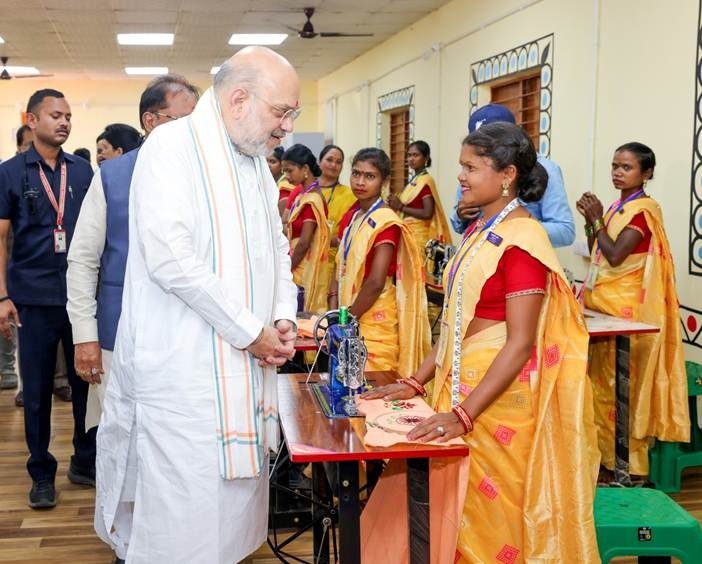
Union Home and Cooperation Minister Amit Shah meets women at a tailoring facility in Netanar, Bastar district, highlighting the skills-training component of the Shaheed Veer Gundadhur Seva Dera initiative. Photo: primelookindia.com Courtesy Dhananjay Rathore / CG/DPR.
Union Home and Cooperation Minister Amit Shah inaugurated the first Shaheed Veer Gundadhur Seva Dera public facilitation centre at the CRPF camp in Netanar, Bastar district, on May 18, 2026.
Netanar holds a special place in Bastar’s history as the birthplace of Gundadhur, the tribal leader remembered for his role in the Bhumkal uprising of 1910. His resistance to British exploitation expressed the tribal community’s assertion of identity, dignity and rights over land, forests and water.
The service centre established on this historic soil seeks to connect that legacy with present-day aspirations for self-reliance, accessible governance and economic opportunity.
Essential Facilities Under One Roof
For many villagers, routine documentation has traditionally involved considerable travel, expense and time away from work.
The Seva Deras bring together facilities such as Aadhaar enrolment and updates, KYC verification, mobile-number linking and online applications for birth, death, income and caste certificates.
Locally available assistance makes these processes more manageable, particularly for families living far from government offices.
The initiative also facilitates access to health consultations and basic services associated with Anganwadis and primary education, broadening the centres’ role in everyday village life.
Bank Sakhis Strengthen Financial Access
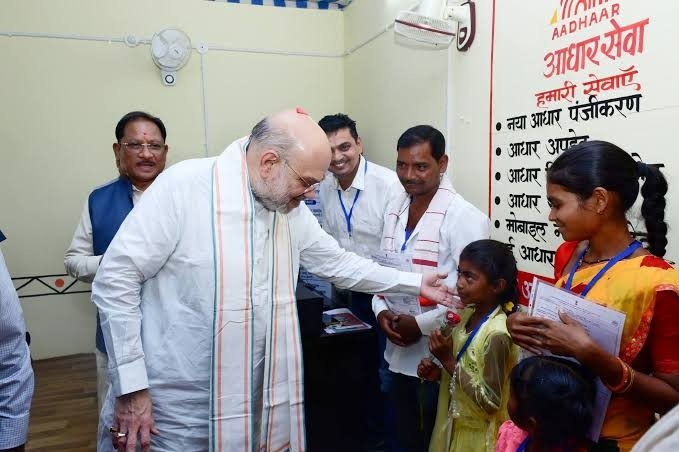
Union Home and Cooperation Minister Amit Shah interacts with children and women at an Aadhaar service centre as Chief Minister Vishnu Deo Sai looks on at Netanar in Bastar district. Photo: primelookindia.com Courtesy Dhananjay Rathore / CG/DPR.
Women are being trained as Bank Sakhis to help residents access banking services within their villages.
Through withdrawals, deposits and assistance with opening accounts, they provide a link between households and financial institutions while developing livelihood opportunities of their own.
This approach places women at the centre of local service delivery and reduces the need for residents to travel for basic banking transactions.
Women’s Groups Add Value to Local Produce
At Netanar, members of the Gundadhur Women’s Self-Help Group are processing tamarind into pulp, creating greater value from locally available produce.
Group member Lambi Nag says the activity is helping women move towards the prospect of earning up to ₹1 lakh annually.
The initiative connects a familiar forest-based resource with processing skills and enterprise, opening an avenue for women to strengthen their household incomes.
For other residents, the benefits are more immediate. Women such as Sukhdevi no longer need to travel far to obtain an Aadhaar card for a young child. Such changes ease the practical demands of accessing essential services.
Traditional Skills Find New Livelihood Opportunities
The centres also support activities rooted in local knowledge and practice.
Women prepare rice using the traditional dhenki and earn additional income through its sale. Paddy husk is used as animal feed, making productive use of the processing by-product.
Tailoring training provides another opportunity to acquire skills and pursue self-employment.
Together, these activities demonstrate how service delivery and livelihood support can develop alongside the preservation of local traditions.
Design Support Opens Possibilities for Wider Markets
Efforts are underway to improve the packaging, branding and presentation of products made by rural women.
A team from the National Institute of Design, Ahmedabad, recently visited Netanar to examine tailoring, tamarind processing and traditional rice-processing activities.
Discussions explored how better design and packaging could help these products reach wider audiences. Access to national and international markets remains an objective, with professional support intended to strengthen the products’ readiness for those opportunities.
Building Trust Through Everyday Services
The journey from security camps to Seva Deras gives existing facilities an additional purpose: helping communities access documentation, financial services, training and livelihood support closer to home.
Its significance lies in the everyday experiences of villagers—a mother securing her child’s Aadhaar, a farmer accessing banking assistance or a women’s group finding value in local produce.
On Gundadhur’s historic soil, these efforts bring together public service, traditional knowledge and the aspiration for greater independence. For Bastar’s remote communities, accessible governance becomes meaningful through the practical improvements it brings to daily life.
About the Author: Dhananjay Rathore is Joint Director at the Directorate of Public Relations, Government of Chhattisgarh, Raipur. He writes on Chhattisgarh’s development, governance, culture and public welfare initiatives.

YOU MAY LIKE THIS