Reg No. - CHHBIL/2010/41479ISSN - 2582-919X

Atal’s Vision, Modi’s Resolve and Vishnu Deo Sai’s Governance-By Kumar Bahukhandi
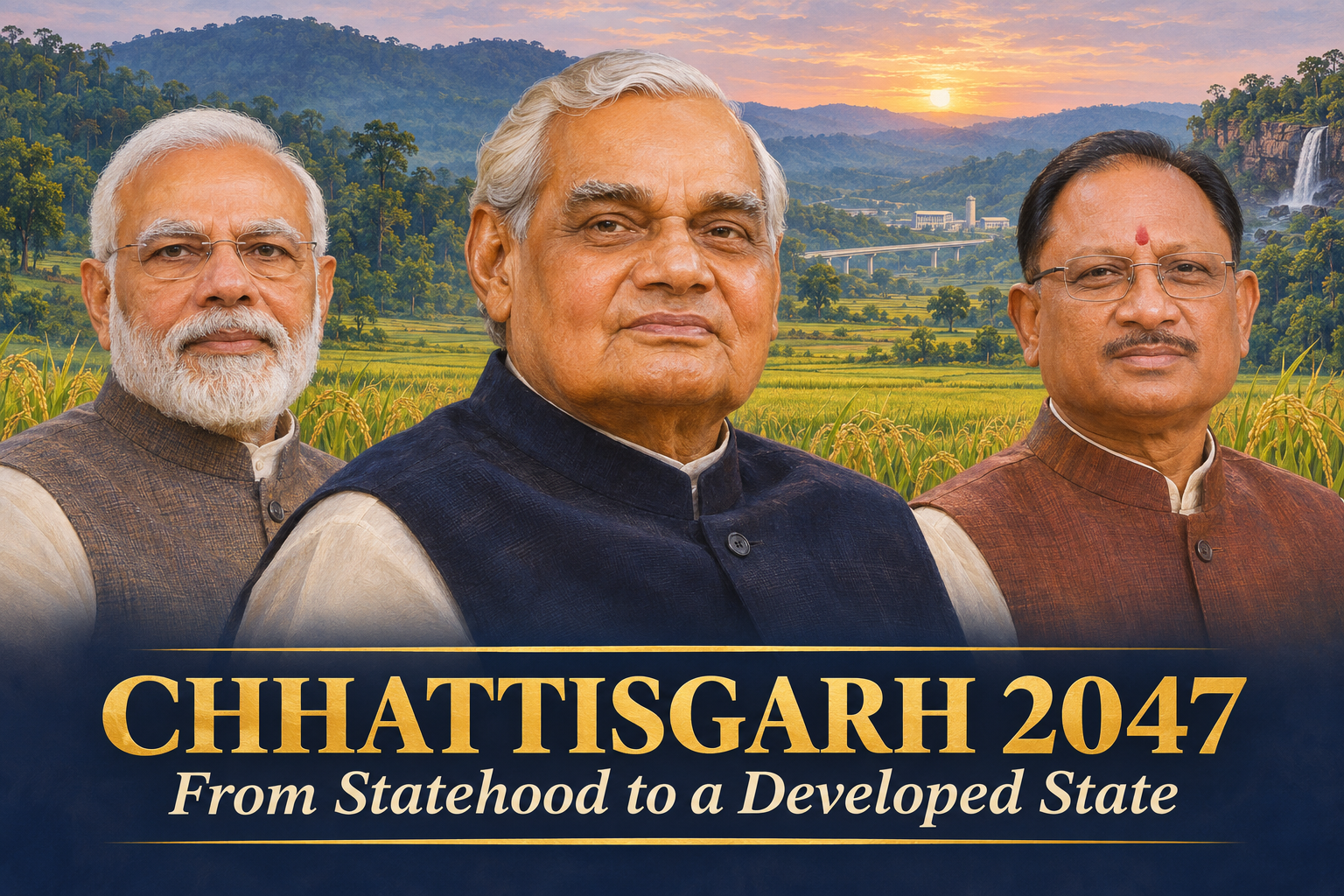
Chhattisgarh 2047: From Statehood to a Developed State, featuring Atal Bihari Vajpayee (centre), Narendra Modi (left) and Vishnu Deo Sai (right). AI-generated for primelookindia.com
From statehood to a developed Chhattisgarh by 2047, the journey of a state built on regional aspirations and the work still needed to earn public trust.
Key Highlights
- Chhattisgarh became India’s 26th state on 1 November 2000, during Atal Bihari Vajpayee’s tenure as Prime Minister.
- Narendra Modi’s Viksit Bharat 2047 sets a national horizon. Under Vishnu Deo Sai, Chhattisgarh’s Anjor Vision 2047 sets out 13 priority areas and 10 missions for the state.
- The test of the vision will be visible at district level, in whether people can find steady work, complete their education, reach a health centre and receive public services on time.
- Chhattisgarh’s development will depend on building on its strengths in farming and industry while extending opportunity to the forested and remote parts of Bastar and Surguja.
Raipur: The most consequential change brought by Chhattisgarh’s creation was that elected institutions within the region gained the authority to set its development priorities. Paddy-growing plains, mineral-rich industrial districts and forest regions with large Adivasi populations came under a government that could plan around their different needs. As Chhattisgarh looks towards 2047, the test of that authority is becoming clearer. A farmer should be able to sell a crop without losing days at a procurement centre. A student should be able to reach college without arranging to live elsewhere. A patient should be able to count on staff and essential medicines at the nearest health centre.
The connection between Atal Bihari Vajpayee, Narendra Modi and Vishnu Deo Sai lies in the responsibilities they assumed at different stages of that journey. Statehood came during Vajpayee’s premiership. Modi’s Viksit Bharat 2047 gave the states a common horizon for long-term planning. The Sai government’s Anjor Vision 2047 translates that national ambition into a roadmap for Chhattisgarh. From here, progress depends on budgets, district administration and the people who keep public services running.
The making of Chhattisgarh
The demand for a separate state grew over decades. It drew strength from the region’s cultural identity and from a desire for greater administrative representation. Behind the demand was a practical question that remains relevant today. Who should decide how the region’s resources are used and which communities receive public investment first?
During Vajpayee’s tenure, Parliament passed the Madhya Pradesh Reorganisation Act, 2000. President K.R. Narayanan gave his assent on 25 August, and Chhattisgarh came into being on 1 November. Vajpayee’s government provided the political leadership for the reorganisation, while the demand itself reflected the work and aspirations of people across the region.
The new state had to establish its Assembly, organise departments and build administrative capacity in the districts. An industrial belt required dependable power, freight links and urban services. Paddy-growing districts needed irrigation, storage and procurement facilities. In Bastar and Surguja, dispersed settlements and difficult terrain called for a different approach to the placement of schools, health centres and transport routes. Having a government of its own gave Chhattisgarh the authority to respond to these differences through its budgets and institutions.
Successive governments, panchayats, urban local bodies, co-operatives and communities have shaped what followed. Their work underscores an aspect of state-building that can be easy to overlook. The inauguration of a road, a hospital or a school begins a commitment that can last decades. Roads need repairs, hospitals need staff and schools need teachers. The ability to maintain public assets across changes of government is part of the institutional legacy of statehood.
Modi’s 2047 horizon and the state’s silver jubilee
The year 2047 marks a century of Indian independence. Chhattisgarh celebrated 25 years of statehood in 2025 and will complete 50 years in 2050. The two milestones give the state a chance to take stock of its first quarter-century and decide what it aims to deliver before it reaches its own half-century.
On 1 November 2025, Modi inaugurated the new Chhattisgarh Legislative Assembly building at Nava Raipur. He also inaugurated the Shaheed Veer Narayan Singh Memorial-cum-Tribal Freedom Fighters Museum. The Assembly building houses the institution that debates laws, approves public spending and holds the executive to account. The museum makes the history of tribal resistance and the freedom struggle more accessible to students, researchers and local communities. Its long-term value will grow if those communities can contribute their accounts and help shape how their history is told.
Modi’s Viksit Bharat 2047 gives the country a shared planning horizon. Applying it in Chhattisgarh involves choices specific to the state. Industrial policy must account for the effects of mining and manufacturing on water and land. Rural development must reflect the role of paddy, forest produce and co-operatives in household incomes. Education and health policy must reckon with the time it takes to reach a school or hospital from a remote settlement. These are decisions that state and district institutions are best placed to make.
Anjor Vision 2047 and the Sai government’s task
Prepared under Chief Minister Vishnu Deo Sai, Anjor Vision 2047 is Chhattisgarh’s long-term development roadmap. NITI Aayog, which partnered with the state in its preparation, records its launch in November 2025. The state’s public information publication identifies 13 priority areas and 10 missions. The roadmap envisages a substantial expansion of the economy alongside progress in human development, infrastructure, technology, sustainability, tourism and industrial diversification.
Putting the roadmap into effect requires a department responsible for each mission, a budget and a timetable for district-level review. A road project illustrates the distinction between different stages of delivery. The government can record an allocation when funds are approved and a completed asset when the road opens. Residents experience the outcome when a bus runs regularly and the route remains usable through the monsoon. A water scheme likewise needs to be tracked from the laying of pipes to the delivery of safe water on a dependable schedule.
The Sai government’s commitment to sushasan, or good governance, can be judged through similarly ordinary encounters. A citizen applying for a pension, an income certificate or a land record should receive an acknowledgement, know when to expect a decision and have a way of challenging an error. Online applications and tracking can save journeys. In places with unreliable internet, assistance at the panchayat, instructions in a familiar language and an offline option determine who can actually use the service.
District averages can conceal poor service in individual blocks. A district may report strong overall progress while particular settlements still lack regular buses or access to health staff. Publishing expenditure, work status and complaint-resolution times gives the Assembly, local bodies and residents a common basis for examining those gaps. Public trust grows when people can see who is responsible for a delay and what is being done about it.
From paddy, forest produce and minerals to local jobs
Paddy procurement is central to the rural economy. For a farmer, the value of the system depends on a timely slot, a centre within reach, accurate weighing and prompt payment. Improvements at the purchase centre address the final stage of the season. Irrigation, soil health, seed availability, drying and storage affect how much of the harvest a farmer can bring to that centre in the first place.
In areas with limited irrigation, pulses, oilseeds and millets can give cultivators more options. A farmer weighing whether to plant a different crop needs to know who will buy it, how far it must travel and whether local facilities can process it. Co-operatives and farmer producer organisations can bring together small quantities from individual growers and negotiate with buyers. Locally milling rice, processing pulses and spices, or preparing forest produce for sale can keep more of the value within the district.
Women’s self-help groups face much the same challenge when they begin selling beyond their villages. Training helps them make a product. Packaging, quality certification, working capital and regular purchase agreements help them build a viable business. A successful exhibition stall may introduce a group to new buyers. Repeat orders are what allow members to plan production and earn consistently.
Chhattisgarh’s mineral, steel, cement and energy sectors give it a substantial industrial base. The opportunity now includes the businesses that can grow around large plants, from engineering workshops and component suppliers to maintenance contractors and logistics firms. These links matter for districts looking to create work for young people trained in local industrial institutes. To see whether investment is delivering that outcome, the state can track projects that have entered production, regular jobs created, local suppliers engaged and trainees who secure employment.
Mining and industry place demands on land, water and air that nearby communities experience directly. Monitoring water use, restoring land after mining ends and publicly accounting for works financed through district mineral funds would allow those communities to assess the benefits and costs. The state’s economic ambitions will be more credible when the local effects of investment receive the same scrutiny as the amount announced.
Closing the distance in Bastar and Surguja
In parts of Bastar and Surguja, distance is measured in travel time, cost and whether the route is open. A road cut off during the rains can delay a pregnant woman’s trip to a health centre. An infrequent bus can turn college into an impractical daily journey. The same transport gap raises the cost of bringing produce to market. Roads, bridges, public transport, mobile networks and the location of essential services need to be planned together.
Initiatives such as Niyad Nellanar bring that challenge into focus. As administration extends its reach into remote settlements, departments responsible for food distribution, health, schooling and documentation need to co-ordinate at village level. Improvements in security can create room for civilian services to expand. Families will judge the effect through the regular presence of teachers, the availability of medicines and the time it takes an ambulance to arrive.
Language is another practical issue. Children can be supported in the early years through teaching in a language they know, with teachers and materials equipped for that approach. A planned transition to Hindi and English can widen access to higher education and work. School reviews can show how well the approach is working by looking at basic reading and numeracy, attendance and how many pupils, particularly girls, stay through secondary school.
Bastar’s craft traditions, festivals and landscapes also create opportunities for community-led tourism. Local people can earn through guiding, homestays, transport and direct sales of craft products. Village communities need a say in where visitors go, how sites are managed and how income is shared. Forest-based livelihoods and the role of gram sabhas belong in those decisions alongside the ecological limits of visitor sites.
Women’s economic participation depends on conditions outside the workplace as well. A payment into a bank account can help a household meet expenses. Safe transport, childcare, training and access to buyers can help women sustain an income of their own. Better nutrition and primary care close to home can save families repeated journeys and reduce pressure on district hospitals.
Six ways to judge progress towards 2047
The state can make a long-term vision easier to assess by publishing a district baseline, setting interim milestones and reviewing progress annually. The following are six measures proposed in this feature for judging what changes on the ground.
- Jobs and incomes. Track businesses that begin operating, local people hired, women entering paid work and trainees who remain employed. In farming and forest produce, measure what producers receive and how much processing takes place locally.
- Education and skills. Publish attendance, foundational learning, secondary-school completion and placements after vocational training. Show the differences between districts and blocks so resources can reach the places with the largest gaps.
- Health and nutrition. Monitor staffing and medicine stocks at primary facilities, travel and referral times, access to maternal care and nutrition outcomes among children.
- Basic services. Track roads that remain open through the year, regular bus services, reliable power and safe drinking water. Report the time taken to resolve complaints when a service fails.
- Forests, water and energy. Publish local data on water use and quality, restoration of mined land and the expansion of clean energy. Give affected communities access to the information used to make decisions.
- Public accountability. Make budgets, tenders and project updates easy for citizens to find. Use open meetings of panchayats and municipalities to explain delays, assign responsibility and report when pending works are completed.
For Chhattisgarh, the significance of Vajpayee’s statehood decision was the ability to make choices closer to the people affected by them. Modi’s 2047 horizon makes it possible to judge those choices against a shared national timetable. Sai’s Anjor Vision puts the state’s priorities on record. The legacy of all three will be felt in the districts, particularly in the places where public services have historically been hardest to reach. When more families can find decent work, educate their children and get treatment within reach of home, and can ask for an answer when a public service fails, they will have concrete grounds for trusting the promise of a developed Chhattisgarh.

YOU MAY LIKE THIS