Reg No. - CHHBIL/2010/41479ISSN - 2582-919X
Israel’s President Urges Parties to Avoid Fresh Election After Inconclusive Vote
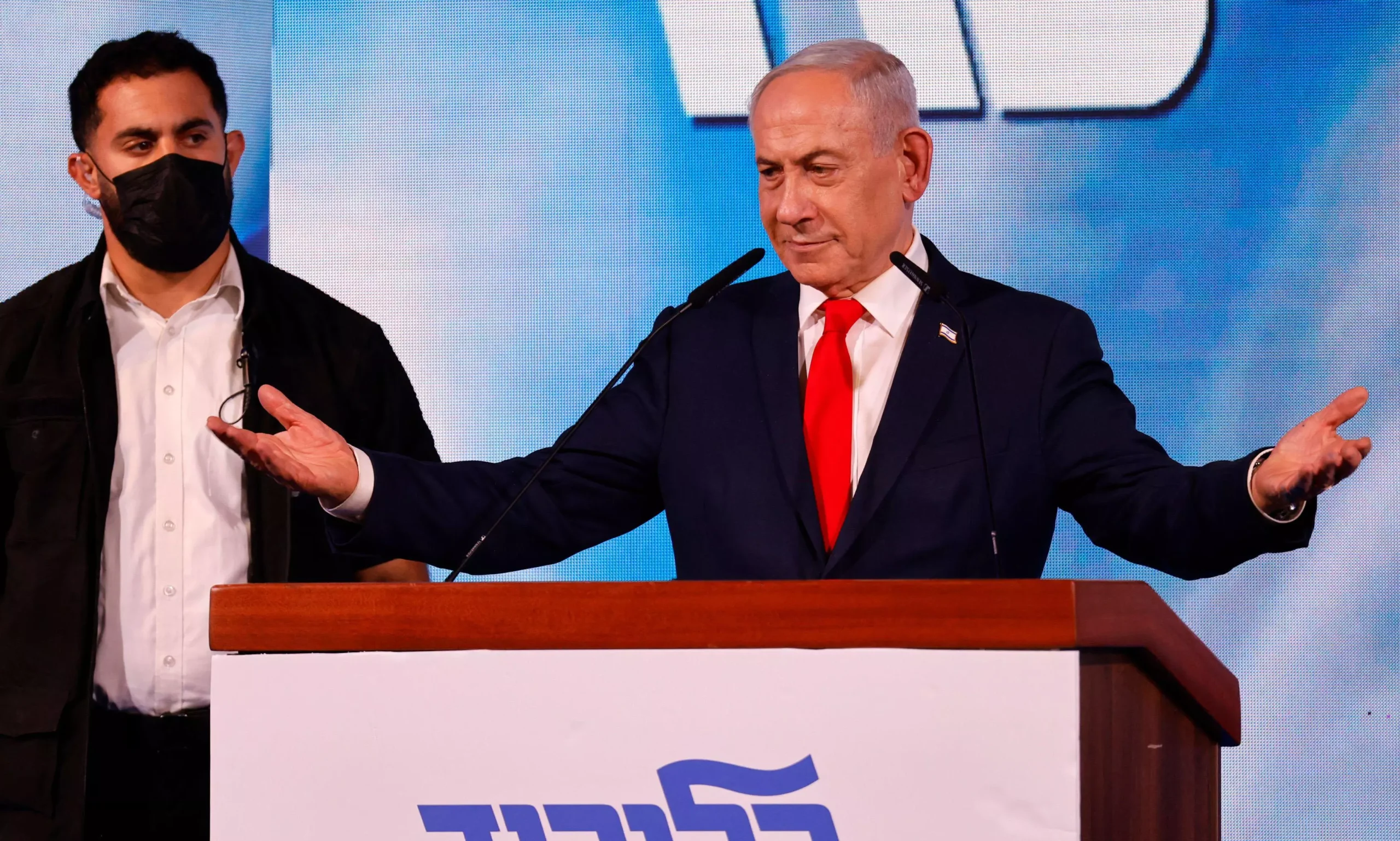
Israeli Prime Minister Benjamin Netanyahu addresses supporters at an election-night rally in Jerusalem after the first exit polls were announced, early on Wednesday, October 28, 2026. (Photo: John Wessels/AFP)
Netanyahu’s bloc leads provisional projections but remains short of a majority; Arab-led parties could play a pivotal role in government formation
Key Highlights
- President Isaac Herzog urged political parties to approach coalition negotiations with an open mind.
- With more than 85 per cent of ballots counted on Wednesday, projections gave Netanyahu’s bloc 53 seats and Gadi Eisenkot’s opposition bloc 48.
- Arab-led parties were projected to secure 19 seats in the 120-member Knesset.
- Neither main bloc had reached the 61-seat majority, raising the prospect of lengthy negotiations.
- The figures remained provisional as counting continued.
Jerusalem: Israeli President Isaac Herzog has urged political leaders to make every effort to avoid another election after Tuesday’s parliamentary vote left neither Prime Minister Benjamin Netanyahu nor his principal opponents with a clear path to a governing majority.
With more than 85 per cent of ballots counted on Wednesday, October 28, media projections placed Netanyahu’s right-wing bloc ahead with 53 seats, compared with 48 for the opposition bloc led by former military chief Gadi Eisenkot. Both remained below the 61 seats required for a majority in the 120-member Knesset. AFP.com
Herzog calls for flexibility
Herzog appealed to parties to consider their options seriously rather than allow the deadlock to send voters back to the polls.
“I expect everyone who comes here to come with an open mind,” he said.
The president is expected to receive the official results next week before consulting parliamentary factions and deciding which candidate should receive the first opportunity to form a government.
Arab-led parties could hold the balance
Arab-led parties were projected to win an unprecedented 19 seats, potentially giving them a decisive role in determining whether an alternative government could be formed.
However, several leading opposition figures had ruled out coalition partnerships with Arab-majority parties before the election. That position complicates Eisenkot’s efforts to assemble sufficient parliamentary support.
The results therefore leave a distinction between opposition to Netanyahu and agreement on a workable government to replace him.
Netanyahu likely to remain caretaker
Netanyahu and Eisenkot have both said they intend to form the next government. Netanyahu’s Likud-led alliance includes right-wing, far-right and ultra-Orthodox parties, while Eisenkot leads a politically diverse opposition camp.
Netanyahu is expected to remain caretaker prime minister while negotiations continue. The seat projections could still change as the remaining ballots are counted.
High turnout, uncertain outcome
The election was Israel’s first since the Hamas-led attack of October 7, 2023, and the subsequent regional wars.
Turnout reached 77.7 per cent, the highest since 1999, according to figures reported from the Central Elections Committee. Despite that participation, the provisional outcome has left the country facing uncertainty over its next government.
The immediate focus is now on the final count and whether political leaders can bridge their differences sufficiently to establish a governing coalition.