Reg No. - CHHBIL/2010/41479ISSN - 2582-919X

IMF Forecasts 7% Growth for India in FY27 and FY28, Warns Global Economic Resilience Is Becoming Fragile
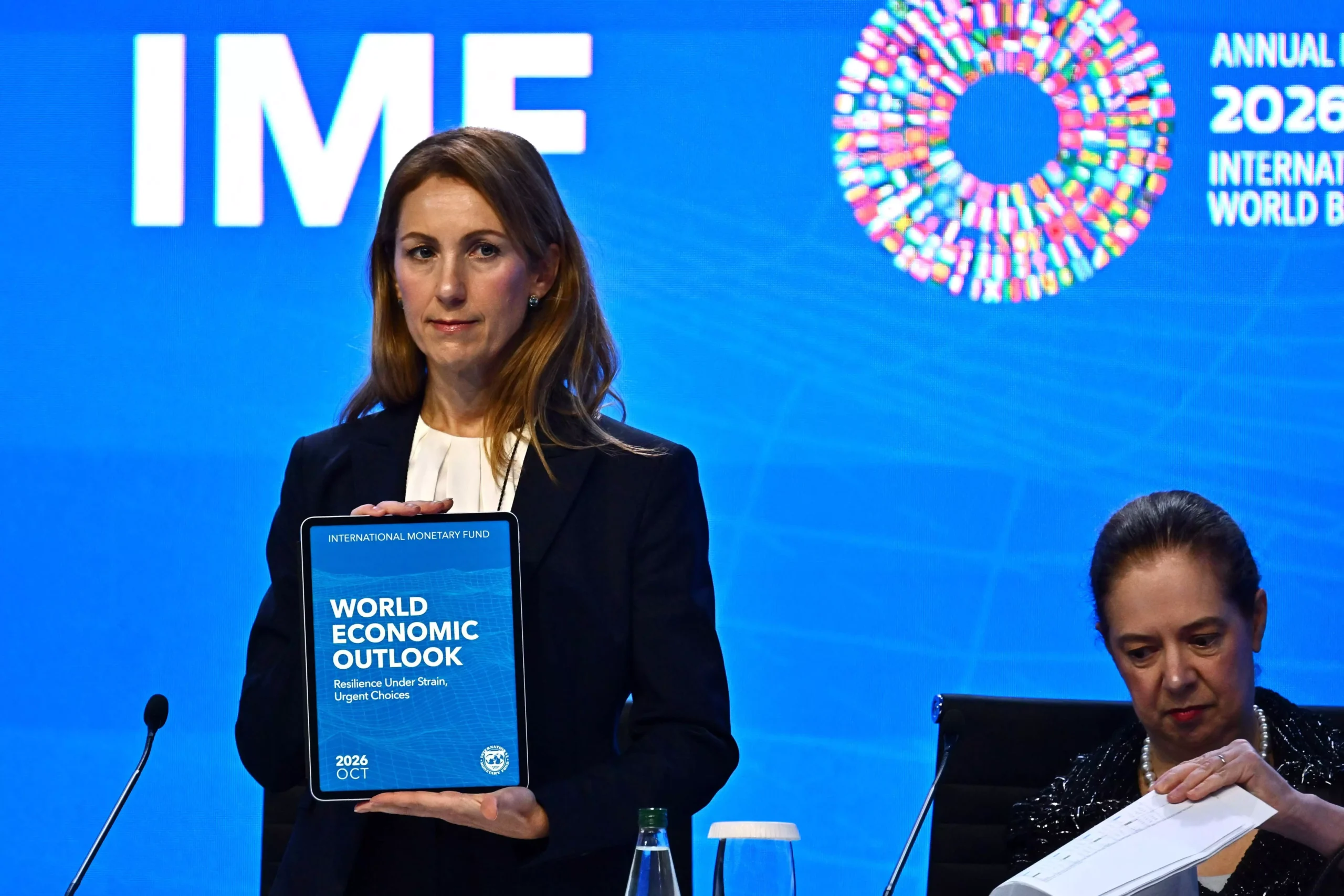
IMF Chief Economist Silvana Tenreyro holds the World Economic Outlook report during a press briefing at the annual meetings of the International Monetary Fund and World Bank Group at the Queen Sirikit National Convention Centre in Bangkok, Thailand. The IMF’s October 2026 outlook projects India’s economic growth at 7 per cent in FY27 and FY28 while warning of increasingly fragile global economic resilience.Photo: Lillian Suwanrumpha / AFP
India Maintains a Strong Growth Outlook Despite Rising Global Inflation, Energy and Food Price Pressures, and Continuing Geopolitical Uncertainty
Key Highlights
- International Monetary Fund projects India’s economic growth at 7 per cent in both FY27 and FY28.
- Global economic growth is forecast at 3.1 per cent in 2026 and 3.4 per cent in 2027.
- Global inflation is expected to reach 4.7 per cent in 2026 before moderating to 4.1 per cent in 2027.
- Higher energy and food prices are identified as major contributors to inflationary pressures.
- IMF cautions that global economic resilience is becoming increasingly fragile and uneven.
New Delhi: India’s economy is projected to expand by 7 per cent in both the financial years 2026–27 and 2027–28, according to the International Monetary Fund’s October 2026 World Economic Outlook, offering a relatively strong growth forecast at a time when the global economy faces mounting pressure from inflation, geopolitical uncertainty and rising energy costs. The Fund, however, has cautioned that the resilience demonstrated by the world economy is becoming increasingly fragile and uneven, raising concerns about the sustainability of growth across countries.
India Retains a Strong Growth Outlook
The IMF’s projection of 7 per cent growth in two consecutive financial years places India in a relatively favourable position against the wider global economic outlook.
The forecast suggests continued economic expansion despite international uncertainties that could affect investment, trade, energy supplies and consumer demand.
Sustaining growth at this level would be important for employment generation, infrastructure development, industrial activity and domestic consumption.
However, economic growth projections are not guarantees. Actual performance will depend on domestic economic conditions, government policies, private investment, agricultural output and developments in the international economy.
Global Growth Remains Moderate
In its October 2026 World Economic Outlook, the IMF projected global economic growth of 3.1 per cent in 2026 and 3.4 per cent in 2027.
The figures indicate that the global economy is expected to continue expanding, although the Fund has expressed concern about the strength and consistency of that expansion.
The IMF warned that global economic resilience was becoming more fragile and uneven, pointing to the challenges confronting countries with different levels of economic stability and capacity to respond to external shocks.
This unevenness matters because economic difficulties in one region can affect international trade, capital flows, supply chains and commodity prices elsewhere.
Inflation Expected to Reach 4.7 Per Cent in 2026
A major concern in the IMF’s assessment is the renewed pressure on global prices.
The Fund expects global inflation to rise to 4.7 per cent in 2026, driven largely by higher energy and food prices.
Inflation is subsequently projected to ease to 4.1 per cent in 2027.
Although the forecast suggests some moderation next year, continued price pressures could affect household purchasing power and business operating costs.
For governments and central banks, the challenge will be to support economic growth while preventing inflation from placing an excessive burden on consumers.
Energy and Food Prices Pose Significant Risks
Energy and food prices remain particularly important because they influence a wide range of economic activities.
Higher fuel prices can increase transportation, manufacturing and distribution costs, while food inflation directly affects household budgets.
For India, international energy price movements are especially relevant because of the country’s dependence on imported crude oil.
A sustained rise in global energy prices could increase import costs and create additional inflationary pressure.
Food prices, meanwhile, remain sensitive to agricultural production, weather conditions, supply chains and international commodity markets.
These factors illustrate why a strong growth forecast does not necessarily eliminate risks to economic stability.
Geopolitical Uncertainty Complicates Economic Planning
The IMF’s warning also reflects the uncertainty created by geopolitical developments.
International conflicts, disruptions to trade routes and changes in global economic relationships can affect business confidence and investment decisions.
For an economy such as India, maintaining growth amid these conditions requires a combination of domestic economic resilience and effective management of external risks.
Stable investment conditions, infrastructure development, productive employment and predictable economic policies can help strengthen the capacity to withstand international shocks.
Seven Per Cent Growth Must Translate Into Wider Economic Benefits
While the IMF’s forecast offers an encouraging economic indicator, the broader significance of growth depends on how its benefits reach businesses, workers and households.
Expansion in national output is important, but employment opportunities, income growth, affordable essential goods and improvements in living standards remain equally relevant measures of economic progress.
The challenge for policymakers is therefore not merely to sustain the projected rate of expansion but also to ensure that economic development remains inclusive and durable.
A Positive Forecast With a Clear Warning
The IMF’s October assessment presents two contrasting realities.
India is expected to maintain relatively strong economic growth, while the global economy faces a more uncertain environment characterised by inflationary pressure and uneven resilience.
The projected 7 per cent growth rate in FY27 and FY28 offers grounds for cautious optimism.
Nevertheless, the Fund’s wider warning underscores the importance of managing inflation, maintaining economic stability and preparing for potential external shocks.
For India, the coming years will test not only its ability to achieve the projected growth figures but also its capacity to convert economic expansion into sustained prosperity for its people.

YOU MAY LIKE THIS