Reg No. - CHHBIL/2010/41479ISSN - 2582-919X

Trump Honours Six Technology Giants With America’s Highest Science and Innovation Awards
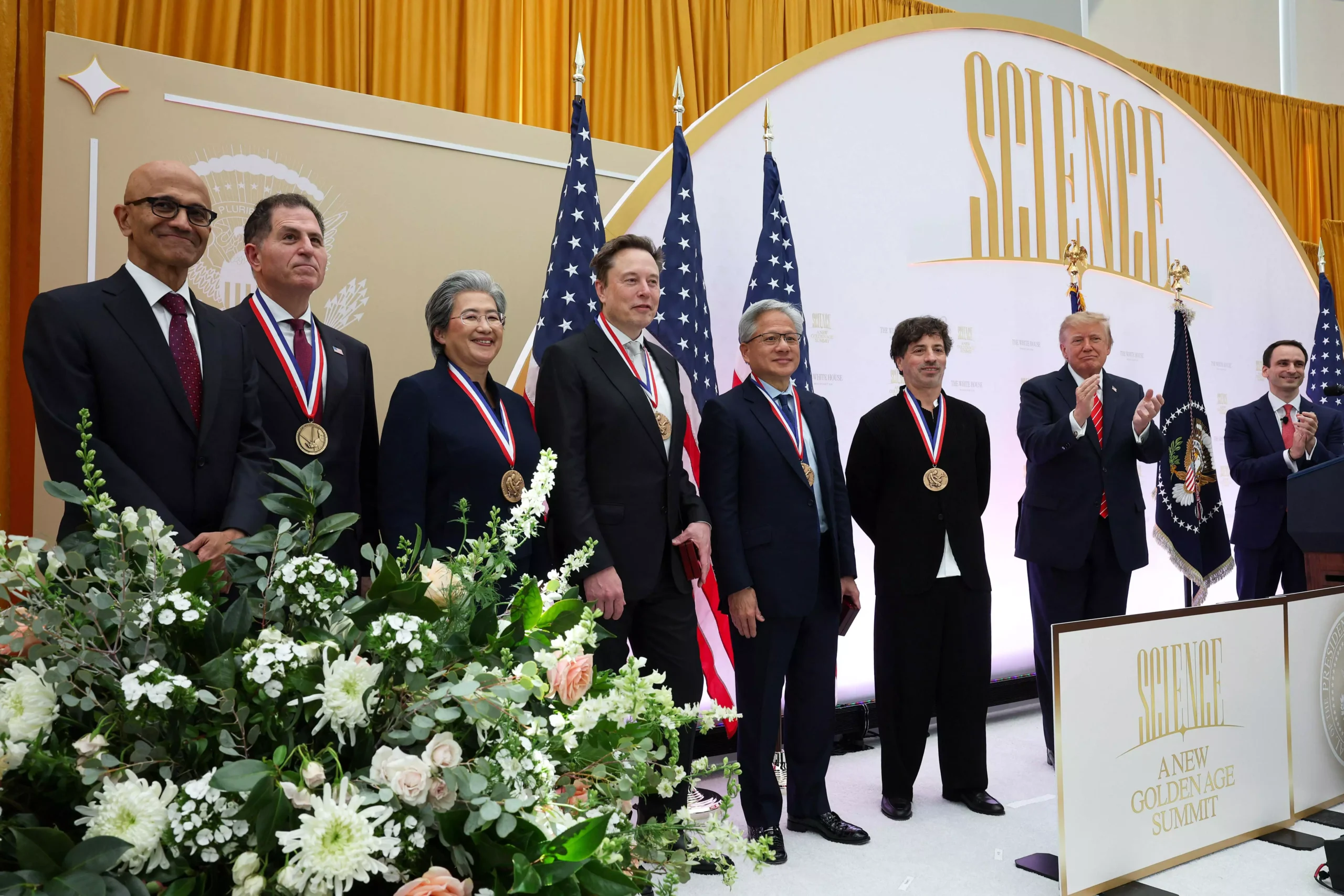
US President Donald Trump applauds six recipients of the National Medal of Science and the National Medal of Technology and Innovation during the Science: A New Golden Age Summit in Washington, DC, on Thursday, October 8, 2026. Pictured from left among the awardees are Microsoft CEO Satya Nadella, Dell Technologies founder Michael Dell, AMD CEO Lisa Su, SpaceX CEO Elon Musk, Nvidia CEO Jensen Huang and Google co-founder Sergey Brin. Photo: Kent Nishimura/AFP.
Elon Musk, Satya Nadella, Sergey Brin, Jensen Huang, Lisa Su and Michael Dell receive prestigious national medals as President Donald Trump outlines his vision for American leadership in artificial intelligence, scientific research and advanced technology.
Key Highlights
- US President Donald Trump honours six influential technology leaders at the Science: A New Golden Age Summit on Thursday.
- Elon Musk, Sergey Brin, Jensen Huang and Lisa Su receive the National Medal of Science.
- Microsoft CEO Satya Nadella and Dell Technologies founder Michael Dell receive the National Medal of Technology and Innovation.
- Trump describes the recipients as national treasures shaping America’s technological future.
- The summit highlights the growing importance of artificial intelligence, semiconductor innovation, space exploration and advanced computing.
Trump Recognises Technology Leaders Driving America’s Scientific Future
America’s technological ambitions took centre stage on Thursday as President Donald Trump honoured six prominent innovators with the country’s highest national awards for achievements in science, engineering and technological advancement.
The ceremony, held during the Science: A New Golden Age Summit in Washington on October 8, 2026, brought together some of the most influential figures in the global technology industry.
The recipients represented organisations whose innovations have transformed computing, artificial intelligence, digital communication, semiconductor manufacturing and space exploration.
Addressing the gathering, Trump praised their contributions to American innovation and described them as “national treasures” helping shape the country’s technological future.
Four Innovators Receive National Medal of Science
The National Medal of Science was presented to four prominent technology leaders whose work has influenced scientific research and industrial development.
Tesla and SpaceX chief Elon Musk received the honour for his engineering achievements in space exploration, intelligent systems and communication technologies.
Google co-founder Sergey Brin was recognised for his contributions to information retrieval and data-processing algorithms that fundamentally changed how people access knowledge.
Nvidia CEO Jensen Huang received the medal for innovations in graphics processing and parallel computing, technologies that have become essential to modern artificial intelligence systems.
AMD CEO Lisa Su was honoured for her leadership in semiconductor engineering, processor architecture and high-performance computing.
The White House said their contributions had strengthened America’s scientific capabilities and established foundations for future technological breakthroughs.
Satya Nadella and Michael Dell Receive Technology and Innovation Medals
Two other technology leaders received the National Medal of Technology and Innovation.
Microsoft Chairman and CEO Satya Nadella was recognised for transforming Microsoft through cloud computing and developing large-scale computing infrastructure supporting advanced artificial intelligence.
Dell Technologies founder Michael Dell received the honour for his contributions to personal and enterprise computing, his leadership in building a global technology company and his support for scientific and engineering education.
The recognition of Nadella, an Indian-born technology executive, also highlighted the contributions of internationally born professionals to America’s technology industry.
Five of the six recipients were born outside the United States, reflecting the international talent that has helped shape the country’s technological development.
Artificial Intelligence at the Centre of America’s New Scientific Vision
Beyond the awards ceremony, the summit reflected the Trump administration’s determination to strengthen America’s position in emerging technologies.
Artificial intelligence, advanced semiconductor design, quantum computing, scientific research infrastructure and space technology featured prominently in the administration’s vision.
The White House emphasised that technological leadership would depend increasingly on collaboration between government institutions, private companies, universities and scientific researchers.
The administration also outlined efforts to accelerate scientific discovery through new research initiatives and greater integration of advanced computing technologies.
The summit followed the release of a policy report in July 2026 examining how the United States could modernise its scientific research system and encourage innovation.
Scientific Achievement and Immigration Policy Present a Contrasting Picture
The ceremony also came against the backdrop of renewed controversy surrounding America’s immigration policies.
Several of the honoured executives built their careers after arriving in the United States from other countries, demonstrating the contribution of international talent to American scientific and technological development.
On the same day, the Trump administration’s restrictions involving the H-1B visa programme attracted attention, particularly because Microsoft was among the companies affected.
The contrasting developments highlighted an important question for the American technology industry: how to maintain global scientific leadership while introducing tighter controls on foreign skilled workers.
Technology, Innovation and the Future of Global Competition
The awards underline the strategic importance of scientific innovation in an increasingly competitive international environment.
Semiconductor manufacturing, artificial intelligence, cloud computing and space exploration are no longer confined to commercial development. They have become central to economic competitiveness, national security and international influence.
By recognising six industry leaders, the Trump administration sought to reinforce its message that scientific discovery and private-sector innovation would remain essential to America’s future.
However, maintaining technological leadership will require more than celebrating individual achievements. Continued investment in research, scientific education, international collaboration and the development of skilled professionals will be equally important.
The ceremony ultimately reflected the growing relationship between technological innovation, economic power and national ambition in the twenty-first century.

YOU MAY LIKE THIS