Reg No. - CHHBIL/2010/41479ISSN - 2582-919X

Cyber Fraud Knows No Borders: PM Modi Calls for Global Action Against Digital Crime and Deepfakes
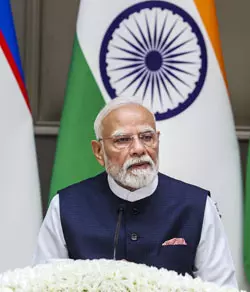
Prime Minister Narendra Modi addresses the 10th India Mobile Congress at Yashobhoomi on Thursday, October 8, 2026, calling for coordinated global action against cyber fraud, cybercrime and deepfake technology while highlighting India’s expanding digital infrastructure. Photo: PTI
At the 10th India Mobile Congress, Prime Minister Narendra Modi urges governments, technology companies, telecom operators and financial institutions to establish a coordinated international framework for digital security.
Key Highlights
- PM Modi warns that cybercriminals are exploiting international borders to carry out sophisticated digital fraud.
- Calls for a global framework involving governments, technology firms, telecom operators and financial institutions.
- Identifies deepfakes as a growing threat to digital trust and security.
- Says India’s Digital India initiative has transformed mobile connectivity into an instrument of public service delivery.
- Highlights direct benefit transfers exceeding ₹50 lakh crore and government estimates of ₹5 lakh crore in prevented leakages.
- Emphasises affordable connectivity, digital education and technological inclusion as essential to India’s development.
Digital Progress Cannot Survive Without Trust, Says Modi
New Delhi: As digital technology increasingly shapes economies, public administration and everyday communication, Prime Minister Narendra Modi has warned that cybercrime and sophisticated online fraud have emerged as threats that no country can confront independently.
Addressing the inaugural session of the 10th India Mobile Congress at Yashobhoomi on Thursday, October 8, 2026 Modi called for an internationally coordinated framework to combat cyber fraud, cybercrime and the growing misuse of artificial intelligence through deepfake technology.
He emphasised that the rapid expansion of digital infrastructure must be accompanied by equally strong measures to protect users, financial transactions and public confidence.
“Technology achieves scale only when it earns trust,” Modi said, highlighting the importance of security in an increasingly interconnected digital environment.
The Prime Minister observed that cybercriminals frequently operate across multiple jurisdictions, exploiting differences in national laws, enforcement capabilities and technological systems.
A criminal operating from one country, he explained, could target victims in another with assistance originating from a third.
Such operations, he suggested, demonstrate why conventional national boundaries offer little protection against modern digital threats.
Deepfakes Present a Serious Challenge to Digital Confidence
Modi expressed particular concern about the misuse of deepfake technology, which can generate convincing but fabricated images, videos and audio recordings.
The increasing sophistication of such content has created fresh challenges for individuals, institutions and law enforcement agencies attempting to distinguish authentic communication from manipulation.
The Prime Minister stressed that responding effectively would require cooperation extending beyond government agencies.
Technology companies, telecom operators and financial institutions, he said, must become active participants in an international framework designed to prevent and address digital crime.
His remarks underline a wider concern: technological innovation can expand economic opportunities and improve public services, but the same systems can also be exploited for impersonation, financial deception and the circulation of misleading information.
The challenge for governments and technology providers is therefore not simply to accelerate digital adoption but to ensure that citizens can use emerging technologies with confidence.
India Mobile Congress Reflects the Country’s Digital Ambitions
Referring to the theme of the 10th India Mobile Congress, Scale Without Boundaries, Modi described the event as an important platform showcasing India’s technological progress and future ambitions.
He observed that global discussions surrounding telecommunications frequently concentrate on network speeds, spectrum allocation, infrastructure and connectivity.
India’s experience, however, demonstrated that telecommunications could serve a much broader social and administrative purpose.
Over the past decade, mobile technology has increasingly become an instrument for delivering government services, improving financial inclusion and connecting communities previously excluded from digital opportunities.
Modi said the country’s large telecommunications market, affordable devices and expanding user base had attracted international attention.
Nevertheless, he urged participants to look beyond the scale of India’s digital infrastructure and examine the policies and public priorities responsible for its expansion.
Digital India and the Democratisation of Technology
The Prime Minister recalled that modern technology had once appeared increasingly concentrated among those with sufficient financial resources and access to infrastructure.
The Digital India initiative, he said, sought to change that situation by placing mobile connectivity at the centre of a wider programme of technological inclusion.
Telecommunications reforms, infrastructure expansion and domestic manufacturing were pursued to make digital services more accessible and affordable.
“This was a very big effort for the democratisation of technology,” Modi said.
The transformation has extended the usefulness of mobile phones far beyond conventional communication.
Banking, healthcare, education and government services have increasingly become accessible through digital platforms, reducing dependence on physical offices and long-distance travel.
For citizens living in remote villages, the availability of mobile connectivity can mean easier access to financial services, administrative information and educational resources.
The Prime Minister also referred to the role of digital infrastructure during the COVID-19 pandemic, when online systems helped educational institutions, offices and banks maintain essential activities despite widespread restrictions.
Digital Education Reaches Remote Communities
Highlighting the importance of technology in education, Modi said digital platforms had helped extend learning opportunities to children in geographically isolated and economically disadvantaged communities.
He referred to the national DIKSHA platform, which, according to figures cited in his address, facilitated more than five billion learning sessions and 60 billion learning minutes during the pandemic period up to July 2022.
The Prime Minister said the government’s objective was now to connect approximately 25 crore students with digital and online educational resources.
The expansion of digital education has the potential to improve access to learning materials, particularly in regions where educational infrastructure and specialist teaching resources remain limited.
However, ensuring equitable access also requires attention to device affordability, internet reliability, digital literacy and the availability of educational material in regional languages.
These factors will remain important as India seeks to extend the benefits of technology across different social and economic groups.
Direct Benefit Transfers Strengthen Public Service Delivery
Modi also highlighted the role of digital connectivity in transforming the distribution of government financial assistance.
According to the figures presented by the Prime Minister, more than ₹50 lakh crore has been transferred directly to beneficiaries through digital mechanisms.
He said these systems had helped prevent an estimated ₹5 lakh crore in corruption-related losses and leakages.
Direct Benefit Transfer mechanisms are intended to reduce intermediary involvement by transferring eligible benefits into recipients’ bank accounts.
The Prime Minister cited the PM-KISAN Samman Nidhi scheme as an example of technology-supported financial inclusion.
He stated that more than ₹4 lakh crore had been deposited directly into the accounts of small farmers under the scheme.
The wider significance of such systems lies in their potential to improve transparency, accelerate payments and reduce administrative obstacles.
At the same time, reliable authentication, accessible grievance mechanisms and strong cybersecurity safeguards remain essential to protecting beneficiaries.
Global Cooperation Must Match the Scale of Digital Threats
The Prime Minister’s appeal for international cooperation comes against the broader backdrop of increasingly interconnected financial and communication systems.
Cybercriminal networks can exploit online payment channels, fraudulent identities, compromised accounts and artificial intelligence tools without being physically present in the countries where their victims reside.
This creates practical difficulties for investigation, evidence collection and prosecution.
A coordinated international response could help improve information-sharing, strengthen fraud detection and support cooperation among law enforcement agencies and digital service providers.
Financial institutions and telecom operators have particularly important roles because many fraudulent operations depend on payment systems, mobile connections and digital identities.
Technology companies must also confront the risks associated with manipulated content and the misuse of emerging artificial intelligence capabilities.
Nevertheless, any international framework would need to balance security requirements with privacy protections, lawful data-sharing and the rights of legitimate technology users.
Technology’s Future Depends on Public Confidence
Modi’s address brought together two closely connected aspects of India’s digital transformation: the opportunities created by widespread technological access and the responsibility to protect citizens from its misuse.
The expansion of mobile connectivity has supported education, financial inclusion, government service delivery and economic participation.
Yet the benefits of digital progress can be undermined when users lose confidence in online transactions, communication platforms or the authenticity of information.
The Prime Minister’s central message was that technological growth and digital security must advance together.
India’s experience in expanding digital public infrastructure, he indicated, could contribute to international efforts to make technology more accessible and secure.
As artificial intelligence, telecommunications and digital finance become increasingly interconnected, the challenge will be to ensure that innovation continues to serve people without exposing them to unacceptable risks.
Technology may operate without geographical boundaries, but public trust will remain the foundation of its success.

YOU MAY LIKE THIS