Reg No. - CHHBIL/2010/41479ISSN - 2582-919X

INDIA Bloc Intensifies Protest Against CEC Gyanesh Kumar Over Electoral Roll Revision
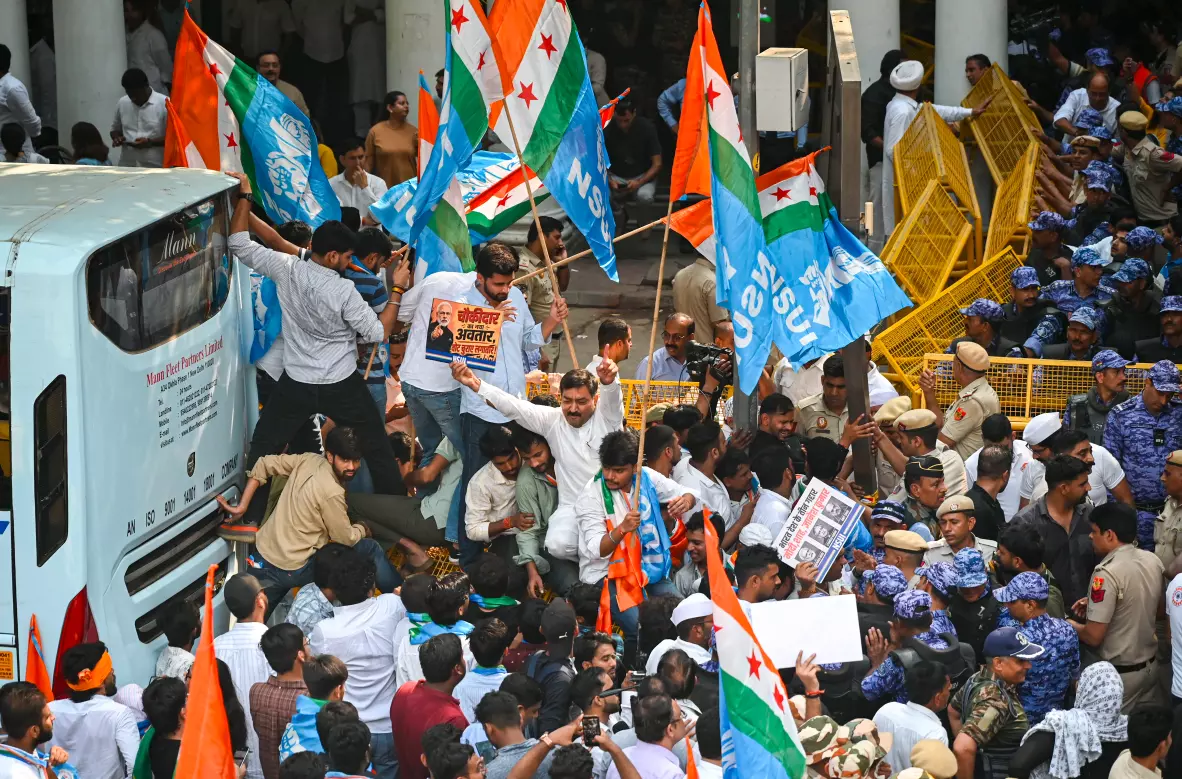
Congress workers and supporters gather amid police deployment and barricades outside Moets in Connaught Place, New Delhi, on Thursday, October 8, 2026, as Congress President Mallikarjun Kharge hosts a lunch meeting for INDIA bloc leaders amid ongoing protests demanding the resignation of Chief Election Commissioner Gyanesh Kumar over electoral roll revision issues.Photo:PTI
Opposition leaders gather in New Delhi amid demands for the Chief Election Commissioner’s resignation, raising questions over electoral transparency and the credibility of voter list revisions.
Key Highlights
- INDIA bloc leaders assemble in New Delhi on October 8 amid continuing protests against Chief Election Commissioner Gyanesh Kumar.
- Opposition parties demand the CEC’s resignation over concerns surrounding electoral roll revision.
- Congress President Mallikarjun Kharge hosts a lunch meeting for INDIA bloc leaders for the second consecutive day.
- Congress workers gather outside Moets in Connaught Place as political demonstrations continue.
- The controversy places electoral transparency, voter rights and the Election Commission’s accountability at the centre of the political debate.
Opposition Steps Up Pressure on Election Commission
The confrontation between the Opposition and the Election Commission has intensified, with INDIA bloc leaders assembling in New Delhi on Thursday, October 8, to press their demand for the resignation of Chief Election Commissioner Gyanesh Kumar over issues surrounding the revision of electoral rolls.
The political mobilisation coincided with a lunch meeting hosted by Congress President Mallikarjun Kharge for INDIA bloc leaders for the second consecutive day.
Congress workers gathered outside Moets in Connaught Place, where the meeting was organised, reflecting the Opposition’s continuing efforts to maintain pressure over electoral administration.
The protests have brought renewed attention to the processes through which electoral rolls are revised and the safeguards necessary to protect eligible citizens’ voting rights.
Electoral Roll Revision Becomes a Political Flashpoint
At the centre of the confrontation are Opposition concerns over the electoral roll revision process.
Electoral rolls determine who is eligible to cast a vote, making their accuracy fundamental to the conduct of democratic elections.
Periodic revisions are necessary to include newly eligible voters, correct inaccurate entries and remove names that no longer qualify under electoral regulations.
However, the process can become controversial when political parties question whether sufficient safeguards exist against the wrongful exclusion of legitimate voters.
The INDIA bloc’s demand for Gyanesh Kumar’s resignation reflects its objections to the handling of the revision exercise.
The specific allegations underlying the latest demonstrations, however, require examination alongside the Election Commission’s official position before conclusions can be drawn about procedural violations.
Kharge’s Meeting Signals Opposition Coordination
The gathering hosted by Mallikarjun Kharge provided another opportunity for Opposition leaders to coordinate their response to the electoral roll controversy.
The meeting, held for the second consecutive day, took place against the backdrop of demonstrations seeking greater accountability from the Election Commission.
For the INDIA bloc, the controversy presents an issue extending beyond individual electoral contests.
Questions surrounding the preparation and maintenance of voter lists affect public confidence in the electoral system itself.
The Opposition’s continuing mobilisation indicates its intention to keep the issue in the national political debate.
Independence and Accountability Must Go Together
The Election Commission occupies a constitutionally significant position in India’s democratic framework.
Its responsibility extends beyond conducting elections to maintaining the integrity of electoral procedures and ensuring that eligible citizens can exercise their franchise.
The independence of the institution is essential, but so are transparency, procedural fairness and public accountability.
Political criticism of electoral administration is legitimate in a democracy. At the same time, allegations of irregularities must be examined through evidence, applicable legal provisions and established procedures.
An electoral roll revision exercise must therefore balance two equally important requirements: removing ineligible entries and protecting eligible voters against wrongful exclusion.
Neither objective should be pursued at the expense of the other.
Electoral Credibility Remains the Larger Question
The continuing dispute between the INDIA bloc and the Election Commission highlights the importance of public confidence in democratic institutions.
While the Opposition has demanded the Chief Election Commissioner’s resignation, the wider issue concerns whether electoral processes are sufficiently transparent, verifiable and accessible to citizens.
The controversy also underscores the need for effective grievance mechanisms through which voters can challenge omissions, corrections or deletions affecting their electoral status.
The legitimacy of an election depends not merely on the declaration of results but also on confidence in the procedures that precede polling.
As Opposition leaders continue their campaign, the focus will remain on how concerns over electoral roll revision are addressed and whether the political confrontation leads to greater procedural clarity.
In a democracy, the credibility of the electoral process must remain above political confrontation, and every eligible citizen’s right to vote must be protected.

YOU MAY LIKE THIS