Reg No. - CHHBIL/2010/41479ISSN - 2582-919X

Major Push to Resolve Mahanadi Water Dispute as Chhattisgarh, Odisha Hold High-Level Talks
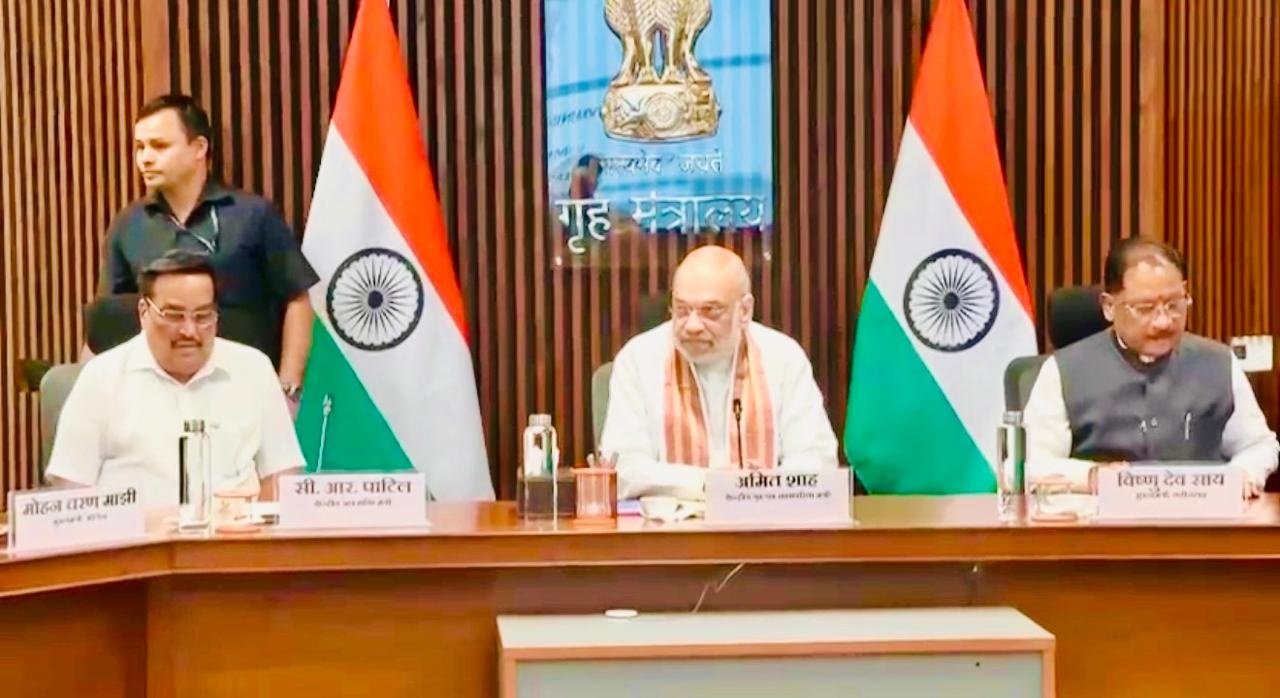
Union Home and Cooperation Minister Amit Shah chairs a high-level meeting on the Mahanadi water dispute in New Delhi on Thursday, October 1, 2026. Union Jal Shakti Minister C.R. Patil and Chhattisgarh Chief Minister Vishnu Deo Sai are seen during the talks involving Chhattisgarh and Odisha aimed at finding an amicable and sustainable solution to the long-pending river-water issue. Photo: CMO
Amit Shah chairs crucial meeting in New Delhi; CM Vishnu Deo Sai calls Mahanadi a lifeline connecting the two States and backs a scientific, transparent and mutually acceptable settlement
Key Highlights
- Union Home and Cooperation Minister Amit Shah chairs high-level Chhattisgarh-Odisha meeting in New Delhi
- Chief Ministers Vishnu Deo Sai and Mohan Charan Majhi present their respective States’ positions
- Union Jal Shakti Minister C.R. Patil and senior Central and State officials participate
- Sai stresses dialogue, scientific assessment, transparency and mutual consent
- Interests of farmers, citizens and future generations placed at the centre of proposed settlement
- Mahanadi Water Disputes Tribunal has been dealing with the dispute since 2018
- Technical and political dialogue between the two States to continue
New Delhi/Raipur: Efforts to resolve the long-running Mahanadi water dispute between Chhattisgarh and Odisha received a significant push on Thursday, October1, 2026 as Union Home and Cooperation Minister Amit Shah chaired a high-level meeting in New Delhi involving the Chief Ministers of both States.
Chhattisgarh Chief Minister Vishnu Deo Sai and Odisha Chief Minister Mohan Charan Majhi participated in the discussions at Kartavya Bhavan and presented their respective States’ positions on issues concerning the river.
Union Jal Shakti Minister C.R. Patil, the Chairman of the Central Water Commission, Chief Secretaries of Chhattisgarh and Odisha and senior officials of the Union Jal Shakti Ministry, CWC and both State governments were also part of the meeting.
The talks are part of continuing efforts to find an amicable solution to a dispute that has remained unresolved for years. Odisha has raised concerns about upstream water projects in Chhattisgarh and their effect on downstream flows, particularly during the non-monsoon period. Chhattisgarh, meanwhile, has maintained that it requires its share of Mahanadi water for irrigation, drinking water, industry and development.
‘Mahanadi Connects Us, It Does Not Divide Us’: Sai
Presenting Chhattisgarh’s position, Sai sought to frame the river not merely as a water-sharing question but as a shared resource connecting the social, cultural and economic lives of the two neighbouring States.
“Mahanadi is not merely a source of water; it is a lifeline connected with the civilisation, culture, agriculture and lives of the people of both States. Mahanadi does not divide Chhattisgarh and Odisha — it connects them.”
He argued that a lasting settlement should consequently emerge through cooperation rather than confrontation.
“The solution should be such that both States win and the interests of the people of both States remain protected.”
Sai said Chhattisgarh favours a settlement that is fair, impartial, scientifically grounded, transparent and sustainable over the long term.
“Our endeavour should be to find a solution in which the interests of both States and their citizens are protected. Chhattisgarh stands for a just, impartial, scientific, transparent and long-term solution.”
The Chief Minister said the interests of farmers, ordinary citizens and future generations should guide the negotiations.
Chhattisgarh Places Its Water Requirements on Record
Sai pointed out that the Mahanadi originates in Chhattisgarh and that a substantial portion of its catchment lies within the State.
Agriculture, irrigation and drinking-water requirements, along with the development needs of tribal and rural regions, are closely connected with the river, he said.
According to Sai, these requirements need adequate consideration in any enduring settlement between the two States.
At the same time, he stressed that asserting Chhattisgarh’s requirements did not mean disregarding Odisha’s interests.
“While speaking about its own interests, Chhattisgarh fully respects the needs and interests of Odisha as well.”
Sai specifically acknowledged the importance of the Hirakud reservoir to Odisha and indicated Chhattisgarh’s willingness to cooperate in matters concerning its interests and smooth operation.
The broader approach, he said, should be to transform water from a potential source of disagreement into an instrument of shared prosperity.
Call for Transparent Sharing of Water Data
A key element of Sai’s position was greater reliance on scientific information and transparent data.
He proposed a mechanism through which information concerning water availability, requirements and utilisation could be transparently shared between the States and decisions taken on a scientific basis.
“An important natural resource such as water should become a medium of shared prosperity.”
Sai said emotional considerations surrounding the river were understandable, but scientific evidence was equally important when deciding water allocation and future requirements.
He expressed confidence in the mediation of the Union Jal Shakti Ministry and in an impartial and transparent technical assessment by the Central Water Commission.
The CWC has already played an important role in recent discussions. In July, the two Chief Ministers participated in talks chaired by the Union Jal Shakti Minister, and both States subsequently gave written assurances that a CWC decision taken in the larger interests of both States would be acceptable to them.
Amit Shah’s Intervention Raises Hopes of Settlement
Sai welcomed the initiative taken by Union Home Minister Amit Shah to bring the two States together for further negotiations.
The October 1 meeting had been convened specifically to advance efforts for a negotiated settlement, following previous discussions between the two States and the Centre.
Sai linked the approach to the broader principle of cooperative federalism, arguing that complicated inter-State questions could be resolved when governments maintained dialogue and mutual confidence.
He also recalled Sardar Vallabhbhai Patel’s role in national integration after Independence and said resolving long-pending inter-State matters through consensus strengthened the same spirit of national unity and cooperation.
The Chief Minister referred to Prime Minister Narendra Modi’s emphasis on cooperative federalism and said coordination between the Centre and States had created an environment in which difficult issues could be addressed through dialogue.
Scientific Assessment Alongside Political Dialogue
Sai stressed that any sustainable agreement would have to consider several competing requirements simultaneously.
These include present water availability, future demand, irrigation, drinking water, environmental requirements and the development needs of both States.
“If the facts become clear at the technical level and dialogue and trust remain at the political level, a solution acceptable to both States and beneficial to future generations can certainly emerge.”
He said Chhattisgarh would cooperate positively with a fair and practical solution emerging from consultations between the two States under the Centre’s mediation.
Sai Draws Parallel With Bastar’s Transformation
The Chhattisgarh Chief Minister also referred to Bastar while explaining his confidence in coordinated action between the Centre and States.
He said Chhattisgarh had witnessed the results of coordinated efforts involving security, development and public confidence in addressing the decades-old challenge of Naxalism.
Sai argued that similarly complicated and longstanding problems could move towards resolution when there was political will, sustained dialogue and confidence among the parties involved.
The analogy was used by the Chief Minister to emphasise coordination rather than equate the two fundamentally different issues.
‘Let Mahanadi Become a Stream of Cooperation, Not Dispute’
Sai also placed considerable emphasis on the historical and cultural relationship between Chhattisgarh and Odisha.
He referred to similarities in tribal traditions and lifestyles and invoked the cultural connection associated with Lord Jagannath, extending from Shivrinarayan in Chhattisgarh to Puri in Odisha.
“Our faith and culture connect us. Mahanadi is also part of this shared heritage and life.”
He added:
“Mahanadi should not become a line of dispute but a stream of cooperation, development and trust. That should be our collective endeavour.”
Both governments, Sai said, ultimately shared a common responsibility towards their farmers and citizens.
He argued that mutual confidence could produce an arrangement under which farmers in both Chhattisgarh and Odisha benefited while the development requirements of both States were accommodated.
Dispute Dates Back More Than a Decade
The disagreement has a long institutional history.
Odisha approached the Centre in 2016 over the sharing of Mahanadi waters, raising objections to upstream projects in Chhattisgarh and their possible effect on downstream flow during lean periods. After earlier negotiations failed to produce a settlement, the Mahanadi Water Disputes Tribunal was constituted in March 2018.
Political negotiations have gained momentum in recent months.
Sai met Majhi in Bhubaneswar on September 20, while earlier discussions were held under C.R. Patil’s chairmanship. The Central Water Commission has been involved in the technical process, and the tribunal has also taken note of efforts towards an amicable settlement.
Thursday’s meeting therefore does not yet constitute a final settlement of the Mahanadi dispute. Rather, it represents another high-level step towards finding a mutually acceptable agreement through political dialogue backed by technical assessment.
Technical and political consultations are expected to continue as Chhattisgarh, Odisha and the Centre work towards bridging their respective requirements.
For millions of people whose agriculture, drinking water and livelihoods are connected with the river, the significance of the process goes far beyond an inter-State disagreement.
As Sai put it, the objective is to ensure that the Mahanadi becomes a river of cooperation rather than a boundary of dispute.