Reg No. - CHHBIL/2010/41479ISSN - 2582-919X

India, China Agree on ‘Early and Substantial Harvest’ in Boundary Delimitation Talks
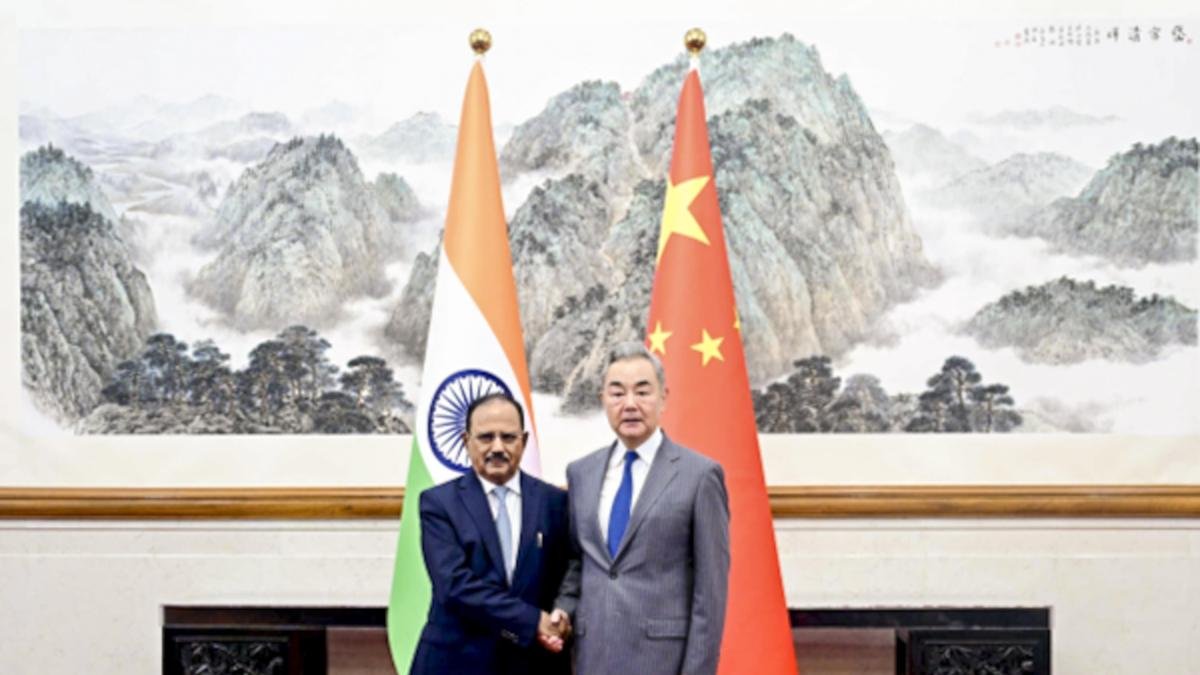
National Security Adviser Ajit Doval (L) with Chinese Foreign Minister Wang Yi during the 25th round of Special Representatives’ talks on the India-China boundary question in Beijing. The two sides agreed to advance discussions on boundary delimitation while strengthening mechanisms for maintaining peace and managing situations along the LAC. Photo: Handout
Doval-Wang Yi talks produce eight-point outcome, including new military meeting points and hotlines, September talks on trans-border rivers and continued negotiations towards a boundary settlement
Key Highlights
- India and China agree to advance discussions on an “Early and Substantial Harvest” of boundary delimitation.
- Two additional meeting points to be established for senior military commander-level engagements.
- Two additional border military hotline channels agreed for the Eastern and Middle Sectors.
- Expert-level mechanism on trans-border rivers to meet in September.
- Both sides to maintain communication on hydrological data sharing and renewal of relevant MoUs.
- Existing diplomatic and military mechanisms to address situations along the LAC promptly.
- 26th round of Special Representatives’ talks to be held in India in 2027.
India and China have agreed to take their long-running boundary negotiations a step forward by pursuing an “Early and Substantial Harvest” of boundary delimitation, while simultaneously strengthening military and diplomatic mechanisms intended to prevent misunderstandings and miscalculations along the Line of Actual Control.
The agreement forms part of an eight-point outcome announced after the 25th round of Special Representatives’ talks in Beijing between National Security Adviser Ajit Doval and Chinese Foreign Minister Wang Yi on Tuesday, August 25. Both governments released the outcome on Wednesday.
The formulation is significant because the two countries are moving beyond merely managing immediate border tensions towards structured discussions on delimitation in appropriate areas. However, it does not mean that India and China have agreed on the alignment of their disputed boundary. The Expert Group must first settle its terms of reference before taking the delimitation discussions forward.
Both sides reaffirmed their commitment to the political parameters and guiding principles agreed in 2005 and said they would continue negotiations towards a fair, reasonable and mutually acceptable solution to the boundary question.
More mechanisms to manage the LAC
An Expert Group on Boundary Delimitation and a Working Group on Border Management under the Working Mechanism for Consultation and Coordination on India-China Border Affairs will respectively take forward discussions on delimitation and border management.
The first task before the two groups will be to agree on their respective terms of reference.
The two sides also agreed that situations on the ground should be dealt with promptly through existing diplomatic and military channels, including the WMCC and local commander-level meetings.
The official outcome said the two countries discussed ways of improving their understanding of the LAC in appropriate areas to facilitate better border management.
In another practical step, India and China agreed to establish two additional meeting points for the General Level Mechanism/Senior Highest Military Commander meetings.
They will also establish two additional military hotline channels in the Eastern and Middle Sectors, expanding direct communication between forces deployed along the disputed frontier.
The developments build on decisions taken during the previous round of Special Representatives’ talks, when the two countries agreed to create an Expert Group to explore an early harvest of boundary delimitation in appropriate sectors and a separate Working Group to improve border management.
Doval, according to the Chinese Foreign Ministry’s account of the talks, said a stable and forward-looking relationship served the interests of both countries.
“India and China are both ancient civilisations, populous countries and major economies, and are cooperative partners rather than competitors,” Doval said, according to the Chinese readout.
He said India was prepared to intensify strategic communication, expand mutually beneficial cooperation, manage the border effectively and explore solutions to the boundary question.
Wang, meanwhile, argued that the two neighbours should deal with their relationship from a strategic and long-term perspective.
“The two sides should draw lessons from history, place the boundary question in an appropriate position in bilateral relations, keep moving forward without stagnation, regression or deviation,” Wang said, according to China’s Foreign Ministry.
Trans-border rivers return to agenda
The talks also produced movement on trans-border river cooperation, an issue of particular importance to India.
The two countries agreed that the China-India Expert-Level Mechanism on Trans-border Rivers will meet in September and that communication will continue on hydrological data sharing and renewal of relevant memoranda of understanding.
Both sides also noted progress in other forms of cross-border cooperation, including the reopening of three designated border trading points and an increase in batches of Indian pilgrims travelling for the Kailash Manasarovar Yatra.
They agreed to strengthen exchanges in border trade, pilgrimage and other areas to foster what the official outcome described as an atmosphere of “dialogue, peace, consultation and cooperation” along the border.
The latest agreements represent a further attempt to stabilise the frontier while the much more difficult question of a final boundary settlement remains unresolved.
The two sides agreed that the 26th round of Special Representatives’ talks will be held in India in 2027.