Reg No. - CHHBIL/2010/41479ISSN - 2582-919X

Doval-Wang Yi Talks Put Boundary Delimitation Back in Focus
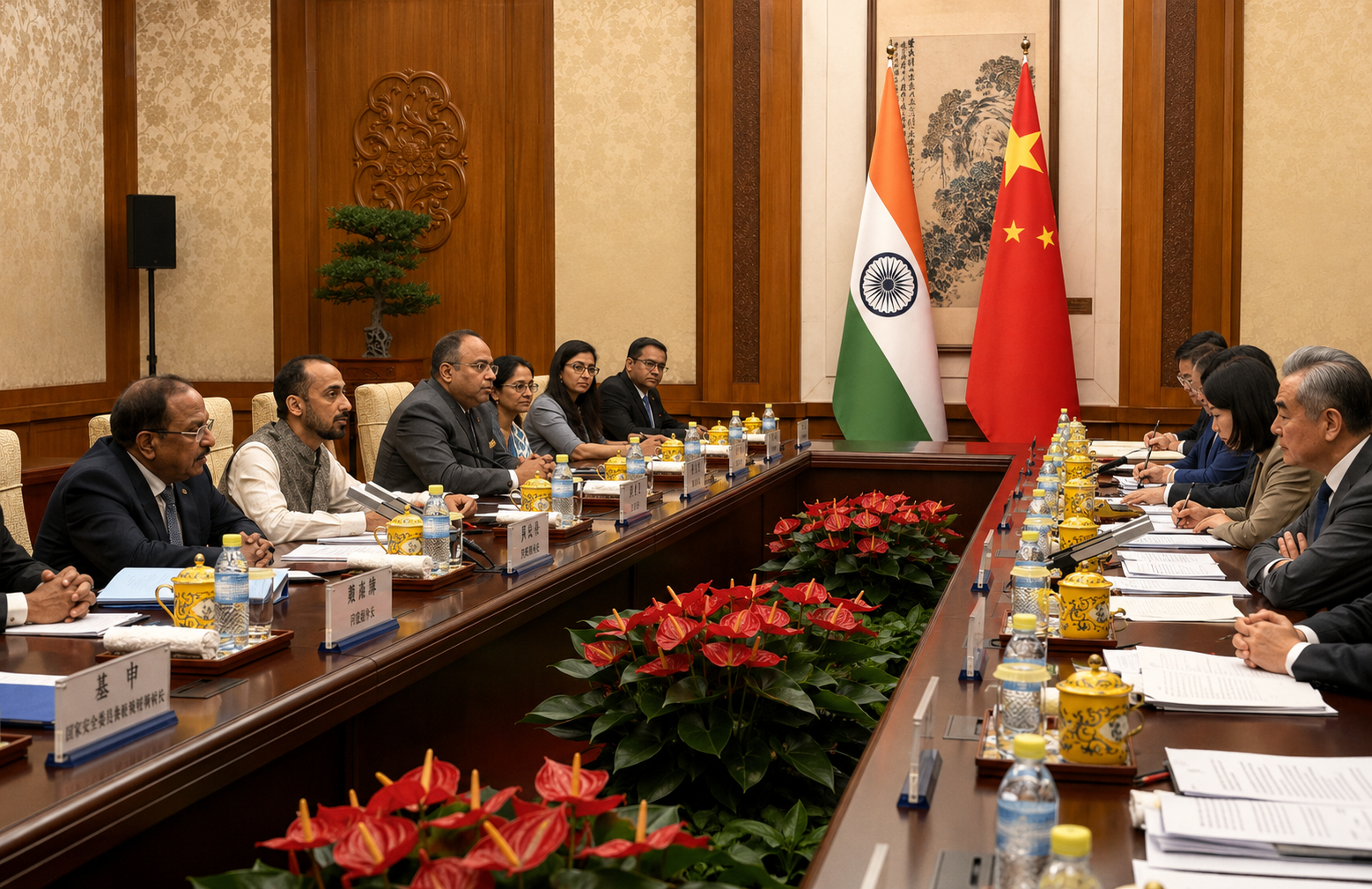
National Security Advisor Ajit Doval (left, second from foreground) leads the Indian delegation during talks with Chinese Foreign Minister and Special Representative Wang Yi (right, second from foreground) at the 25th round of India-China Special Representatives’ talks on the boundary question in Beijing on Tuesday, August 25, 2026. The two sides discussed boundary delimitation, border management and maintaining peace and tranquillity along the frontier. (Photo: Official/Chinese Foreign Ministry)
25th Special Representatives’ talks focus on boundary delimitation, border management and restoring stability in ties; next round to be held in India in 2027
Key Factors
- Ajit Doval and Wang Yi hold 25th round of Special Representatives’ talks in Beijing
- Both sides discuss advancing boundary delimitation negotiations and strengthening border management
- India and China reaffirm commitment to the 2005 Political Parameters and Guiding Principles
- Doval says normalisation of relations is directly linked to peace and tranquillity along the border
- Wang urges both countries to move forward “without stagnating, backtracking or veering off course”
- Talks also cover bilateral cooperation, cross-border mechanisms and regional and international issues
- 26th round of Special Representatives’ talks agreed to be held in India in 2027
Beijing: India and China moved to give fresh momentum to efforts to address their long-running boundary dispute on Tuesday, with National Security Advisor Ajit Doval and Chinese Foreign Minister Wang Yi holding extensive talks in Beijing on boundary delimitation, border management and the broader normalisation of bilateral relations.
The meeting marked the 25th round of Special Representatives’ talks on the India-China Boundary Question, the principal high-level mechanism through which the two countries seek a negotiated settlement of their disputed frontier. China’s Foreign Ministry confirmed after the meeting that the two sides held in-depth discussions on advancing boundary delimitation negotiations, strengthening border management, improving institutional mechanisms and promoting cross-border cooperation.
The significance of the discussions lies in the renewed attention being given to the boundary question after years in which tensions along the Line of Actual Control severely strained bilateral relations.
Doval emphasised the link between stability at the border and the wider relationship, saying the improvement witnessed in bilateral ties had been made possible by maintaining peace and tranquillity in the border areas.
“The normalcy we have witnessed in our relationship has been a direct result of both sides maintaining peace and tranquillity in the border areas,” Doval said.
He said the two sides had extensively discussed ways to reinforce and consolidate their efforts to preserve peace along the border.
China’s official account said Doval described India and China as partners rather than competitors and stressed that a stable, predictable and forward-looking relationship was in the interests of the two countries as well as Asia and the wider world.
Boundary Settlement Back in Focus
A potentially important element of the talks was the discussion on advancing boundary delimitation negotiations. Neither side, however, publicly identified particular sectors of the Line of Actual Control that might be taken up first.
Both sides reaffirmed their commitment to the 2005 Political Parameters and Guiding Principles and agreed to continue using the Special Representatives’ mechanism to pursue what China’s official statement described as a fair, reasonable and mutually acceptable package settlement of the boundary question.
Wang Yi, a member of the Communist Party of China Politburo and China’s Special Representative on the boundary question, called for the dispute to be handled without allowing it to derail the broader relationship.
China and India should “keep moving forward without stagnating, backtracking or veering off course,” Wang said.
He argued that the boundary question should be placed appropriately within the overall bilateral relationship and called for dialogue, peace, consultation and cooperation to become the dominant features of India-China boundary affairs.
The Chinese side said agreements reached through the Special Representatives’ mechanism were being implemented in an orderly manner, institutional exchanges and cooperation between the two countries were gradually resuming, and both sides remained committed to maintaining peace and tranquillity in the border areas.
Doval’s Beijing engagements extended beyond the talks with Wang. Earlier on Tuesday, he met Chinese Vice-President Han Zheng, who called on the two countries to increase strategic mutual trust, expand cooperation and appropriately manage differences. The Chinese account said Doval conveyed India’s willingness to deepen mutually beneficial cooperation while properly handling the boundary question.
The talks come as New Delhi and Beijing continue efforts to stabilise a relationship severely disrupted by the military confrontation along the LAC beginning in 2020.
Wang said the India-China relationship had significance beyond the two countries and called for the two Asian powers to become good neighbours and mutually beneficial partners, invoking Beijing’s formulation of a “Dragon-Elephant Dance.”
The two sides also exchanged views on international and regional issues and agreed that the 26th round of Special Representatives’ talks will be held in India in 2027.
The Beijing meeting does not by itself signal a settlement of the boundary dispute, and no detailed delimitation roadmap was publicly announced. It does, however, indicate that both sides are again using their highest-level boundary mechanism not merely to manage immediate tensions but to explore movement towards the unresolved boundary question itself.

YOU MAY LIKE THIS