Reg No. - CHHBIL/2010/41479ISSN - 2582-919X

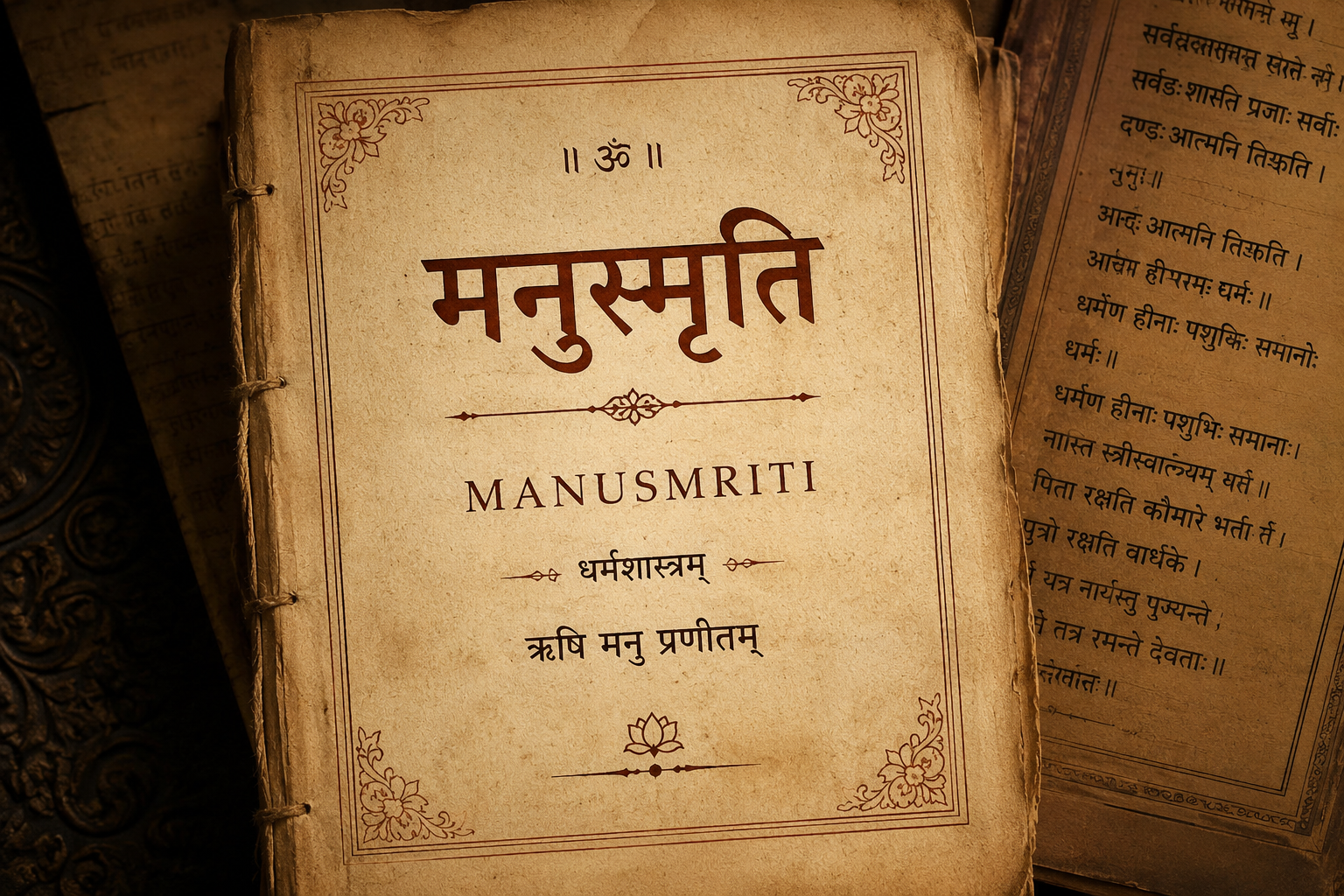
Manusmriti in the Contemporary Context: Women, Autonomy, Dignity and the Problem of Interpretation-By-Kumar Bahukhandi
About the Author: Kumar Bahukhandi is an Assistant Professor in the Department of Journalism and Mass Communication at Pragati College, Raipur, Chhattisgarh, and a working journalist.
Abstract
Manusmriti, or the Mānava-Dharmaśāstra, remains among the most discussed, defended and criticised texts associated with the ancient Indian normative tradition. Its prescriptions concerning women are particularly contested.
One frequently cited passage, Manusmriti 9.3, places a woman under the protection of her father, husband and sons at different stages of life and concludes with the expression “na strī svātantryam arhati”. Read through contemporary concepts of individual autonomy, this formulation appears fundamentally restrictive. Yet other passages within the same text, particularly Manusmriti 3.55–3.57, emphasise the honour, respect and wellbeing of women, including the celebrated declaration “yatra nāryastu pūjyante ramante tatra devatāḥ” — where women are honoured, there the gods rejoice (Manusmriti 3.56; Olivelle, 2005).
This paper examines this apparent tension without attempting either an uncritical defence or a wholesale rejection of the text. It argues that respect, protection and autonomy represent different normative concepts and that the high status rhetorically accorded to women in parts of the text does not automatically establish individual agency in the modern sense. Conversely, restrictive prescriptions should not be employed to erase passages that accord women honour and significance.
The paper also examines the widely circulated Sanskrit verse beginning “Kāryeṣu mantrī karaṇeṣu dāsī”, while cautioning that its attribution to Manusmriti is uncertain. The study proposes that ancient normative texts should be subjected to contextual, textual and comparative analysis before being employed in contemporary political or social argument.
Keywords: Manusmriti, women, autonomy, gender, Sanskrit texts, Dharmaśāstra, Indian tradition, constitutional equality, women’s dignity, textual interpretation
1. Introduction
Few ancient Indian texts generate as much contemporary controversy as Manusmriti. Discussions surrounding it frequently move between two sharply opposed positions.
One treats the text as representative of ancient civilisational wisdom whose prescriptions must be understood in their historical setting. The other regards several of its social and gender prescriptions as evidence of hierarchical structures incompatible with contemporary ideas of equality.
The position of women is at the centre of this debate.
The difficulty begins when individual verses are detached from the larger text and made to represent Manusmriti in its entirety.
This is problematic whether the selected verse is favourable or restrictive.
A verse commanding society to honour women cannot by itself establish that Manusmriti recognised female autonomy in the modern sense. Equally, a verse restricting women’s independence cannot, without further textual examination, establish that the entire work regarded women merely with hostility.
The central research question of this paper is therefore:
How should the apparently different conceptions of women’s protection, dependence, honour and social importance in Manusmriti be understood when the text is examined in the contemporary context of autonomy and constitutional equality?
The purpose is neither to put an ancient text on trial according to twenty-first-century standards nor to exempt it from critical examination merely because of its antiquity.
The objective is to read before judging.
2. Manusmriti and the Problem of Historical Context
Manusmriti belongs to the Dharmaśāstra tradition and represents a normative attempt to articulate duties, social relations, conduct, family structures, inheritance, governance and other dimensions of social order (Olivelle, 2005; Davis, 2010).
Understanding it simply as the equivalent of a modern statutory code can therefore be misleading. Scholarship on Dharmaśāstra emphasises the broader relationship among law, religion, household, community, custom and social obligation within the Hindu legal tradition (Davis, 2010).
This distinction between a normative text and a descriptive historical record is fundamental.
A prescription tells us what its authors or transmitters believed ought to occur. It does not necessarily prove that every community throughout ancient India actually lived according to that prescription.
Modern interpretation becomes particularly difficult because terms such as dharma, rakṣā and svātantrya carry intellectual and social associations that cannot always be transferred mechanically into contemporary English expressions such as religion, protection and independence.
Translation is therefore already an act of interpretation.
This becomes especially important in the discussion of women.
3. The Contested Proposition: “Na Strī Svātantryam Arhati”
Among the passages most frequently cited in contemporary debates is Manusmriti 9.3:
पिता रक्षति कौमारे भर्ता रक्षति यौवने।
रक्षन्ति स्थविरे पुत्रा न स्त्री स्वातन्त्र्यमर्हति॥
Pitā rakṣati kaumāre bhartā rakṣati yauvane,
Rakṣanti sthavire putrā na strī svātantryam arhati.
Broadly translated:
The father protects her in childhood, the husband protects her in youth, and the sons protect her in old age; a woman is not considered fit for independence.
(Manusmriti 9.3; Olivelle, 2005; Jha, 1999).
The final expression—
न स्त्री स्वातन्त्र्यमर्हति
na strī svātantryam arhati
—creates the greatest difficulty for a contemporary reader.
Viewed through twenty-first-century concepts of individual liberty, the proposition conflicts with the principle that an adult woman possesses agency independently of her father, husband or sons.
Yet the preceding verb also requires attention:
रक्षति — rakṣati.
Its semantic field includes guarding, protecting or preserving. The verse therefore conceptualises male family members as bearing responsibility for a woman’s protection at different stages of life.
But this does not eliminate the central problem.
Protection and autonomy are not synonymous.
A social system may sincerely consider itself protective while simultaneously limiting the independence of the person being protected.
Consequently, recognising the protective dimension of rakṣati does not make the restriction upon svātantrya disappear.
This distinction is crucial to a balanced interpretation.
4. Honour and the Divine: A Different Voice Within the Text
Another celebrated passage presents a different dimension of the text’s conception of women.
Manusmriti 3.56 states:
यत्र नार्यस्तु पूज्यन्ते रमन्ते तत्र देवताः।
यत्रैतास्तु न पूज्यन्ते सर्वास्तत्राफलाः क्रियाः॥
Yatra nāryastu pūjyante ramante tatra devatāḥ,
Yatraitāstu na pūjyante sarvāstatrāphalāḥ kriyāḥ.
Broadly:
Where women are honoured, there the gods rejoice; where they are not honoured, all acts become fruitless.
(Manusmriti 3.56; Olivelle, 2005; Jha, 1999).
The importance attributed to women here is unmistakable.
The verse does not merely recommend courtesy. It connects the treatment of women with the moral and religious wellbeing of the household. The surrounding passages, particularly Manusmriti 3.55–3.57, reinforce the association between women’s honour and familial wellbeing (Olivelle, 2005).
This creates one of the central interpretative problems addressed by this paper.
How can a text that restricts women’s independence in one context simultaneously insist upon their honour in another?
The answer may lie in recognising that honour and autonomy belong to different conceptual categories.
5. Honour Is Not Necessarily Autonomy
A woman can occupy an honoured position within a social system without possessing the degree of individual independence recognised in a modern constitutional order.
Traditional Hindu jurisprudence placed substantial emphasis upon household and familial relationships as locations of normative obligation, rather than treating law exclusively as commands emanating from the state (Davis, 2010).
Within such a structure, a woman could simultaneously be considered worthy of protection, indispensable to household prosperity and deserving of honour while remaining subject to prescribed familial relationships.
Thus:
यत्र नार्यस्तु पूज्यन्ते — “where women are honoured”
does not logically cancel:
न स्त्री स्वातन्त्र्यमर्हति — “a woman is not independent.”
Nor does the second expression erase the first.
The two passages instead reveal a conception of womanhood in which high social or moral value could coexist with restricted individual autonomy.
For a modern reader, this distinction is critical.
Contemporary equality demands more than honour.
It requires agency.
6. The Contemporary Constitutional Perspective
Modern India is governed not by Dharmaśāstra prescriptions but by the Constitution and laws enacted within the constitutional framework.
The Constitution transforms the legal foundation of citizenship by recognising women as individual rights-bearing citizens.
Article 14 guarantees equality before the law and equal protection of the laws.
Article 15 prohibits the State from discriminating against citizens on specified grounds including sex.
Article 21 guarantees that no person shall be deprived of life or personal liberty except according to procedure established by law (Constitution of India, Arts. 14, 15 and 21).
Consequently, an adult woman’s legal identity does not derive from her father, husband or son.
In contemporary constitutional terms:
A woman belongs to herself.
This proposition need not be understood as an attack upon family.
Family relationships can involve love, responsibility, protection and mutual dependence. What constitutional equality rejects is the transformation of those relationships into a legal justification for denying adult women agency.
The difference between the ancient and contemporary frameworks therefore lies substantially in the location and conception of authority.
One emphasises relational duties within a family-centred social order.
The other recognises the individual citizen as the bearer of fundamental constitutional rights.
7. “Kāryeṣu Mantrī”: The Ideal Wife in Popular Sanskrit Tradition
Another Sanskrit verse frequently appears in discussions of traditional Indian conceptions of the wife:
कार्येषु मन्त्री करणेषु दासी
भोज्येषु माता शयनेषु रम्भा।
धर्मानुकूला क्षमया धरित्री
भार्या च षाड्गुण्यवतीह दुर्लभा॥
Kāryeṣu mantrī karaṇeṣu dāsī,
Bhojyeṣu mātā śayaneṣu rambhā;
Dharmānukūlā kṣamayā dharitrī,
Bhāryā ca ṣāḍguṇyavatīha durlabhā.
The verse describes an idealised wife through six qualities.
The expression:
कार्येषु मन्त्री — kāryeṣu mantrī
is particularly significant.
Mantrī means a counsellor or adviser. The wife is therefore represented as somebody whose counsel matters in affairs and decisions.
The verse goes on to portray her as devoted in duties, nurturing like a mother in matters of food, an intimate companion, supportive in dharma, and patient like the earth.
It consequently offers a multidimensional representation of the wife rather than one confined entirely to obedience.
At the same time, another expression—
करणेषु दासी — karaṇeṣu dāsī
—employs the image of service.
A contemporary gender analysis cannot simply ignore this because other portions of the verse appear favourable.
Ancient literature should neither be selectively condemned nor selectively sanitised.
A Necessary Textual Caution
Despite its widespread circulation, the precise textual provenance and authorship of the “Kāryeṣu Mantrī” verse have not been established here with sufficient certainty to attribute it to Manusmriti.
It is therefore included in this paper only as an example of a widely circulated Sanskrit formulation concerning the ideal wife.
It is not used as primary textual evidence for the position of Manusmriti.
This distinction demonstrates a larger methodological principle: textual verification should precede attribution and interpretation.
8. Respect, Protection and Agency: Three Different Concepts
Much of the contemporary argument surrounding women in ancient texts becomes confused because three concepts are treated as though they were interchangeable:
Respect. Protection. Agency.
They are not.
Respect concerns the value and dignity accorded to a person.
Protection concerns responsibility for another person’s safety or welfare.
Agency concerns that person’s ability to make decisions and exercise autonomy.
A social system can provide the first two while restricting the third.
This conceptual distinction helps explain how apparently conflicting passages can coexist within a single normative framework.
The important scholarly question is consequently not simply:
“Did Manusmriti respect women?”
Nor is it adequately answered by asking:
“Did Manusmriti restrict women?”
A more productive inquiry is:
What conception of women’s social position emerges when its prescriptions concerning honour, protection, duties, dependence and agency are examined together?
9. The Danger of Selective Quotation
Selective quotation presents perhaps the greatest obstacle to serious discussion of ancient texts.
Those wishing to defend Manusmriti may quote:
यत्र नार्यस्तु पूज्यन्ते रमन्ते तत्र देवताः।
(Manusmriti 3.56).
Those wishing to condemn it may quote:
न स्त्री स्वातन्त्र्यमर्हति।
(Manusmriti 9.3).
Both quotations are relevant.
Neither quotation is the whole text.
The intellectual error begins when either fragment is made to carry a conclusion larger than the textual evidence permits.
A responsible interpretation must therefore consider the textual setting of individual verses, the meaning of Sanskrit terminology, the normative purpose of the work, its historical context and the difference between ancient social structures and contemporary constitutional principles (Olivelle, 2005; Davis, 2010).
This does not mean that objectionable prescriptions should escape criticism.
Contextualisation is not exoneration.
Likewise, criticism should not require the suppression of textual evidence that complicates the argument.
Scholarship begins precisely where such complications are allowed to remain visible.
10. Can Ancient Texts Be Judged by Modern Standards?
This question requires a distinction between historical understanding and contemporary application.
It would be historically simplistic to assume that the political, social and legal vocabulary of twenty-first-century constitutional democracy existed unchanged in ancient society.
But it would be equally problematic to argue that antiquity places a prescription permanently beyond moral examination.
Ancient texts can be studied historically while their prescriptions are simultaneously evaluated from contemporary ethical and constitutional perspectives.
The two exercises should not be confused.
Historical inquiry asks:
What did this prescription mean within the society and intellectual tradition in which it developed?
Contemporary normative inquiry asks:
Should such a prescription govern human relationships today?
The answer to the second question does not have to determine the answer to the first.
11. Manusmriti in Today’s India
The continuing controversy surrounding Manusmriti demonstrates that ancient texts remain part of India’s living intellectual and political discourse.
But modern India does not need to choose between two extremes: treating every ancient prescription as eternally binding or dismissing an entire intellectual tradition because portions of its normative literature conflict with contemporary values.
A mature engagement permits discrimination between ideas.
A prescription inconsistent with equality can be rejected.
A philosophical or ethical insight that retains value can be studied.
A historically significant text can be criticised without being caricatured.
And cultural inheritance can be respected without being placed beyond examination.
This approach is particularly necessary when discussing women.
Modern constitutional equality establishes a standard substantially different from the paternalistic social structures reflected in many ancient societies.
Honouring women is important.
Protecting women from violence and exploitation is important.
But neither can substitute for women’s agency.
The contemporary principle must therefore be:
Respect without control.
Protection without possession.
Family without subordination.
Equality with autonomy.
12. Discussion
The textual evidence examined here suggests that reducing Manusmriti either to a manifesto against women or to an uncomplicated celebration of women produces an inadequate interpretation.
The passages reveal a more complex normative structure.
Women could be accorded considerable moral and familial significance while their independence remained constrained within a patriarchal organisation of social responsibility.
This need not appear internally contradictory when understood within a social framework organised substantially around household, family, duty and status. Scholarship on Hindu jurisprudence demonstrates the importance of precisely these social locations and relationships in understanding Dharmaśāstra (Davis, 2010).
It becomes far more difficult when such prescriptions are transferred unchanged into a modern constitutional framework in which dignity and equality are associated with individual agency.
The central lesson is therefore methodological as much as social.
Ancient texts require contextual reading.
Translations require scrutiny.
Popularly attributed verses require textual verification.
And contemporary political or ideological arguments should distinguish between what a text actually states and what later traditions claim on its behalf.
13. Conclusion
Manusmriti cannot meaningfully be understood through one celebrated verse or one controversial expression.
“न स्त्री स्वातन्त्र्यमर्हति” raises a serious problem when examined through contemporary principles of female autonomy.
“यत्र नार्यस्तु पूज्यन्ते रमन्ते तत्र देवताः” demonstrates that the same text also assigns profound importance to honouring women.
Neither should be hidden.
Nor should one be employed to erase the other.
The widely circulated “कार्येषु मन्त्री” verse adds another dimension to traditional representations of womanhood by imagining the wife as counsellor, caregiver and companion, while simultaneously employing language of service. Its uncertain provenance, however, makes careful attribution essential.
The contemporary constitutional position moves beyond these ancient formulations.
A woman need not be honoured because divine favour depends upon it.
Nor should she be protected because she is presumed incapable of independence.
She deserves dignity because she is a human being and equality because she is an equal citizen.
This does not make the study of Manusmriti irrelevant.
It makes careful study more important.
Ancient texts need neither blind reverence nor reflexive rejection. They require historical understanding, textual honesty and the intellectual confidence to distinguish between what belongs to the past and what continues to illuminate the present.
Before defending Manusmriti or condemning Manusmriti, the first scholarly obligation remains the simplest: read it.
References
Davis, Donald R., Jr. (2010). The Spirit of Hindu Law. Cambridge: Cambridge University Press.
Government of India. The Constitution of India. Articles 14, 15 and 21. Legislative Department, Ministry of Law and Justice.
Jha, Ganganath (ed. and trans.). (1999). Manusmṛti with the “Manubhāṣya” of Medhātithi. 2nd ed. Delhi: Motilal Banarsidass. Originally published by the University of Calcutta, 1920–1939.
Lingat, Robert. (1973). The Classical Law of India. Translated by J. Duncan M. Derrett. Berkeley: University of California Press.
Olivelle, Patrick (ed. and trans.). (2005). Manu’s Code of Law: A Critical Edition and Translation of the Mānava-Dharmaśāstra. New Delhi: Oxford University Press.

YOU MAY LIKE THIS