Reg No. - CHHBIL/2010/41479ISSN - 2582-919X

When Dissent Becomes a Veto: The NALSAR–CJI Row Raises Uncomfortable Questions-By-Kumar Bahukhandi (Editorial)
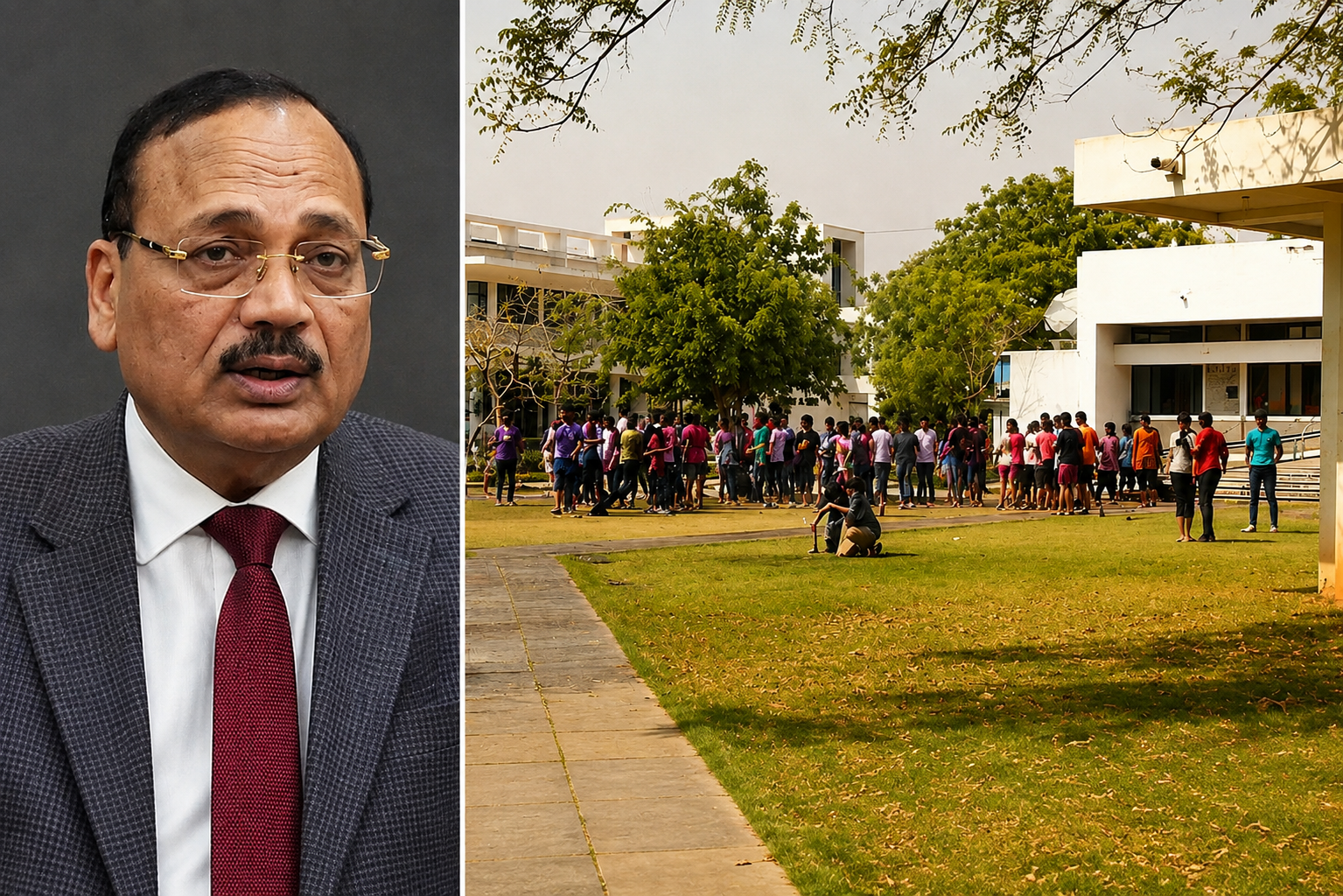
Chief Justice of India Surya Kant and a representational view of students at NALSAR University of Law, Hyderabad. Opposition by a section of the 2026 graduating batch to the CJI’s proposed presence at the convocation, followed by the Bar Council of India’s intervention and subsequent withdrawal of action, has triggered a wider debate over student dissent, institutional authority and the right to be heard. (Photos: File/Representational)
Students have every right to question authority, but does that right extend to deciding who may address a university? The Bar Council’s sweeping response was equally troubling
Universities are supposed to be places where uncomfortable questions are asked. Law universities, perhaps more than most institutions, should encourage students to interrogate authority, challenge established arguments and defend constitutional freedoms.
But the controversy surrounding the proposed presence of Chief Justice of India Surya Kant at the convocation of NALSAR University of Law, Hyderabad, presents a more difficult question: does the right to dissent also confer a right to veto the presence of someone with whom students strongly disagree?
A large section of NALSAR’s outgoing students reportedly urged the university to reconsider inviting the CJI as chief guest. Their objection arose principally from his reported remarks during proceedings concerning allegations of police excesses against protesters in Delhi. Reports said around 450 students communicated their objections to the university authorities.
Their disagreement cannot simply be dismissed.
Students of law have every right to scrutinise judgments, judicial observations and the conduct of constitutional authorities. Indeed, a generation of lawyers unwilling to question power would hardly strengthen Indian democracy.
But there is an important distinction between questioning a constitutional authority and insisting that the authority should not be heard.
That distinction deserves serious consideration.
A Convocation Should Not Become an Ideological Test
The Chief Justice of India is not merely another public speaker. The office represents the head of one of the three principal constitutional institutions of the Republic.
Inviting the CJI to address graduating law students is therefore neither extraordinary nor inherently political. There is, in fact, a history of the CJI delivering convocation addresses at NALSAR.
Students are perfectly entitled to disagree with Justice Surya Kant. They may write an open letter, wear badges, ask difficult questions, organise a peaceful demonstration or publicly explain why they consider particular judicial observations objectionable.
That is democracy.
But asking that a speaker be kept away because his views or judicial conduct are considered unacceptable creates another problem.
If every university begins determining its guest list according to whether every significant section of students approves of a speaker’s views, campuses risk becoming intellectually comfortable spaces rather than intellectually challenging ones.
A university should expose students to people they admire and people they profoundly disagree with.
The better response to an uncomfortable speaker is often not an empty chair but a stronger argument.
But the Bar Council Went Too Far
The Bar Council of India’s initial reaction was, in its own way, equally difficult to defend.
The BCI chairman initially directed State Bar Councils not to enrol any student graduating from NALSAR in 2026 until further orders and sought a factual report identifying those principally involved in organising or mobilising the campaign.
That amounted to potentially placing the professional futures of an entire graduating batch in jeopardy over a controversy in which many students may have played no role whatsoever.
Collective punishment cannot be the answer to collective protest.
The BCI itself subsequently recognised the problem. It withdrew the blanket restriction, saying in effect that students who were not at fault should not suffer, allowing graduates to proceed with enrolment.
Later, the BCI chairman reportedly decided to close the proceedings altogether.
That reversal was sensible.
A student cannot lose the opportunity to enter the legal profession merely because he or she belongs to the same graduating batch as students who organised a protest. Professional eligibility must rest upon law and individual conduct, not guilt by association.
Is Opposition Becoming the Default Response?
There is, however, a wider question that should not be avoided merely because it is politically uncomfortable.
Indian public life increasingly appears to operate through instant camps: support or boycott, invite or cancel, nationalist or anti-national, establishment or resistance.
Almost every institutional decision is rapidly interpreted through a political lens.
A visitor from Delhi becomes a representative of “Delhi”. A constitutional office-holder becomes indistinguishable from the government of the day. An academic disagreement becomes a political confrontation.
That tendency is unhealthy regardless of which ideological side practises it.
The Chief Justice of India is not the Union Government. The Supreme Court is not Parliament. A judge may deliver decisions or make observations that students, lawyers, journalists and citizens strongly criticise — but disagreement with a judge should not automatically transform the judge into a political representative of New Delhi.
The independence of the judiciary demands something more sophisticated from citizens: criticise judges when criticism is warranted, but do not collapse the distinction between the judiciary and the executive.
Law Students Carry an Additional Responsibility
There is another reason why this controversy matters.
These are not merely university students. They are future advocates, judges, academics and perhaps lawmakers.
The profession they are preparing to enter is built upon disagreement.
Every courtroom contains opposing arguments. A lawyer cannot demand the exclusion of the opposing counsel because his argument is offensive. Nor can a judge refuse to hear an advocate simply because that advocate has previously criticised a judicial decision.
The discipline of law teaches something democracy desperately needs: the ability to disagree without denying the other side a hearing.
NALSAR students therefore had the right to protest the proposed invitation.
But there was another possible response that might have demonstrated even greater intellectual confidence: invite the Chief Justice, hear him, question his ideas afterwards, peacefully register disagreement and allow the country to judge both sides.
That would not have diminished the students’ protest.
It might have strengthened it.
Dissent Must Remain Free — and Tolerant
There are lessons for both sides.
Students must retain their freedom to criticise even the highest constitutional authorities without fearing that their careers will be destroyed.
Regulatory institutions, meanwhile, must resist using disproportionate professional sanctions in response to campus dissent.
But students defending freedom of expression should also remember that freedom becomes meaningful when it extends to voices they do not particularly want to hear.
Democracy cannot operate on the principle that “I have the right to speak, but you should not be invited to speak.”
Nor can authority respond with: “If you protest against me, your professional future will suffer.”
Both impulses lead to the same destination — intolerance, exercised from opposite directions.
The NALSAR controversy therefore should not become another contest over who “won”: the students or the Bar Council.
It should instead remind India’s universities, regulators and constitutional institutions of something more fundamental.
The strength of democracy is not measured by how loudly we can oppose one another. It is measured by whether, after disagreeing profoundly, we are still prepared to hear one another.

YOU MAY LIKE THIS