Reg No. - CHHBIL/2010/41479ISSN - 2582-919X

From Traditional Farming to Prosperity: How Scientific Cucumber Cultivation Transformed a Tribal Farmer’s Life-By- Dhananjay Rathore
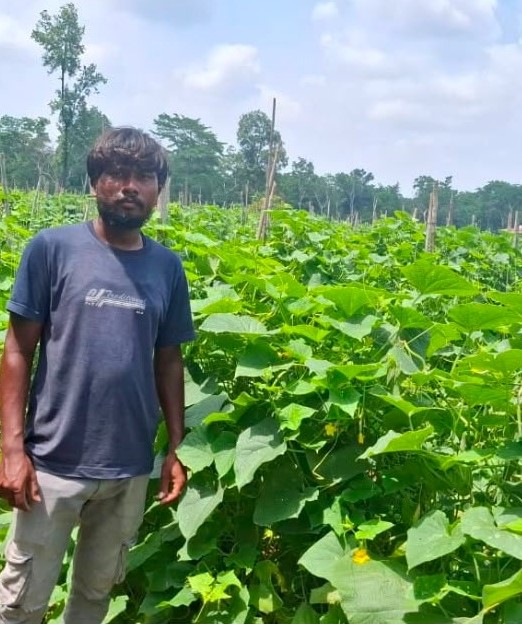
rom Traditional Farming to Prosperity: Khimanshu Gajesing, a farmer from the Particularly Vulnerable Tribal Group (PVTG) Kamar community in Dhamtari district, stands proudly in his four-acre cucumber farm, where scientific cultivation and government support have transformed his livelihood into a profitable enterprise-Photo Credit-channel24india.com via CG/PR
Government Support and Modern Horticulture Techniques Help a Kamar Farmer Build a Profitable Future
Raipur: The story of Khimanshu Gajesing, a farmer from the Particularly Vulnerable Tribal Group (PVTG) Kamar community in Chhattisgarh’s Dhamtari district, demonstrates how scientific farming, coupled with timely government support, can transform agriculture into a sustainable and rewarding enterprise.
Hailing from Selbahara village in Nagri block, Gajesing has emerged as an inspiration for fellow farmers by successfully adopting commercial cucumber cultivation with technical guidance from the state’s Horticulture Department. His remarkable progress highlights the growing impact of modern agricultural practices on rural livelihoods.
Turning Four Acres into a Success Story
Owning a total of ten acres of farmland, Gajesing devoted four acres to commercial cucumber cultivation this season. Rather than relying on traditional farming methods, he embraced scientific cultivation techniques promoted by horticulture experts.
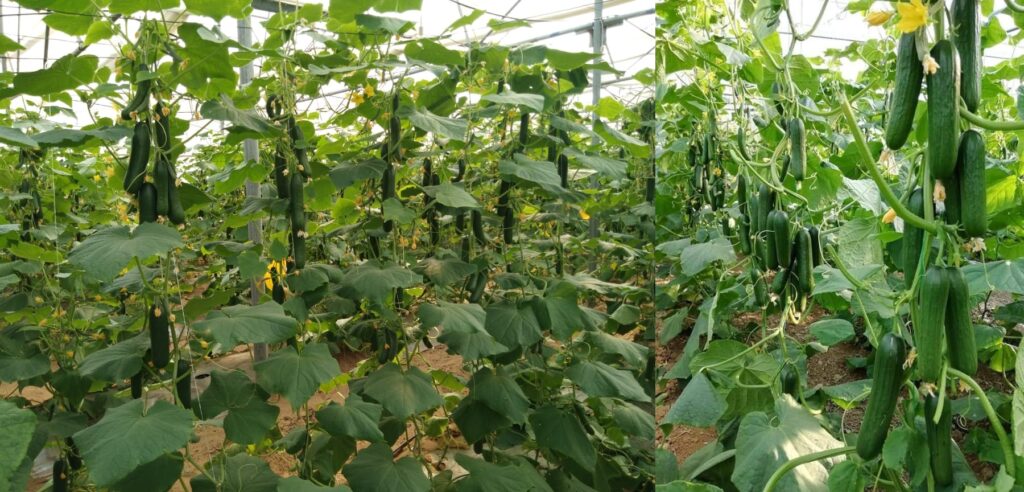
Scientific farming bears fruit: Healthy cucumbers grown using the trellis cultivation method showcase the higher quality, better yield and improved market value achieved through modern horticultural practices adopted by Kamar farmer Khimanshu Gajesing-Photo Credit -channel24india.com via CG/PR
With continuous support from departmental officers, he adopted high-quality seed varieties, balanced nutrient management, modern irrigation systems, crop protection measures, and trellis-based cultivation—a method in which cucumber vines are trained to grow vertically on wires and support structures instead of spreading across the ground.
This approach significantly improves fruit quality by preventing contact with the soil, reducing spoilage, and producing cucumbers with a more attractive appearance, better colour and superior market value.
A Harvest that Delivers Quick Returns
Commercial cucumber farming is recognised as one of the most profitable short-duration horticultural ventures. The crop begins yielding within 45 to 50 days of sowing, enabling farmers to generate income quickly.
The trellis system not only enhances fruit quality but also increases productivity, with yields ranging between 30 and 45 quintals per acre under proper management. Such high productivity has made cucumber cultivation an increasingly attractive option for farmers seeking higher returns from limited land.
From Struggle to Financial Stability
Until recently, Gajesing followed conventional farming methods that generated only modest returns. Recovering production costs was often difficult, leaving little scope for improving his family’s financial condition.
The transition to scientific farming has completely altered that picture. Improved crop quality and higher yields have created strong demand for his produce in local as well as neighbouring markets. Better prices have translated into significantly higher earnings, strengthening his family’s economic security and improving their standard of living.
His success demonstrates that adopting modern agricultural practices can substantially increase farm profitability without expanding landholdings.
Looking Beyond One Crop
Encouraged by the results, Gajesing now plans to diversify into other horticultural crops while continuing to expand the use of advanced farming techniques.
Reflecting on his journey, he credits the Horticulture Department for changing his outlook towards agriculture.
“The technical guidance and government support gave me the confidence to adopt scientific farming. This success has encouraged me to explore new horticultural crops and further improve my productivity through modern agricultural practices,” he said.
Empowering Farmers Through Innovation
The Chhattisgarh Horticulture Department continues to promote scientific cultivation methods, improved technologies and government schemes aimed at enhancing farmers’ incomes and making agriculture more resilient and profitable.
Khimanshu Gajesing’s journey is a compelling example of how innovation, expert guidance and effective implementation of government initiatives can empower tribal farmers, improve rural livelihoods and demonstrate that agriculture, when practised scientifically, can become a thriving and sustainable business rather than merely a means of subsistence.
The author is Joint Director, Department of Public Relations, Government of Chhattisgarh, Raipur.

YOU MAY LIKE THIS