Reg No. - CHHBIL/2010/41479ISSN - 2582-919X

Consumers to continue receiving rebate benefits under the Chief Minister’s Energy Relief Scheme in Chhattisgarh -CGSERC
Representational Image -Credit Instagram
In Short
Electricity in Chhattisgarh remains cheaper compared to Madhya Pradesh, Maharashtra, and Jharkhand
Electricity tariff rates have seen a marginal increase, accounting for rising inflation and the increased costs of coal, power generation, and supply over recent years
Raipur: The Chhattisgarh State Electricity Regulatory Commission (CGSERC) has on Monday June 15, 2026 announced new electricity rates for the financial year 2026-27. These new rates will come into effect on July 1, 2026. The Commission has raised electricity charges by an average of 6.23 percent.
The Commission states that this marginal increase is necessary and justified, considering rising inflation, the costs of coal, generation, and supply, as well as the need to recover losses from previous years.
For domestic consumers, electricity rates have been increased by an average of 30 paise per unit. However, depending on consumption slabs, this hike will range from 30 to 50 paise per unit.
The increase is set at 30 paise per unit for consumers using up to 200 units, 40 paise per unit for those consuming between 201 and 600 units, and 50 paise per unit for consumption exceeding 600 units.
The actual impact of the tariff hike on lakhs of families in the state will be around 15 to 20 paise per unit. While revising the tariffs, the Commission has kept the interests of the general public and low-income groups in mind.
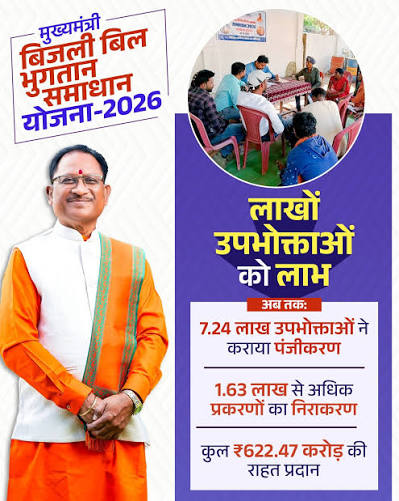
Under the government’s Chief Minister’s Energy Relief Scheme, consumers using up to 400 units of electricity receive the benefit of paying only half the bill for the first 200 units consumed. Consequently, the actual additional financial burden on a large number of low- and middle-income families will remain relatively low.
It is estimated that the impact on these consumers’ bills will average only about 15 to 20 paise per unit.
Similarly, many consumers who previously used between 201 and 600 units of electricity are now bringing their grid-based consumption down to within 400 units by installing rooftop solar plants under the PM Surya Ghar Yojana. The impact of the hike is likely to be minimal for such consumers as well.
Electricity rates for non-domestic category consumers have been increased by an average of 20 to 40 paise per unit.
Meanwhile, a hike of 40 paise per unit has been announced for agricultural pumps. However, farmers will not face the direct impact of this increase due to the subsidy provided by the state government.
Electricity charges have also been revised for High Tension (HT) industrial consumers. In the 220 kV and 132 kV categories, energy charges have been raised by 30 paise per unit and demand charges by ₹25 per kVA.
A hike of 40 paise per unit will apply to the 33 kV category, and 30 paise per unit to the 11 kV category.
Certain special concessions have also been introduced under the new tariff structure.
Hostels located in the Tribal Development Authority areas of the Bastar and Sarguja regions have been granted relief by being reclassified from the commercial category to the domestic category.
Additionally, the system for delayed payment surcharges has been simplified in the interest of consumers; extra charges will now be levied solely based on the actual duration of the delay.
Consumers in the domestic and non-domestic categories with a connected load exceeding 10 kW will also receive a rebate of 20 paise per unit for electricity consumption during off-peak hours.
According to the Commission, despite the revised rates, electricity charges in Chhattisgarh remain lower than those in neighboring states like Madhya Pradesh, Maharashtra, and Jharkhand. Consequently, electricity rates for consumers and industries in the state will remain competitive.
Overall, while there has been an increase in electricity rates, the impact on average domestic consumers will be relatively limited due to relief schemes, subsidies, and policies promoting solar energy,

YOU MAY LIKE THIS