Reg No. - CHHBIL/2010/41479ISSN - 2582-919X

Major Decisions in Chhattisgarh: Preparation of UCC Draft, 50% Rebate for Women on Property Registration
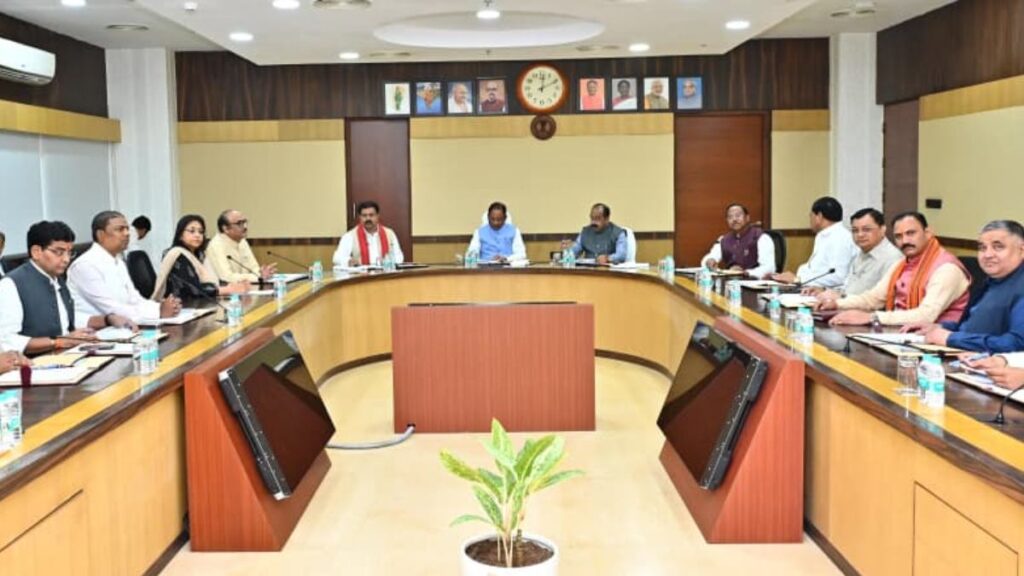
Raipur: Several significant decisions were taken today on Wednesday April 15, 2026 during the meeting of the Council of Ministers, held at the Mantralaya (Mahanadi Bhawan) under the chairmanship of Chief Minister Vishnu Deo Sai.
Taking a major step towards implementing the Uniform Civil Code (UCC) in Chhattisgarh, the Cabinet decided to constitute a committee—headed by retired Justice Ranjana Prakash Desai—to draft the framework for the same. The committee will prepare the draft after soliciting suggestions from citizens, organisations, and experts.
Key Decisions Taken During the Cabinet Meeting:
- The Council of Ministers decided to constitute a committee, chaired by retired Justice Ranjana Prakash Desai, to draft the Uniform Civil Code for its implementation in Chhattisgarh. Furthermore, the Chief Minister was authorised to nominate the members of this committee.
Currently, various personal laws—specific to different religions—govern disputes related to marriage, divorce, inheritance, adoption, maintenance, and family matters in Chhattisgarh. Under Article 44 of the Indian Constitution, the State is directed to implement a Uniform Civil Code for all its citizens.
The existence of disparate laws creates inequalities within the legal framework, thereby complicating the judicial process. Consequently, implementing a Uniform Civil Code is deemed essential to render the law simple, uniform, and equitable—a move that will also foster religious and gender equality.
In furtherance of this objective, a decision has been taken to constitute a high-level committee in Chhattisgarh, which will formulate the draft of the Uniform Civil Code after gathering comprehensive suggestions from the state’s citizens, organisations, and experts.
The committee may also invite feedback through a dedicated web portal. Based on the committee’s recommendations, the prepared draft will be presented before the Legislative Assembly—following its approval by the Council of Ministers in accordance with due legal procedure—with the aim of establishing a uniform and transparent civil legal system within the state.
- The Council of Ministers took a significant decision in the interest of women, resolving to reduce the registration fee applicable to land registered in women’s names by 50 percent. The objective of this measure is to encourage women to acquire property and to empower them economically. This decision will result in a revenue shortfall of approximately ₹153 crore for the government; however, it is regarded as a significant step toward women’s empowerment.
- During the Cabinet meeting, a significant decision was taken in the interest of the state’s serving soldiers, ex-servicemen, and their widows. Under this decision, they will be granted a one-time, lifetime exemption of 25 percent on the stamp duty payable for the purchase of property (land/building) worth up to ₹25 lakh within the state of Chhattisgarh. The lives of soldiers dedicated to serving the nation are often characterised by frequent transfers and instability; consequently, when they eventually purchase property for permanent residence, this decision will provide them with much-needed financial relief.
- The Cabinet approved a proposal to amend the Chhattisgarh Industrial Land and Building Management Rules, 2015. This amendment will provide clear statutory eligibility for land allocation to the service sector. It will establish a logical balance regarding the minimum and maximum limits within land allocation provisions. A statutory provision has also been introduced for the construction of approach roads to plots within the Land Bank. The inclusion of financial institutions—including Non-Banking Financial Companies (NBFCs)—will expand the options for credit availability for industries. Furthermore, the provisions regarding changes in shareholding within companies will gain practical clarity, thereby ensuring greater ‘Ease of Doing Business.’ Clear provisions for the Public-Private Partnership (PPP) model will provide a boost to private investment and the development of industrial infrastructure.
- The Cabinet approved amendments to the Chhattisgarh Minor Mineral (Ordinary Sand) (Mining and Trade) Rules, 2025. Under the revised rules, sand mines can now be reserved for Public Sector Undertakings (PSUs) of either the Central or State Government—such as the Chhattisgarh Mineral Development Corporation Limited. This measure is expected to alleviate sand supply crises often caused by monopolistic practices among leaseholders, while simultaneously ensuring the smooth operation of sand mines in remote areas and facilitating the easy availability of sand.
- During the Cabinet meeting, a proposal for comprehensive amendments to the Chhattisgarh Minor Mineral Rules, 2015, was approved. The primary objective of these amendments is to ensure transparency, effective regulation, and revenue growth within the mining sector, as well as to curb illegal mining and simplify administrative procedures. Strict provisions have been introduced regarding minor mineral mines that remain closed or remain dormant without valid justification. The rate of dead rent for these mines has now been revised upwards after a period of 30 years. Stringent provisions regarding the declaration of such mines as ‘lapsed’ have been incorporated into the rules, thereby ensuring that the mandatory operation of these mines is strictly enforced. Strict penalties have been prescribed for the illegal excavation, transportation, or storage of minerals, with a minimum fine fixed at ₹25,000—a sum that may extend up to ₹500,000. In cases involving illegal transportation, specific bail amounts have also been stipulated for the release of seized property. Furthermore, in alignment with the ‘Ease of Doing Business’ initiative, provisions concerning the issuance of Royalty Clearance Certificates are being implemented uniformly across the entire state.
Additionally, provisions such as the amalgamation of mining leases, land entry rights post-contract execution, and mining operations conducted in strict compliance with environmental norms have been strengthened. These measures are expected to facilitate the systematic exploitation of mineral resources and bolster the economic consolidation of the state.
- The Council of Ministers approved amendments to the Pilot Project Scheme regarding the supply of milch animals, specifically to ensure that beneficiaries from all social categories—including Scheduled Tribes—are covered. Additionally, amendments to the relevant clause of the Memorandum of Understanding (MoU) executed with the NDDB were approved. This initiative will enable the extension of benefits to beneficiaries across all social strata, thereby fostering self-employment and income growth, and contributing to the comprehensive social and economic development of the state.
- To ensure the timely availability of essential vaccines for protecting livestock in the state against infectious diseases, the Council of Ministers granted permission to procure vaccines from Indian Immunologicals Limited, Hyderabad—a subsidiary of the National Dairy Development Board (NDDB). Timely vaccine supply had been hindered due to a lack of adequate competition during the tender process and the unavailability of rates on the GeM portal, which was adversely affecting the regular vaccination of livestock. As per this decision, essential vaccines for the financial year 2026-27 (up to January 2027) will be procured from the aforementioned agency; this will ensure the prevention of livestock diseases, a reduction in mortality rates, economic security for livestock farmers, and an increase in the production of milk, eggs, and meat.
- During the meeting of the Council of Ministers, a significant financial proposal was approved. In accordance with the provisions of the Madhya Pradesh Reorganization Act, 2000—and specifically regarding the apportionment of pension liabilities between Chhattisgarh and Madhya Pradesh—consent was granted for the repayment of an excess pension amount of ₹10,536 crore, which had been paid by the Government of Chhattisgarh in previous years. This excess payment resulted from erroneous accounting by banks in the past; the figures have since been reconciled and verified by a joint team. As per the proposal, the Government of Madhya Pradesh has already disbursed a sum of ₹2,000 crore during the financial year 2025-26, while the remaining balance of ₹8,536 crore will be repaid in six equal annual installments over the coming years. Accepting this arrangement, the Council of Ministers has authorized the Finance Department to take the necessary action.
Additionally, during the meeting of the Council of Ministers, the arrangements for fertilisers for the upcoming Kharif season and the status of LPG availability in the state were reviewed.