Reg No. - CHHBIL/2010/41479ISSN - 2582-919X

Will Pradhan Be Odisha’s Next Chief Minister? Datia Win Reshapes Congress Equations
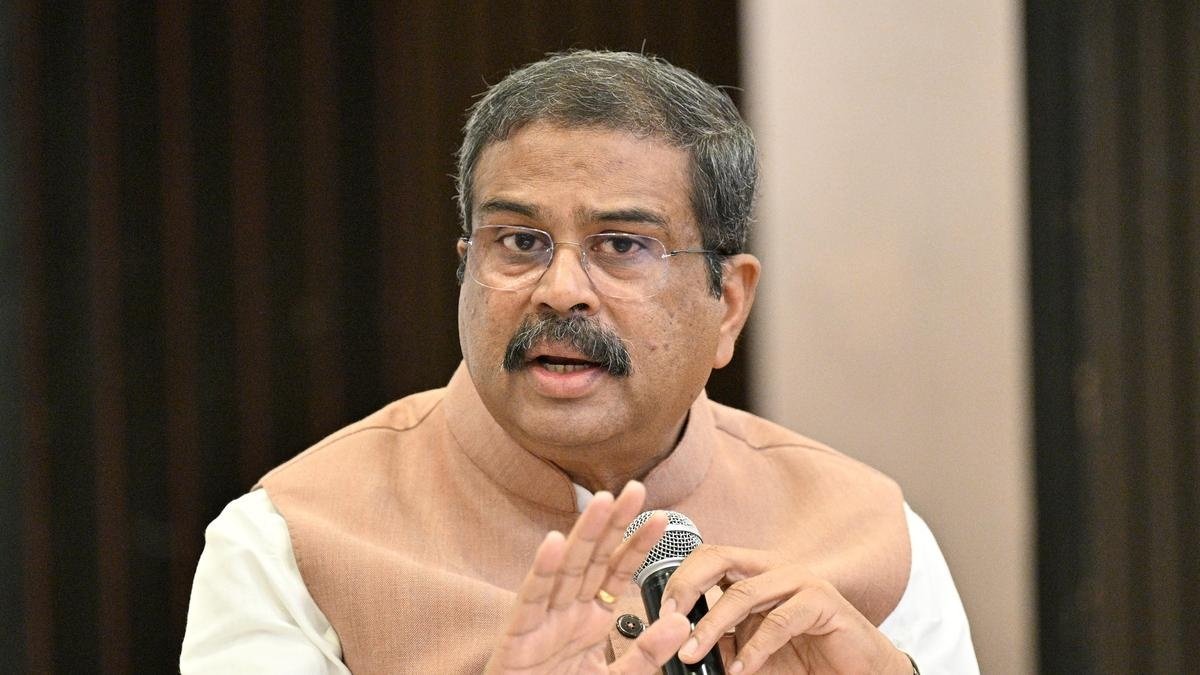
Former Union Education Minister Dharmendra Pradhan. His renewed political outreach in Odisha following his resignation from the Union Cabinet has fuelled speculation over whether the BJP could eventually assign him a larger role in state politics. (File Photo)
Dharmendra Pradhan’s return to Odisha after leaving the Union Cabinet fuels political speculation, while Congress’s Datia bypoll victory gives Jitu Patwari fresh political momentum in Madhya Pradesh
Key Factors
- Dharmendra Pradhan’s Odisha outreach fuels speculation over a possible larger role in state politics
- Former Union minister receives a warm welcome during his journey to Sambalpur
- Pradhan invokes Odia pride and reaches out positively to Gen Z after the NEET controversy
- Amit Shah’s late offer for a parliamentary debate on student protests raises political questions
- Congress’s Datia victory strengthens Jitu Patwari’s position in Madhya Pradesh
- Kamal Nath and Digvijaya Singh could face a changing internal power equation as Patwari gains ground
New Delhi: Former Union Education Minister Dharmendra Pradhan’s political future has become a subject of growing speculation following his resignation from the Union Cabinet amid sustained student protests over the NEET examination paper leak.
The question now circulating in political circles is whether Pradhan could eventually be moved to Odisha and emerge as a possible successor to Chief Minister Mohan Charan Majhi.
Pradhan’s activities immediately after leaving the Union government have added to the speculation. On returning to Odisha, he undertook a road journey to his Lok Sabha constituency of Sambalpur, receiving a warm welcome from BJP workers and supporters along the way.
At a public gathering, Pradhan spoke positively about Gen Z and invoked Odia pride, a theme that played an important role in the BJP’s campaign when it ended the Biju Janata Dal’s long rule in the state.
The reception also suggested that the controversy surrounding his departure from the Union Cabinet has not necessarily diminished his standing among the BJP organisation in his home state.
Pradhan is expected to increase his political engagement across Odisha in the coming period. Any such outreach will inevitably be watched for signs of whether the BJP leadership has a larger organisational or governmental assignment in mind for him.
Pradhan had long been regarded as one of the BJP’s most prominent faces from Odisha and was among the names discussed in political circles when the party came to power in the state. The leadership eventually chose Mohan Charan Majhi, a tribal leader, as Chief Minister.
Whether the political equation has changed sufficiently for the BJP to contemplate another arrangement remains uncertain. There has been no official indication that Majhi is being replaced, and speculation over Pradhan’s future should therefore be treated as political conjecture rather than an impending leadership change.
What is clear, however, is that Pradhan remains an important figure within the BJP despite having relinquished his ministerial position. His next moves in Odisha will consequently attract attention well beyond Sambalpur.
Student Protests, Parliament and the Political Counter-Offensive
The controversy that led to Pradhan’s resignation has also continued to influence national politics.
Union Home Minister Amit Shah offered to respond to a parliamentary debate on the student protests shortly before the Monsoon Session concluded. The Congress-led Opposition, which had earlier pressed for a discussion and demanded answers over the July 20 police action against protesters at Jantar Mantar, did not accept the offer.
The timing itself became politically significant.
By then, student protests in Jharkhand had intensified, with police action against demonstrators creating difficulties for the JMM-Congress government in the state. This potentially gave the BJP an opportunity to turn the Opposition’s criticism back on the Congress by questioning police action in a state governed by its own alliance.
The episode illustrates how quickly an issue originating with students and examination integrity became entangled in the competitive politics between the government and Opposition.
For students, however, the fundamental questions remain considerably more straightforward: examination credibility, accountability and the right to protest peacefully.
Political parties on either side risk losing sight of those concerns when student movements become instruments for scoring points against their opponents.
The developments have also revived another familiar debate in Indian politics — the balance between central party leadership and the autonomy of state governments.
The BJP is frequently accused by its opponents of concentrating important decisions in its national leadership. Chief Ministers and state leaders regularly consult the party’s central leadership over major political and organisational decisions.
Yet the phenomenon is hardly unique to the BJP.
The Congress has historically been associated with a powerful “high command” culture in which chief ministers and state leaders seek the central leadership’s approval for Cabinet formation, political appointments and important organisational decisions.
Recent political developments suggest that the distinction between the two parties on this question may sometimes be narrower than their public rhetoric implies.
The larger issue is institutional: how much autonomy should an elected Chief Minister possess in choosing a government and determining state-level priorities, and how much authority should reside with a national party leadership?
That debate will remain relevant irrespective of which political party occupies power.
Meanwhile, another state has produced a development capable of changing internal political equations — this time within the Congress.
The party’s victory in the Datia Assembly bypoll in Madhya Pradesh has given state Congress president Jitu Patwari a much-needed political boost.
The significance goes beyond a single Assembly constituency.
The Datia result represents the Congress’s first Assembly bypoll victory in Madhya Pradesh since Patwari assumed charge of the state organisation more than two years ago. Having struggled to establish undisputed authority within a party organisation long influenced by powerful senior leaders, Patwari can now point to an electoral success achieved under his leadership.
That could have implications for former Chief Ministers Kamal Nath and Digvijaya Singh.
Both remain important figures in Madhya Pradesh Congress politics and retain influence within sections of the organisation. But a stronger Patwari inevitably alters the internal balance, particularly as the party looks towards its next generation of leadership.
There is also a family dimension to these political equations.
Digvijaya Singh’s son Jaivardhan Singh is a member of the Madhya Pradesh Legislative Assembly, while Kamal Nath’s son Nakul Nath, who won the Chhindwara Lok Sabha constituency in 2019, lost the seat in the 2024 general election.
A rising state Congress president with an electoral victory behind him potentially reduces the space available for politics organised primarily around established regional power centres and political inheritance.
One bypoll victory, of course, does not rewrite the political map of Madhya Pradesh.
But politics often turns on momentum.
For Patwari, Datia provides precisely that.
For Kamal Nath and Digvijaya Singh, it is a reminder that the Congress’s internal generational transition may be gathering pace.
And for Dharmendra Pradhan, developments hundreds of kilometres away underline a similar reality from the opposite side of the political spectrum: leaving one position in Indian politics does not necessarily mean leaving the centre of political attention.
His resignation may have closed a chapter in New Delhi, but his increasingly visible presence in Odisha has opened another question.
Whether that road ultimately leads to the Chief Minister’s office remains to be seen.
For now, Mohan Charan Majhi remains Odisha Chief Minister, and any suggestion of Pradhan replacing him remains speculation rather than an established political move.

YOU MAY LIKE THIS