Reg No. - CHHBIL/2010/41479ISSN - 2582-919X

When Youth Find Their Voice, Dignity Must Not Lose Its Place-By-Kumar Bahukhandi
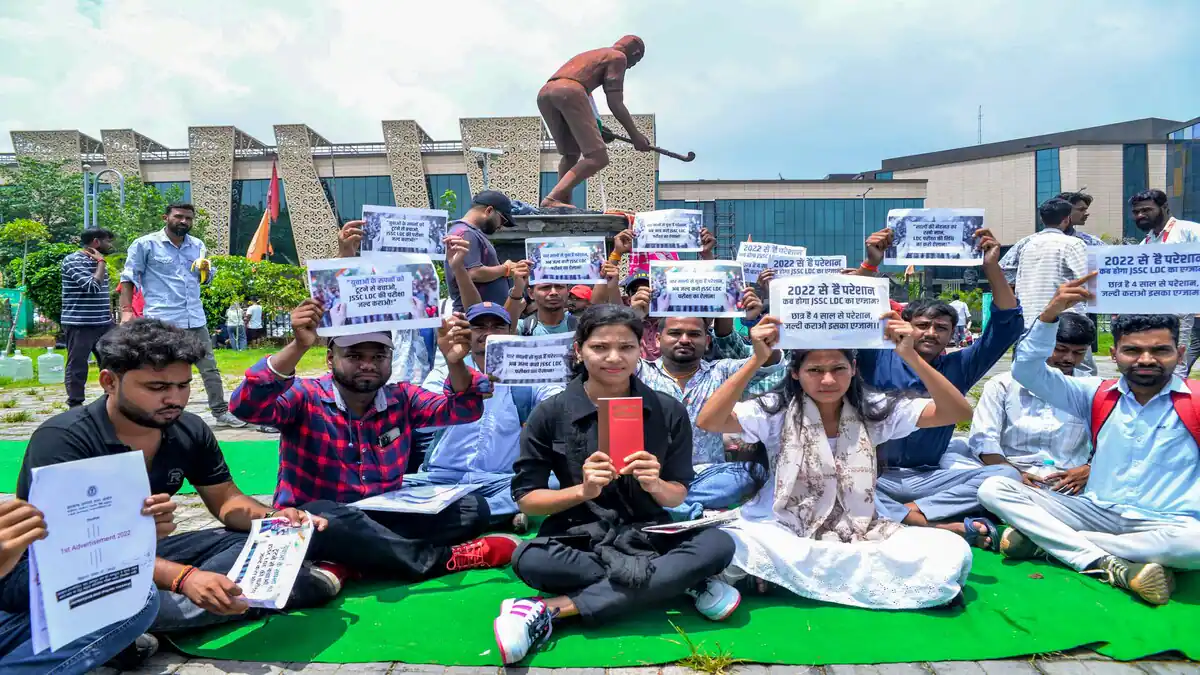
Youth Demand Answers: Young aspirants stage a sit-in during the JPSC-JSSC agitation at Jaipal Singh Munda Stadium in Ranchi, Jharkhand, in August 2026, demanding accountability over alleged recruitment examination irregularities. Their protest captures the power of youth to challenge the system—and the responsibility to ensure that dissent retains its dignity. Photo Credit-PTI
From grassroots rallies to national uprisings, young people are increasingly taking centre stage. Their right to question authority must be protected—but dissent cannot become a licence for personal abuse.
If one were asked what connects young people across the world today, the easiest answer might be the internet. But technology is merely the network. The greater force travelling through that network is youth power.
From universities and streets to start-ups, laboratories, political movements and climate campaigns, young people are no longer content to wait for tomorrow before claiming a role in shaping it.
International Youth Day 2026 captures this reality through its theme, “Different Contexts, Common Aspirations.” Young people may live under different political systems and vastly different economic and social circumstances, but their fundamental aspirations remain remarkably similar: education, employment, dignity, opportunity, security and a meaningful voice in decisions affecting their future.
That voice deserves to be heard.
But it must also be said that having a voice does not give anyone the right to abuse another human being.
Protest Is a Right, Abuse Is Not
India has recently witnessed the strength of youth mobilisation over examinations, alleged paper leaks, recruitment processes and demands for greater accountability. Such movements perform an important democratic function. When institutions fail, citizens—particularly young citizens whose futures are directly affected—have every right to ask difficult questions.
Governments must listen to them.
Police and administrative authorities must respect peaceful dissent.
Political leaders must be prepared to face criticism, uncomfortable questions and even public anger. Holding public office necessarily brings greater scrutiny.
But there is a line between criticising those who exercise political power and attacking their families.
No democratic movement becomes stronger by abusing someone’s mother, father, wife, husband or children merely because that person happens to occupy political office. Family members who do not participate in politics cannot legitimately become substitutes for the politician one wishes to confront.
This principle must apply equally whether the target is Prime Minister Narendra Modi, an Opposition leader, a chief minister, an activist or an ordinary citizen.
A simple test is enough: if we would find the same words intolerable when directed at our own mother, father or spouse, what moral right do we have to use them against somebody else’s family?
Freedom of expression protects criticism. It does not transform cruelty into courage.
The Courage to Question
History nevertheless demonstrates why societies must take young voices seriously.
Malala Yousafzai’s campaign for girls’ education emerged from circumstances in which simply attending school could become an act of defiance. Hong Kong’s Joshua Wong and Nathan Law became prominent voices in youth-led democratic movements. Sudan’s Ala’a Salah became one of the defining faces of the country’s 2019 uprising.
Bangladesh’s student movement in 2024 demonstrated how rapidly dissatisfaction over employment quotas could expand into a national political crisis. Kenya’s Gen Z protests against the Finance Bill showed how digitally connected young citizens could organise outside conventional party structures.
Climate activism has produced another generation of young voices. India’s Licypriya Kangujam, Uganda’s Vanessa Nakate, Xiye Bastida and Indigenous Canadian water activist Autumn Peltier demonstrate how environmental questions that once appeared confined to conferences have become deeply personal concerns for young people.
Their countries, causes and methods are different. Their common message is unmistakable: do not decide our future without allowing us into the conversation.
India’s Young People Are Asking Questions Too
India should welcome that spirit rather than fear it.
Students questioning examination irregularities, recruitment delays or alleged paper leaks are not weakening democracy merely by protesting. A democracy becomes stronger when its institutions can withstand scrutiny and correct mistakes.
Recent student movements have demonstrated that young Indians can organise rapidly and compel governments and institutions to respond. They have also demonstrated something equally important: a movement’s credibility ultimately depends upon its conduct.
The moment legitimate demands become mixed with abusive slogans, personal humiliation, intimidation or violence, attention begins shifting away from the issue towards the behaviour of the protesters.
That is a loss for the movement itself.
A student demanding a fair examination does not need to insult anybody’s mother to make that demand stronger. A young citizen demanding accountability does not need vulgarity to prove courage. And a leader who commands thousands of young followers carries an even greater responsibility to prevent anger from degenerating into personal hatred.
Leadership Is Also Restraint
We often define leadership by the courage required to start a movement.
Perhaps we should also judge leadership by the courage required to restrain one.
It is relatively easy to excite an angry crowd. It is considerably harder to tell one’s own supporters that a particular slogan is unacceptable, that an opponent’s family is off limits, or that a protest must remain peaceful even when emotions are running high.
That distinction separates activism from mob behaviour.
Young leaders seeking to transform politics should therefore demand higher standards not merely from governments but also from themselves.
Question the Prime Minister.
Question the government.
Question ministers, bureaucracies, universities, examination authorities and political parties.
Demand resignations when accountability requires them. Seek investigations where evidence warrants them. March peacefully, organise, debate, vote and challenge those exercising power.
But leave mothers, wives, husbands and children out of political battles when they themselves are not political actors.
That principle should know no party.
Dissent Needs Dignity
The world does not need a generation that remains silent before injustice. Nor does it need a generation that mistakes aggression for bravery.
It needs young people capable of combining courage with reason, passion with responsibility and dissent with dignity.
This is particularly important in the digital age. A slogan shouted before a few hundred people can reach millions within minutes. Anger can travel faster than context. An abusive remark can overshadow months of legitimate campaigning.
That gives today’s young activists enormous power—but also enormous responsibility.
International Youth Day should therefore celebrate more than the energy of youth. It should celebrate the values with which that energy is exercised.
Young people are no longer waiting for tomorrow.
They are already influencing governments, economies, technology, environmental policy and public discourse. They are demanding their rightful seat at the table.
And they should.
But if this generation truly wants to build a more just political culture than the one it inherited, it cannot reproduce the very intolerance it seeks to challenge.
Raise your voice. Question authority. Challenge injustice. Demand accountability.
But never confuse the freedom to speak with the freedom to humiliate.
The strongest voice in a democracy is not necessarily the loudest one.
It is the one that can speak fearlessly—and still know where dignity demands that it stop.

YOU MAY LIKE THIS