Reg No. - CHHBIL/2010/41479ISSN - 2582-919X

When Even Silence Becomes Difficult-By- Kumar Bahukhandi
The one thing that perhaps frightens human beings most is death. Rich or poor, powerful or ordinary, every human journey must eventually come to an end. Sometimes the end gives us warning; sometimes it arrives without knocking. Yet, despite its inevitability, even a discussion about death makes many of us uncomfortable.
When we visit a bereaved family to pay our respects to someone who has passed away — a friend, relative or acquaintance — we expect silence, restraint and reflection. Yet funerals can also reveal some peculiar aspects of human behaviour. There are people who seem capable of turning almost any gathering, even one of mourning, into an opportunity for conversation, networking and displaying their social skills.
It happened one evening when a friend came to my house and informed me that his maternal uncle had passed away after a prolonged illness. The funeral was to take place later that evening, and I decided to accompany him.
The moment we entered the house, I recognised a few familiar faces. Our expressions exchanged greetings.
There are occasions when words are unnecessary. Grief is one of them.
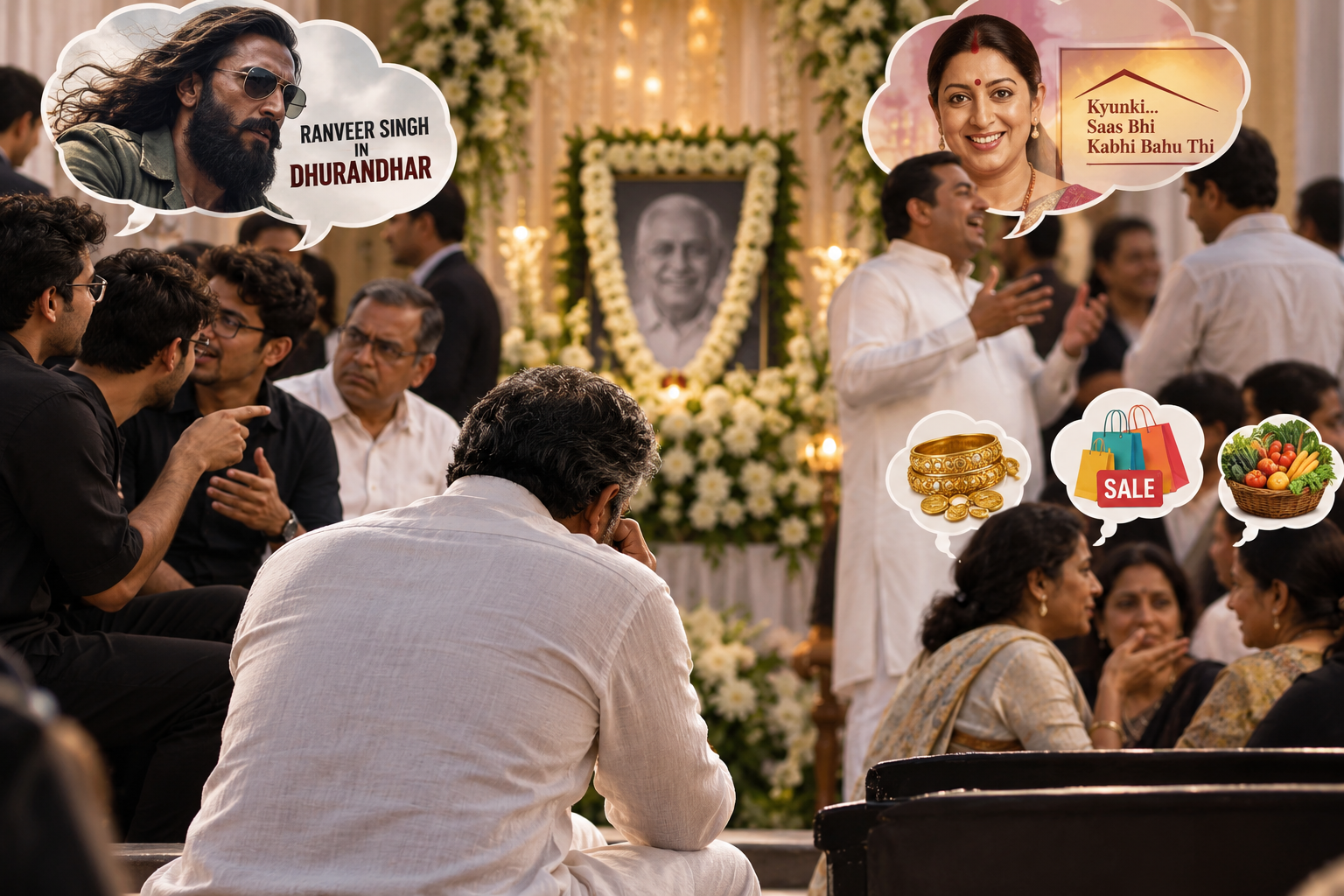
After conveying my condolences to the bereaved family, I quietly sat in a corner and began observing the people around me. Some energetic young men were helping with the funeral arrangements. Two others, however, appeared temporarily to have forgotten where they were.
Their subject was cinema.
One was enthusiastically discussing Ranveer Singh’s rugged appearance in Dhurandhar. The other immediately joined in, talking about his long-haired look and confidently predicting that young men would soon start trying to imitate it.
A middle-aged gentleman sitting nearby listened for a while before giving them a stern look.
The film discussion ended instantly.
Perhaps silence sometimes needs an enforcer.
People continued arriving and leaving after paying their last respects. At a funeral, most of us instinctively dress simply. Nobody wants to appear excessively colourful or attract unnecessary attention.
Then arrived a gentleman in an immaculate white kurta-pyjama. His clothes were so perfectly pressed and his entrance so carefully composed that, for a moment, one wondered whether he had come to mourn or had accidentally walked onto the set of a television serial.
He began grieving loudly. His display suggested an intimacy with the departed that few others could possibly have shared. Yet within minutes, the tears had disappeared and he was comfortably engaged in conversation with the people around him.
Watching him, my mind wandered to the strange world of television, where an ordinary entrance can suddenly become a dramatic one. Smriti Irani’s own journey comes to mind: she has recalled earning just Rs 1,800 a month working at McDonald’s before Ekta Kapoor chose her to play Tulsi in Kyunki Saas Bhi Kabhi Bahu Thi. Life, television and circumstances can transform a person’s role rather quickly.
But our gentleman in white needed no television producer. He had apparently cast himself.
Perhaps public mourning, too, has acquired its own performance.
Not far away, another conversation had begun. A small group was discussing the rising price of gold. Someone advised against buying immediately because prices might change during the festive season. Another person wanted information about discounts being offered by clothing stores. Soon the conversation moved effortlessly from jewellery to shopping and then to the rising prices of vegetables and groceries.
None of these conversations was extraordinary.
That was precisely what made them extraordinary.
Cinema, clothes, gold, discounts, groceries — the routine business of life had quietly entered a house of mourning.
There is nothing wrong with conversation. Human beings communicate because communication connects us. Perhaps people sometimes talk at funerals because silence itself makes them uncomfortable. Ordinary conversation may even be an unconscious attempt to escape the disturbing reminder that one day the silence could be for us.
But every place has its own language, and sometimes that language is silence.
There are moments when we need not demonstrate our relationships, display our social importance or fill every uncomfortable pause with words. Sitting quietly beside someone who has lost a loved one can communicate more than a hundred carefully chosen sentences.
Perhaps our inability to remain silent says something about the times in which we live.
We have become accustomed to speaking, posting, commenting and reacting almost continuously. Every moment appears to demand an opinion and every gathering seems to require conversation. Silence, once considered a natural part of human interaction, increasingly seems like an awkward space that must immediately be filled.
Yet some moments ask for nothing from us except our presence.
A funeral is one of them.
And perhaps the greatest respect we can sometimes offer another human being is simply to know when not to speak.

YOU MAY LIKE THIS