Reg No. - CHHBIL/2010/41479ISSN - 2582-919X

‘Vasundhara’ to Usher in a New Era of Transparent Revenue Services in Chhattisgarh-By Vishnu Prasad Verma
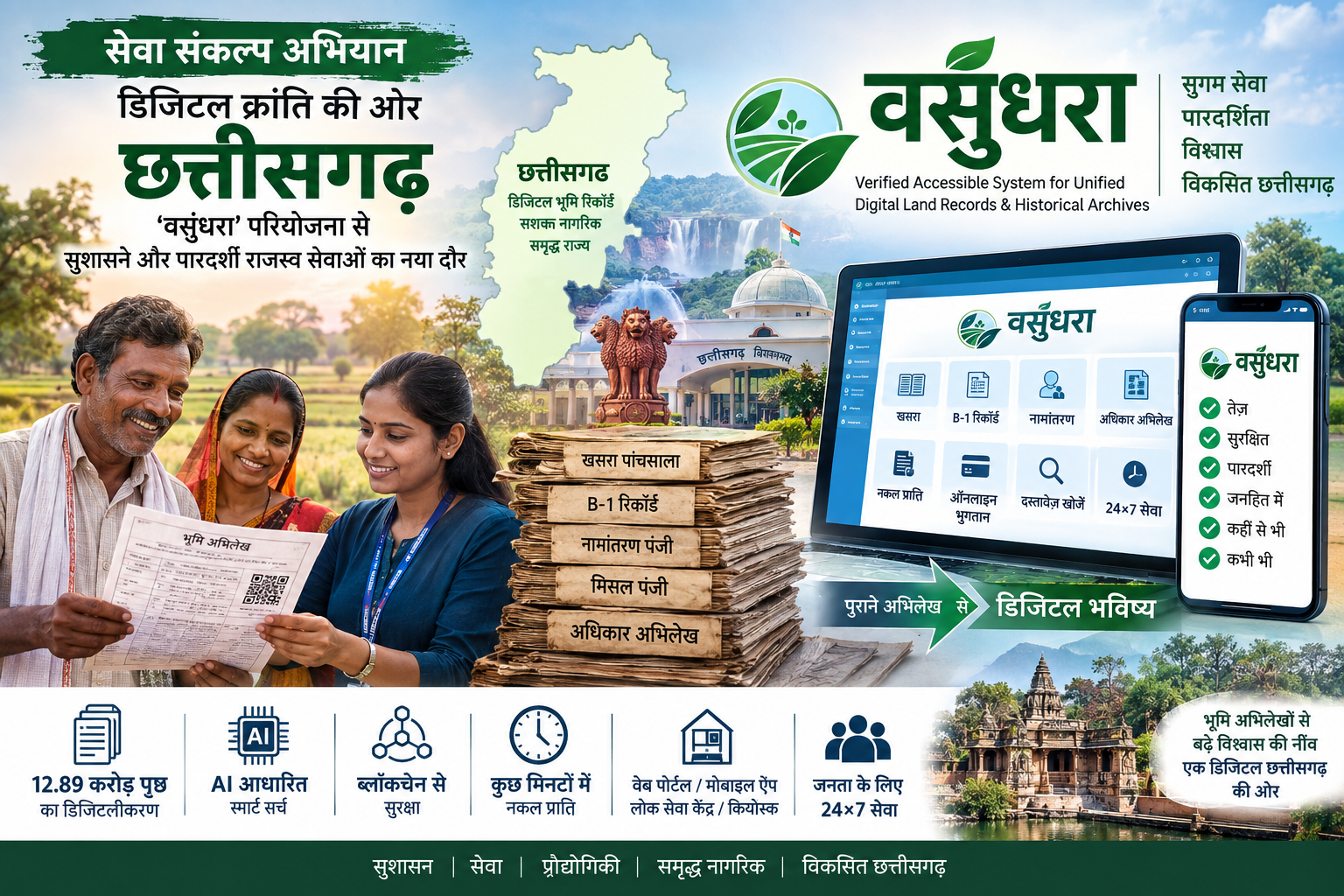
An AI-generated representational image depicts Chhattisgarh’s proposed ‘Vasundhara’ project, aimed at digitising nearly 12.89 crore pages of land and revenue records and enabling faster, transparent and secure access through web, mobile and kiosk-based services. The project envisages the use of AI-assisted search, digital authentication and blockchain-based safeguards as part of the State’s push towards digital governance. (AI-generated representational image)
State plans digitisation of nearly 12.89 crore pages of land and revenue records, integrating AI, blockchain security and round-the-clock citizen access
Chhattisgarh is preparing for a major transformation in the way citizens access land and revenue records, with the State Government taking its digital governance push to a new level through the ambitious ‘Vasundhara’ project — Verified Accessible System for Unified Digital Land Records & Historical Archives.
Being implemented by the Revenue, Disaster Management and Rehabilitation Department under the spirit of the Seva Sankalp Abhiyan, the project seeks to digitise, preserve and authenticate decades of old as well as current revenue records across the State.
The objective goes beyond converting paper documents into digital files. Vasundhara aims to build a system in which citizens can obtain authenticated revenue records quickly and transparently without repeatedly visiting government offices.
Once fully implemented, a process that presently takes between three and seven days for obtaining copies of records is expected to be reduced to just a few minutes, with services accessible around the clock through digital platforms.
Dantewada Model Lays the Foundation
The State-wide initiative draws significantly from the experience of Dantewada, where a digital revenue service model has already demonstrated how technology can simplify access to government records.
During the past year, more than 12,000 citizens in Dantewada availed themselves of kiosk-based services, while over 15,000 caste certificates were issued within one to two days. Hundreds of disputed cases were also resolved quickly, while no case of tampering with the digitised records was reported during the period.
The experience provided the government with a working model that could be expanded across Chhattisgarh.
The scale of the State-wide project, however, is considerably larger.
Nearly 12.89 crore pages of different categories of revenue records have been identified for digitisation. The proposed exercise includes 5.68 crore pages of Khasra Panchsala records, with an estimated expenditure of ₹22.72 crore, and 2.94 crore pages of B-1 records, estimated at ₹11.77 crore.
Another 2.49 crore pages of mutation and amendment registers are proposed to be digitised at a cost of ₹9.98 crore. The plan also covers 53.16 lakh pages of Misal registers, estimated at ₹2.13 crore, and 47.29 lakh pages of records of rights, with an estimated expenditure of ₹1.89 crore.
Other important documents, including Nistar Patrak, Wajib-ul-Arz, renumbering lists, ordinary Khasra records, Nazul sheets and diversion registers, are also proposed to be digitally preserved.
The project envisages a total one-time capital expenditure of ₹65.41 crore, along with an annual operational expenditure of ₹50 lakh. Funding is proposed through the State’s infrastructure allocation and the Central Government’s Digital India Land Records Modernization Programme (DILRMP) 3.0.
AI, Blockchain and Smart Search to Protect Records
Technology is expected to form the backbone of Vasundhara.
With the support of the National Informatics Centre (NIC), the government plans to develop a dedicated Vasundhara web portal and mobile application within three months. Implementing agencies will subsequently be selected, with the digitisation and verification of the identified records targeted for completion within one year.
The project proposes the use of Artificial Intelligence-based Optical Character Recognition (OCR), document classification and smart-search technology, potentially allowing even decades-old records to be located quickly.
Security is another major component of the proposed system.
Blockchain-based safeguards, digital signatures and unique QR and barcode mechanisms are proposed to protect records against unauthorised alteration and strengthen their authenticity. For officials, real-time monitoring tools are expected to provide greater oversight of the system.
For citizens, the most visible change would be accessibility.
Authenticated records are proposed to be made available through the web portal, mobile application, Lok Seva Kendras and kiosks. An online payment gateway is also planned, reducing dependence on physical visits to revenue offices.
For people dealing with land transactions, inheritance, mutation, certificates or disputes, easier access to authenticated historical records could significantly reduce delays and uncertainty.
The larger significance of Vasundhara, therefore, lies not merely in the number of pages being scanned. Its real test will be whether digitisation translates into simpler procedures, reliable records, quicker services and greater accountability at the citizen-government interface.
As Chhattisgarh expands digital governance under the Seva Sankalp Abhiyan, Vasundhara represents an attempt to take one of the oldest and most document-intensive areas of administration — land and revenue records — into a system built around accessibility, traceability and transparency.
If implemented within the proposed timeline and with the technological safeguards envisaged, the project could mark an important shift from citizens searching through government records to government records becoming readily accessible to citizens.
About the Author: Vishnu Prasad Verma is an Assistant Director and writes on governance, public administration and development initiatives in Chhattisgarh.

YOU MAY LIKE THIS