Reg No. - CHHBIL/2010/41479ISSN - 2582-919X
Trump Names Jay Clayton to Lead New ‘Super Intelligence Force’
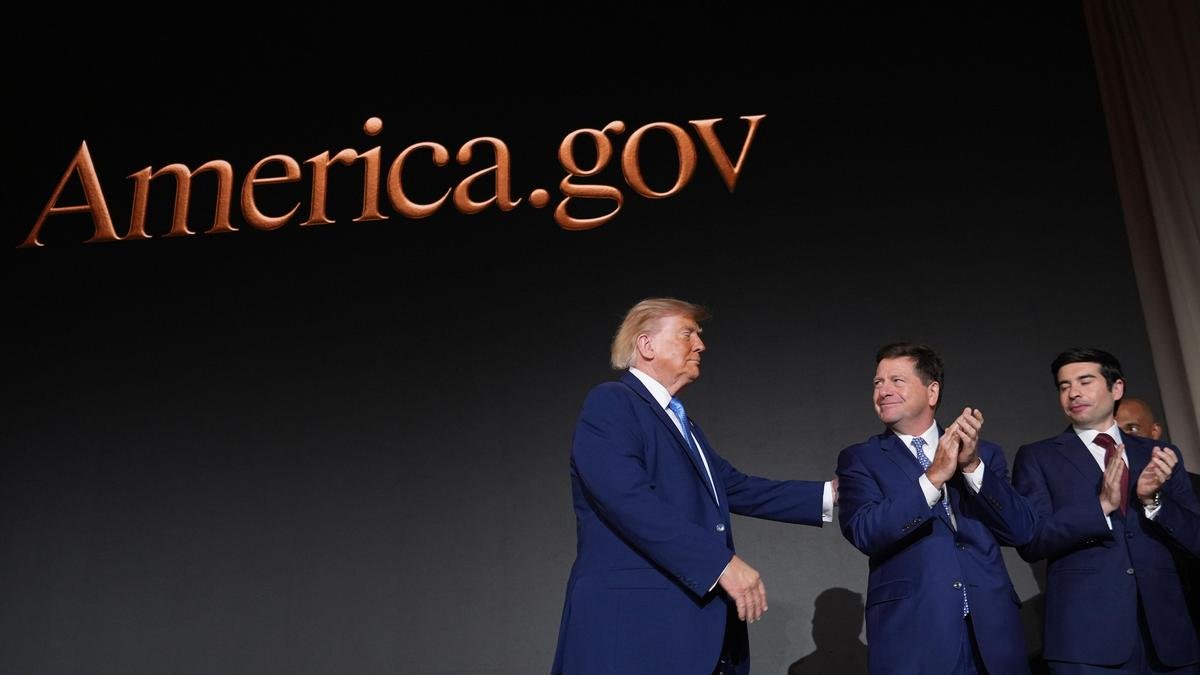
US President Donald Trump appears with Director of National Intelligence Jay Clayton (second from right) at an event in Washington. Trump has named Clayton to lead the newly established Super Intelligence Force, which has been tasked with assessing the risks and opportunities of advanced AI and the federal government’s role in addressing them. Photo: AP/File Image.
US intelligence chief becomes face of federal AI initiative as new task force gets 120 days to assess risks, opportunities and government responsibilities
Key Highlights
- President Donald Trump announces a new federal Super Intelligence Force (SIF).
- Director of National Intelligence Jay Clayton will lead the task force and serve as the administration’s new AI czar.
- SIF has been given 120 days to examine the risks and opportunities associated with advanced AI.
- FTC Chairman Andrew Ferguson, Pentagon technology chief Emil Michael and OPM Director Scott Kupor are among its senior leaders.
- Task force will engage AI companies, consumers, public-interest organisations and critical-infrastructure providers.
- Formation follows the White House Accord with major technology companies.
- The initiative comes as the administration seeks US technological leadership while generally favouring a lighter regulatory approach.
Washington: President Donald Trump has placed America’s intelligence chief at the centre of his administration’s next phase of artificial-intelligence policy, naming Director of National Intelligence Jay Clayton to lead a newly created Super Intelligence Force (SIF).
Trump announced the initiative on Sunday, October 4, following the White House Accord on advanced AI. The task force is intended to coordinate federal policy as Washington confronts both the opportunities and risks arising from increasingly powerful AI systems.
Clayton, who previously chaired the Securities and Exchange Commission, will head the initiative alongside Federal Trade Commission Chairman Andrew Ferguson, Pentagon Chief Technology Officer Emil Michael and Office of Personnel Management Director Scott Kupor. The group will report to Trump and White House Chief of Staff Susie Wiles.
Why ‘Super Intelligence’?
The name itself reflects a deliberate shift in the administration’s terminology.
On September 29, Trump signed an executive order directing the executive branch, to the extent permitted by law, to use “Super Intelligence” and “SI” instead of “Artificial Intelligence” and “AI” in official communications and non-statutory documents. For purposes of implementing the order, however, “Super Intelligence” currently refers to technologies encompassed by the existing statutory definition of artificial intelligence.
Trump described the technology as potentially transformative on a scale comparable with the Industrial Revolution and the Internet, and said the new task force would coordinate government efforts aimed at maintaining US leadership.
120 Days to Answer Difficult Questions
The SIF has been given 120 days to examine the risks and opportunities presented by the technology and consider what responsibilities the federal government should assume.
Its remit is expected to involve engagement with technology companies, consumers, public-interest and religious organisations, businesses and operators of critical infrastructure.
That gives Clayton a role extending well beyond conventional intelligence coordination. Questions surrounding advanced AI now touch national security, cyberattacks, critical infrastructure, employment, economic competitiveness and the possibility of increasingly autonomous systems.
The appointment also reflects the extent to which AI policy is becoming intertwined with national-security policy.
Regulation Without Losing the AI Race
The creation of SIF comes at an interesting point in Trump’s technology policy.
The President has generally favoured a lighter regulatory approach, arguing that excessive restrictions could undermine America’s ability to compete internationally, particularly against China. Yet creating a high-level task force specifically charged with examining risks indicates that the administration also sees a role for federal coordination and oversight.
The challenge facing Clayton and his colleagues will therefore be one of balance: how far government should intervene to address demonstrable risks without creating a regulatory structure that the administration believes could slow technological development.
The task force follows Trump’s meeting with leading technology executives and the White House Accord on advanced AI, under which companies made voluntary commitments concerning the development of the technology.
Who Is Jay Clayton?
Clayton is a lawyer and former Wall Street adviser who served as Chairman of the Securities and Exchange Commission during Trump’s first presidency. He subsequently served as US Attorney for the Southern District of New York before becoming Director of National Intelligence.
He is therefore not being brought into the role principally as an AI scientist or engineer. His experience lies primarily in law, financial regulation, enforcement and national security — an indication that the administration views advanced AI as an issue extending beyond technology laboratories into economic and security policy.
His leadership of SIF will nevertheless be shared with officials responsible for competition policy, defence technology and the federal workforce.
That structure means the task force’s eventual direction will depend not only on Clayton but on how these different arms of government reconcile innovation, competition, security and public protection.
The Real Test Comes in 120 Days
For now, SIF is a coordinating body with an unusually broad assignment.
The more consequential moment will arrive when its 120-day review is completed. That report should provide a clearer indication of whether the administration intends to continue relying primarily on voluntary industry commitments or believes additional federal safeguards are necessary.
It will also reveal how Trump’s preference for rapid American technological development is reconciled with concerns about cybersecurity, critical infrastructure, employment and potentially dangerous uses of increasingly capable systems.
The significance of Clayton’s appointment, therefore, lies less in the title of “AI czar” than in the authority and recommendations that ultimately emerge from the Super Intelligence Force.

YOU MAY LIKE THIS