Reg No. - CHHBIL/2010/41479ISSN - 2582-919X

The Masks-By- Kumar Bahukhandi
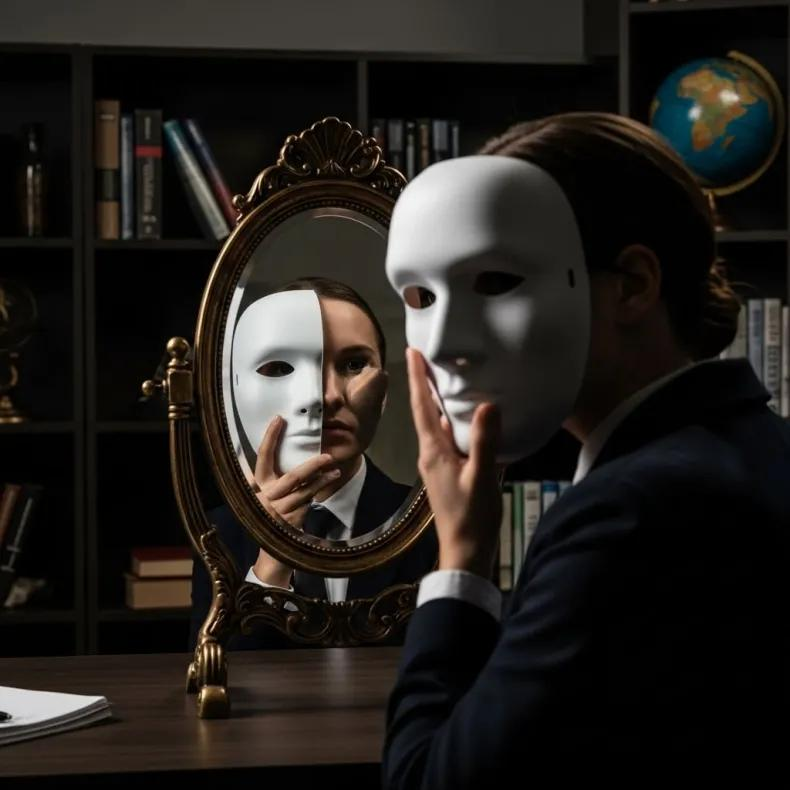
The many faces we wear are not always masks of deception. Roles, relationships and responsibilities change our behaviour; character is revealed by the values that remain unchanged beneath them(Representational Image )
“Ek chehre pe kai chehre laga lete hain log.”
— Sahir Ludhianvi, Daag (1973)
The old Hindi number was playing on my car stereo. Beautiful, melodious and meaningful. Yet beneath its melody lies a rather sarcastic accusation: people put many faces over their real one, hiding themselves behind masks to achieve ulterior motives.
But as I listened, another thought occurred to me. Is every mask necessarily bad?
When we talk about a mask, after all, we are not talking about the face alone. A mask can represent a change in personality, attitude, behaviour or even body language. And we all change these, often without even realising it.
In everyday conversation, such changes are usually described negatively. “Girgit ki tarah rang badalna” — changing colours like a chameleon — or “mukhota chadhana” — putting on a mask — are expressions used for people whose behaviour changes according to circumstances.
But is that always wrong? Is every change of behaviour dishonest or mala fide?
I don’t think so.
We all wear masks, and some of them are necessary.
A man behaves differently as a father and as a son; as a husband and as a brother; as an employer and as an employee. There can be countless examples from our social relationships. With every situation, our mental attitude changes to some extent, and so does our body language.
A person cannot behave with his mother, wife and sister in exactly the same manner. In fact, we do not behave with even the same person in precisely the same way on every occasion.
Circumstances change. Responsibilities change. Our roles change.
And sometimes, the mask we wear is a professional one.
Doctors, lawyers, police personnel, journalists and people in several other professions are sometimes accused of being emotionless, hard-hearted or excessively serious. But what appears to be coldness may sometimes simply be the professional mask necessary to perform one’s duty.
Consider a doctor.
A patient is critically ill and is about to undergo a difficult operation. Outside the operation theatre, the patient’s family may be frightened, emotional and perhaps crying. The doctor may feel the same human anxiety, but cannot afford to carry all those emotions onto the operating table. At that moment, professional composure becomes essential.
It does not necessarily mean that the doctor does not care. Perhaps the doctor also silently prays for the patient’s recovery. Perhaps failure to save a life causes pain long after the hospital duty is over.
The professional face, therefore, may conceal emotion not because emotion is absent, but because duty demands control over it.
A writer faces a different situation.
Writing, particularly reflective or creative writing, draws deeply upon observation, memory and emotion. A writer may appear serious, detached or even stern while working, yet the very act of writing often requires sensitivity towards people and situations.
This creates an interesting contradiction. Society expects a writer to be sensitive, but also expects a professional to remain composed.
Which mask, then, is the real one?
Perhaps both are.
The problem is not that human beings change their behaviour according to relationships, responsibilities and circumstances. The problem begins when they change their fundamental human values — honesty, commitment, trustworthiness and integrity.
There are, of course, people who deliberately conceal their intentions. They may appear friendly when they seek an advantage, loyal when loyalty benefits them, or concerned when concern is merely a means to an end.
Those are the dangerous masks.
The difference, therefore, is not between a person who changes and one who never changes. Human beings inevitably change according to circumstances. The real distinction is between adaptation and deception.
One changes one’s behaviour to fulfil a role. The other changes one’s face to conceal an intention.
There is another kind of mask that fascinates me: the mask other people put on us.
Society tends to create rigid frames for different professions. A writer must supposedly always be serious. A doctor must be restrained. A teacher must behave in a particular manner. A police officer must look stern. A priest must fit another predetermined image.
And when the person walks out of that frame, people become uncomfortable.
I have experienced this myself.
Some people who know me primarily through my professional work are surprised to discover that a serious writer can also be light-hearted, fun-loving and jovial at a social gathering. The person has not suddenly changed; what has broken is the frame in which someone else had placed him.
Perhaps that is why we should be careful before accusing someone of wearing too many masks.
A father, son, husband, friend, teacher, writer or professional may present different faces to the world without any of those faces necessarily being false.
We are not one-dimensional beings.
The real test is much simpler: when the face changes, do the values underneath it remain the same?
If honesty remains honesty, commitment remains commitment and trust remains trust, a changing face may merely reflect the many roles of being human.
But when values themselves change for convenience, the mask ceases to be a social necessity.
It becomes a disguise.
And perhaps the greater irony is that sometimes the mask we think we see on another person’s face exists only in the frame through which we have chosen to see them.
Kumar Bahukhandi
Journalist, Editor & Educator
Editor, Prime Look
Editor, Channel24India.com
Raipur, Chhattisgarh, India

YOU MAY LIKE THIS