Reg No. - CHHBIL/2010/41479ISSN - 2582-919X

Shah Focuses on Siliguri Corridor Security, Darjeeling Political Solution
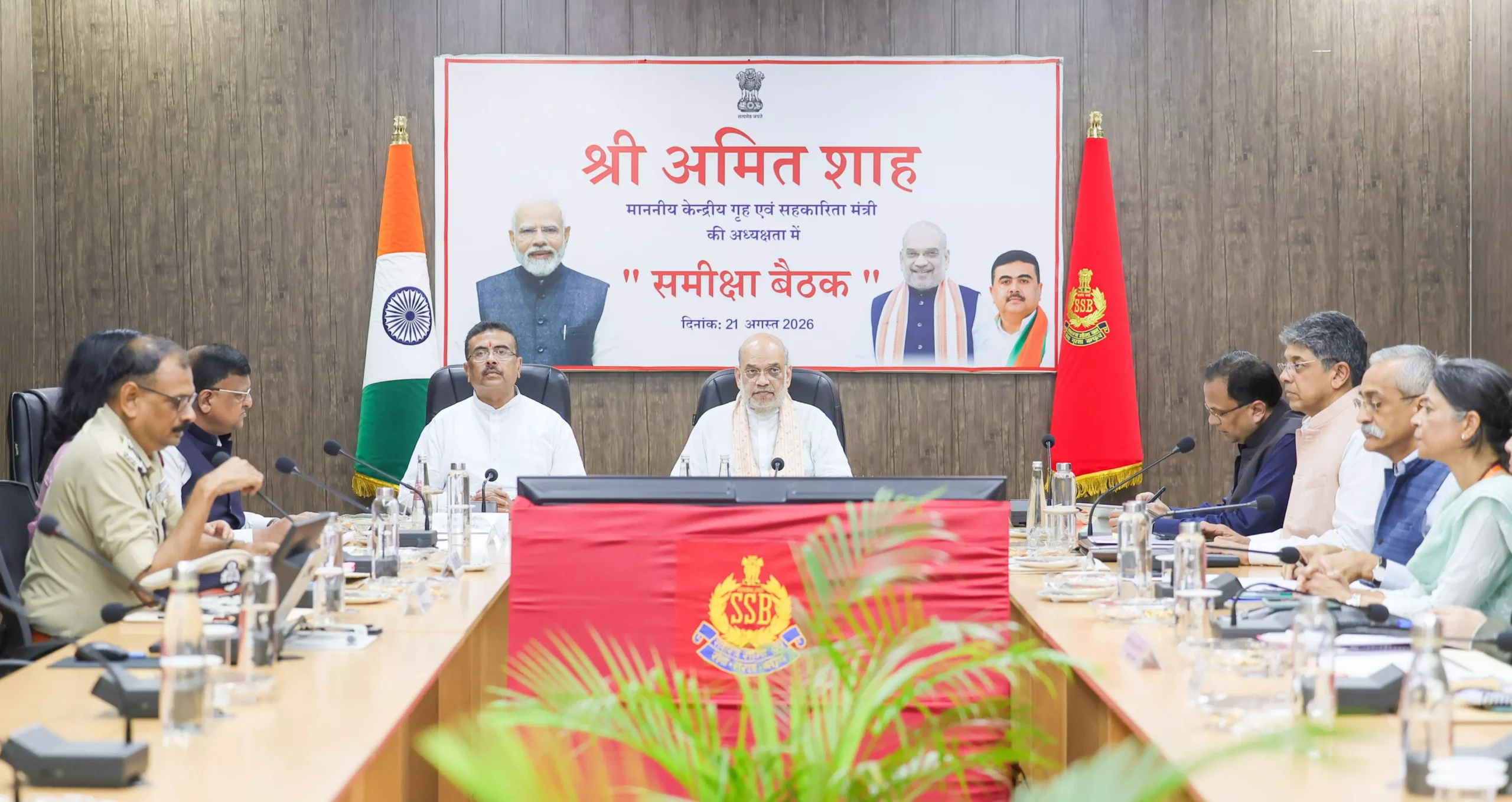
Union Home Minister Amit Shah chairs a high-level security review meeting at the Sashastra Seema Bal (SSB) Frontier Headquarters in Siliguri, West Bengal, on Friday, August 21, 2026. West Bengal Chief Minister Suvendu Adhikari is seated beside Shah, along with senior officials and security personnel, during discussions on border management and security in the strategically sensitive Siliguri region. Photo: Official/SSB
Home Minister’s Siliguri engagements put the strategically vital ‘Chicken’s Neck’ and long-pending political demands of the Darjeeling hills at the centre of discussions
Key Highlights
- Amit Shah’s three-day West Bengal visit focuses heavily on security of the strategically sensitive Siliguri Corridor
- Centre moves towards a coordinated security grid involving border forces and state agencies
- Darjeeling hills’ long-pending demand for a “permanent political solution” remains on the political agenda
- Shah says improved Centre-state coordination has accelerated land availability for border-security infrastructure
- Siliguri Corridor connects the Northeast with the rest of India and lies close to Nepal, Bhutan and Bangladesh
Siliguri: Union Home Minister Amit Shah’s three-day visit to West Bengal has put the security of the strategically crucial Siliguri Corridor and the unresolved political questions of the Darjeeling hills firmly in focus, with high-level discussions involving security agencies and regional political representatives.
Shah, who is on the final day of his visit on Saturday, August 22, has been holding meetings in and around Siliguri as the Centre intensifies its security planning for the narrow land corridor connecting India’s northeastern states with the rest of the country.
The Siliguri Corridor, commonly known as the “Chicken’s Neck”, assumes exceptional strategic importance because of its geography and proximity to the international borders with Nepal, Bhutan and Bangladesh.
Security coordination among the Sashastra Seema Bal (SSB), Border Security Force (BSF), intelligence agencies and the West Bengal administration has emerged as a major component of Shah’s visit.
The Centre has also moved towards strengthening the security architecture around the corridor through a coordinated security grid intended to improve surveillance and cooperation among the agencies responsible for protecting the sensitive region.
Darjeeling Political Question Returns to Centre Stage
Alongside security, attention has turned to the long-pending political demands of the Darjeeling hills and the BJP’s commitment to finding what it has described as a “permanent political solution” for the region.
Political leaders from the hills, including representatives associated with the Gorkha movement, are expected to press for clarity on the Centre’s approach to the issue.
The Darjeeling hills have witnessed demands for a separate Gorkhaland state for decades. Successive attempts to address the political aspirations of the region led to administrative arrangements including the Darjeeling Gorkha Hill Council and subsequently the Gorkhaland Territorial Administration.
The issue gained renewed political significance after Shah reiterated the BJP’s commitment to a permanent solution during the 2026 West Bengal Assembly election campaign.
Shah’s latest meetings follow a series of engagements in Siliguri on Friday, when he visited the SSB Frontier Headquarters and inaugurated and laid foundation stones for infrastructure projects intended to strengthen the force’s operational capabilities.
During the programme, Shah stressed the need to secure India’s borders and criticised the previous Mamata Banerjee government over delays in providing land required for border fencing and security infrastructure.
He contrasted this with the cooperation being extended by the government headed by Chief Minister Suvendu Adhikari, saying the state administration was now responding quickly to requirements concerning border security.
The Home Minister said that land sought for strengthening border infrastructure had been made available following the change of government in West Bengal, underlining what he described as improved coordination between the Centre and the state.
Shah also attended a programme connected with India’s three new criminal laws at Kawakhali during his Siliguri engagements.
With security infrastructure, inter-agency coordination and the Darjeeling political question converging during the visit, Shah’s engagements underline the Centre’s broader strategic focus on the Siliguri region — an area whose stability is critical not only for West Bengal but also for connectivity and security across India’s Northeast.