Reg No. - CHHBIL/2010/41479ISSN - 2582-919X

Minimal impact of electricity tariff revision on Common consumers
Representational Image -Credit -Instagram
Key Factors
 * Relief for 41 lakh domestic consumers
 * 14.5 lakh families continue to receive free electricity
 * No additional burden on farmers using irrigation pumps
 * Most consumers protected through subsidies, solar energy, and relief schemes
Raipur: Despite the annual revision of electricity tariffs in Chhattisgarh, the state government has implemented relief and protection measures at various levels to minimise the additional burden on common consumers.
The Electricity Regulatory Commission has approved an average increase of 6.23 percent—approximately 42 paise per unit—for the year 2026-27; however, the impact on most consumers will remain quite limited due to state initiatives such as the Mukhyamantri Urja Rahat Yojana, Bijli Bill Samadhan Yojana, and PM Suryaghar Yojana.
It is worth mentioning that electricity tariffs are determined by the Chhattisgarh State Electricity Regulatory Commission (CGSERC), an independent statutory body.
The Commission sets rates after analysing various economic factors, including the annual revenue requirements of power companies, generation costs, and expenses related to coal, transmission, and distribution. Under the new tariff structure, rates for domestic consumers have been increased by 30 to 50 paise per unit. However, thanks to the Mukhyamantri Urja Rahat Yojana, most families in the state will not face an additional financial burden.
There are approximately 51 lakh domestic consumers in the state. Among them, 14.5 lakh BPL (Below Poverty Line) families receive up to 30 units of electricity free of charge, with the entire cost borne by the state government.
Additionally, for 26.5 lakh consumers with a monthly consumption of up to 400 units, a rebate of up to 50 percent is provided on the first 200 units consumed.
Due to these relief measures, the impact of the tariff hike on approximately 41 lakh domestic consumers will range from zero to a maximum of only 3.65 percent. No Additional Financial Burden on Farmers
Energy charges for the state’s 8.65 lakh agricultural consumers have been increased by 40 paise per unit; however, since the state government is compensating for this through subsidies, farmers will not face any additional financial burden. Fixed charges for agricultural pumps have also been kept unchanged.
Solar Energy Reduces Bills to Zero for Thousands of Families
To enhance self-reliance in the energy sector, the ‘PM Surya Ghar Yojana’—run by the Central and State governments—is being rapidly implemented in Chhattisgarh. So far, approximately 66,000 consumers have benefited from this scheme, with 16,000 families seeing their electricity bills drop to zero. Currently, work is underway to install solar plants in about 89,000 households. The state government has set a target to install solar plants in 5 lakh homes over the coming years, which will reduce electricity consumption costs.
Major Relief Through the Electricity Bill Resolution Scheme
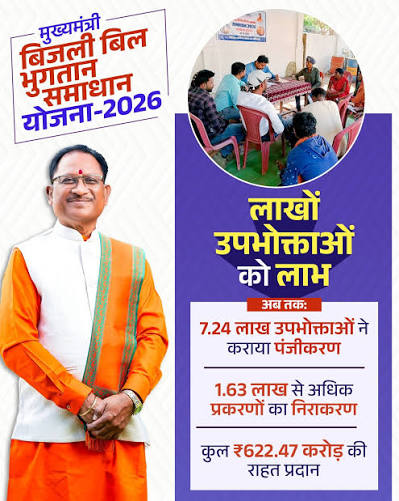
The ‘Chief Minister Electricity Bill Resolution Scheme’ was launched by Chief Minister Vishnu Deo Sai’s government on March 12, 2026. Under this scheme, special relief regarding outstanding electricity bills is being provided to BPL (Below Poverty Line), domestic, and agricultural consumers.
BPL consumers are receiving a 75% waiver on the principal outstanding amount and a complete waiver on surcharges. Meanwhile, domestic and agricultural consumers are benefiting from a 50% waiver on the principal amount and a full waiver on surcharges.
Besides , a facility to pay the remaining amount in up to 60 installments has been provided. So far, 6 lakh BPL consumers, 1.5 lakh domestic consumers, and 33,000 agricultural consumers have applied under the scheme. Outstanding dues amounting to approximately ₹1,328 crore have been resolved, with consumers receiving relief worth ₹749 crore.
Emphasis on Maintaining Industrial Competitiveness
To encourage industrial investment and employment in the state, the existing 25% rebate on load factors for steel industries has been continued. This ensures that the state’s industries remain competitive compared to those in other states and boosts production activities. Special Relief for Hostels in Tribal Areas
Hostels operating within the Bastar and Sarguja Tribal Development Authority regions have been granted special relief by being reclassified from the ‘non-domestic’ category to the ‘domestic’ category. This move will reduce the operational expenses of these institutions.
New Opportunity to Reduce Electricity Costs
Domestic, non-domestic, industrial, and public utility consumers with a connected load exceeding 10 kW will be offered a discount of up to 5% on electricity usage during off-peak hours (9:00 AM to 5:00 PM). Conversely, an additional surcharge of 5% has been stipulated for peak hours. This initiative will enable consumers to better manage their electricity consumption.
Major Investment to Strengthen Energy Infrastructure
The state government is making significant investments to bolster the power generation and distribution systems. Work has already commenced on a supercritical thermal power plant with a capacity of 2×660 MW; the first unit is expected to become operational by March 2029, moreover , plans are underway for a new 800 MW power plant at Marwa.
In the coming years, new substations will be established, including four 400/132 kV, seventeen 220/132 kV, and thirty-four 132/33 kV units. Meanwhile, to strengthen the distribution network, the construction of 106 new 33/11 kV substations is currently in progress, and plans have been formulated to set up approximately 300 additional substations.
*Balancing Consumer Interests and System Efficiency
Energy experts believe that this revision—undertaken in view of rising generation and distribution costs, past financial liabilities, and the need for power infrastructure expansion—is limited in scope.
The state government has endeavored to minimise the impact on common consumers through subsidies, relief schemes, and solar energy programs.