Reg No. - CHHBIL/2010/41479ISSN - 2582-919X

MCC would be strictly implemented in Tamil Nadu against poll inducements, says CEC Gyanesh Kumar
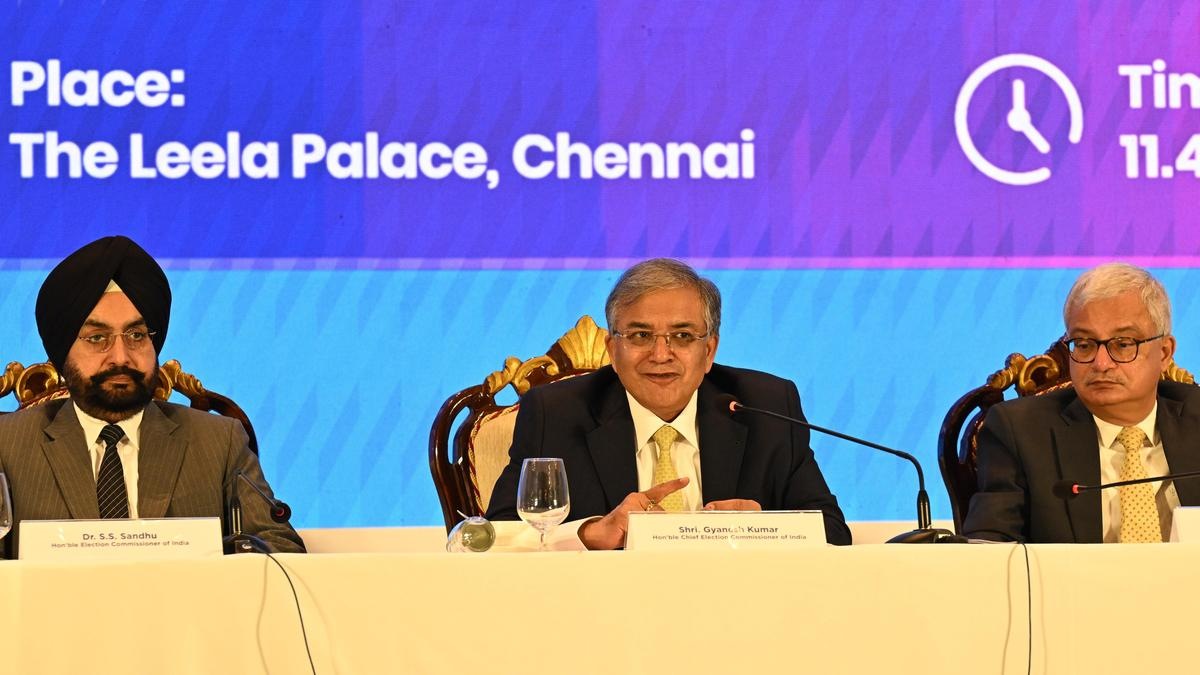
Chief Election Commissioner Gyanesh Kumar, along with Election Commissioners Sukhbir Singh Sandhu and Vivek Joshi, addressing the media in Chennai – Photo Credit-Internet
Out of 5.67 crore electors, only 216 appeals have been filed till day, points out CEC; ‘SIR in TN was a model for the country, great success,’ he says
The Model Code of Conduct (MCC) would be implemented strictly against the money distribution and inducement during the upcoming Assembly election in Tamil Nadu, Chief Election Commissioner (CEC) Gyanesh Kumar said in Chennai recently . The Election Commission of India was “confident” that the elections in the State “would be different this time”,
Addressing a press conference along with Election Commissioners Sukhbir Singh Sandhu and Vivek Joshi, following their review of the State’s poll preparedness, Kumar, said the menace of money distribution for elections, was among the points of discussion during the Commission’s meeting with all political parties. The political parties have “committed” before the Commission against the menace, Kumar said.
“The Election Commission is confident that this time the Tamil Nadu elections are going to be different,” he said. With regard to poll promises, as per law, the Election Commission’s jurisdiction over the entire electoral process starts the day the Model Code of Conduct comes into force, he said. “And that [the MCC] shall be implemented strictly to ensure…. money distribution during elections, the inducement during elections [is acted against]. The entire electoral machinery has been geared up to ensure that this menace of Tamil Nadu elections shall not exist this time.”
The Special Intensive Revision (SIR) of the electoral rolls, which was carried out in Tamil Nadu was a “model for the country” and was a “great success”, Kumar maintained.
The objective of the SIR was no eligible elector should be excluded and no ineligible elector should be included. The revision has to be carried out before the election by the Commission under Section 21 of the Representation of the People Act, 1950. “The basic objective of any revision is to ensure cleaner rolls,” he said.
“About the correctness of SIR in Tamil Nadu, I congratulate the electoral machinery and all the electors of Tamil Nadu that out of 5.67 crore electors, only 216 appeals have been filed till date with the Collectors. That shows the professionalism with which the SIR was carried out in Tamil Nadu,” Gyanesh Kumar said.
When pointed out the elector-population (EP) ratio was not released by the Commission, Kumar said: “The last population Census was done in 2011 and any other population figures are projective and not accurate. So, let us wait for the Census to complete to give you an exact EP ratio.”
Answering a question on political parties urging the Commission to hold a single-phase polling in T.N., Gyanesh Kumar said all the concerns would be taken into account and the Commission would take a decision on how many phases the polling in Tamil Nadu should be held. “The law and order situation in Tamil Nadu is perfectly fine, as we reviewed,” he said.
The final electoral roll was published on February 23, “but as per law, if any person who is eligible and an Indian citizen and wants to add his name even now, it is possible by filling up Form 6 + declaration and necessary documents,” said Gyanesh Kumar.
The application for deletion of names or shifting of names too was still possible, he said. “These three Forms 6, 7 and 8 could be submitted till 10 days before the nomination,” he said.

YOU MAY LIKE THIS