Reg No. - CHHBIL/2010/41479ISSN - 2582-919X

Chhattisgarh Tops Nation in Jal Sanchay Jan Bhagidari 3.0, Five Districts Enter Top 10
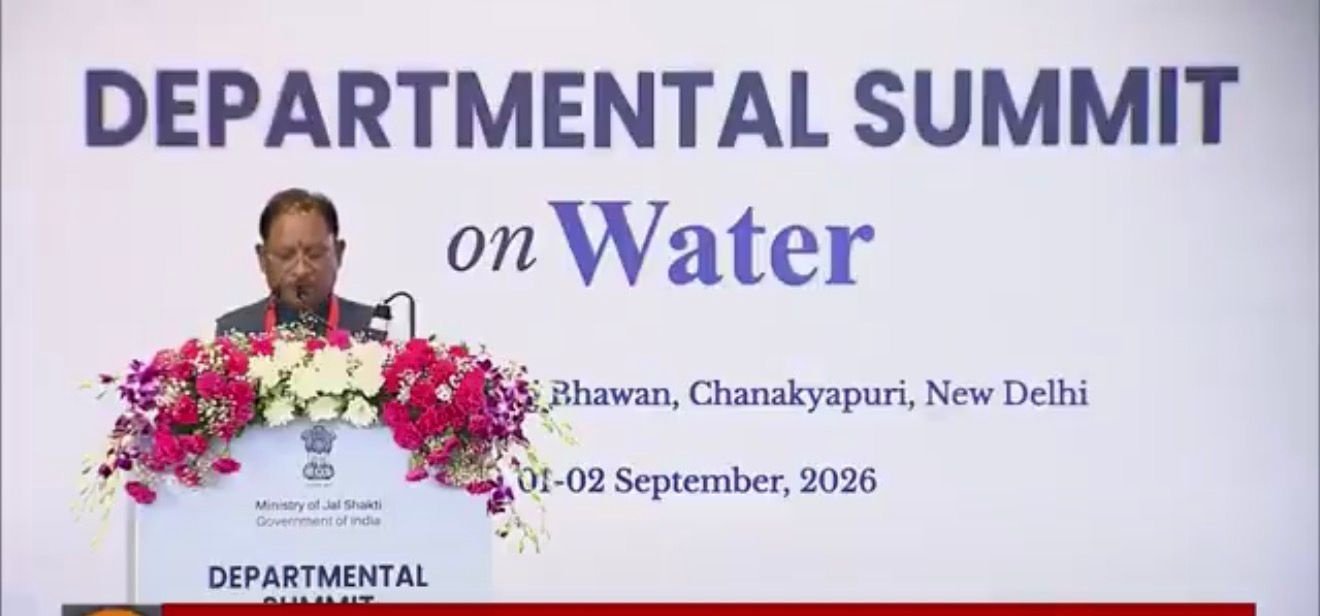
Chief Minister Vishnu Deo Sai addresses the Departmental Summit on Water at Sushma Swaraj Bhawan, New Delhi, on Wednesday, highlighting Chhattisgarh’s efforts to turn rainwater harvesting and groundwater recharge into a community movement-Photo Credit:primelookindia.com via CMO
CM Vishnu Deo Sai showcases state’s community-driven water conservation model at national summit; farmers’ ‘5% model’ emerges as key innovation
Key Factors
- Chhattisgarh ranks No. 1 nationally in JSJB 3.0 after finishing second in the first two phases.
- More than 28 lakh water structures have been registered across the three phases.
- Five Chhattisgarh districts are among the country’s top 10 performers.
- Korea’s ‘5% model’ involves farmers voluntarily setting aside part of their land for water conservation.
- Water-deficient blocks have declined from 26 to 19, according to the state government.
- Sai proposed state-specific Catch the Rain plans, State Water Awards and quarterly monitoring.
Raipur: Chhattisgarh has secured first position in the country in the third phase of the Jal Sanchay Jan Bhagidari (JSJB 3.0) campaign, strengthening its standing in rainwater harvesting and groundwater recharge through community participation.
Chief Minister Vishnu Deo Sai presented Chhattisgarh’s water conservation model at the Ministry of Jal Shakti’s Departmental Summit on Water at Sushma Swaraj Bhawan in New Delhi on Wednesday, September 2, 2026, in the presence of Prime Minister Narendra Modi.
The achievement extends beyond the state ranking. Surajpur, Mahasamund, Balod, Balodabazar-Bhatapara and Kabirdham have figured among the country’s top 10 districts for their performance in water conservation.
“For a farmer, water is not merely a natural resource. It is directly connected with his crop, his family, his livelihood and his future.” — Chief Minister Vishnu Deo Sai
Sai said Chhattisgarh had deliberately moved beyond treating water conservation as merely a government programme by involving farmers, gram panchayats, Jal Sakhis, Jal Mitras and local communities.
Drawing upon his own farming background, the Chief Minister said his experience of cultivating land in his native village Bagiya had given him a close understanding of the importance of water to rural families.
“We have not confined water conservation to government schemes and construction of water structures. By bringing farmers, panchayats and local communities into the effort, Chhattisgarh has turned it into a people’s movement.” — Vishnu Deo Sai
Farmers Put Land Behind Water Conservation
A major feature presented by Sai was the ‘5% model’ pioneered in Korea district, under which participating farmers voluntarily set aside around five per cent of their agricultural land for rainwater harvesting and groundwater recharge structures.
Instead of allowing rainwater to flow away from fields, structures are created to retain it locally and enable gradual percolation into the ground. The initiative makes farmers active partners in conservation rather than merely beneficiaries of government projects.
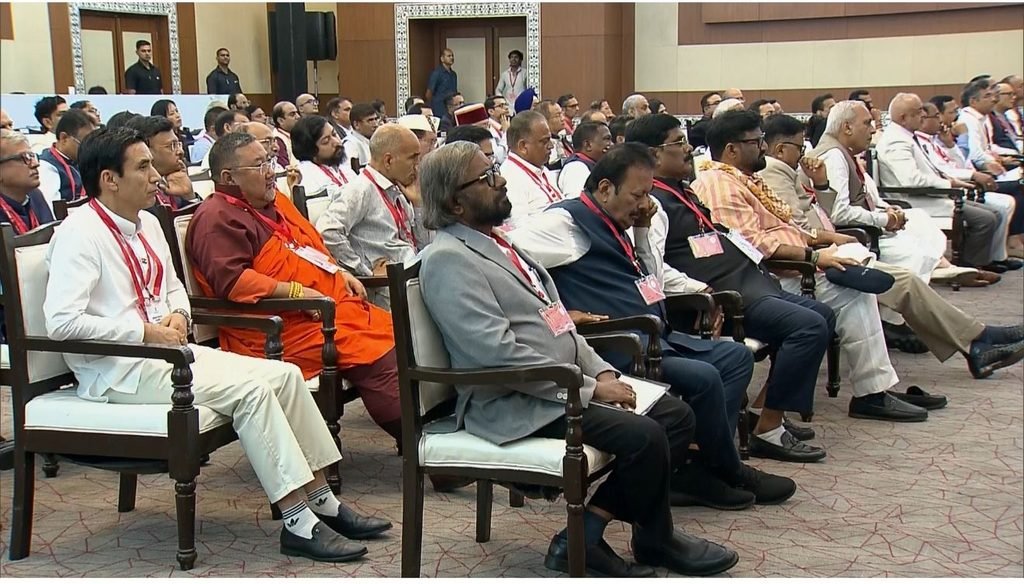
Delegates attend the Departmental Summit on Water in New Delhi on Wednesday September 2, 2026 , where Chhattisgarh showcased its community participation-based approach to rainwater harvesting and groundwater recharge-Photo Credit:primelookindia.com via CMO
The model combines community participation with geo-tagging, monitoring and coordination among government departments and local bodies.
Chhattisgarh’s performance under JSJB has shown consistent improvement. The state ranked second nationally in the first two phases before moving to the number-one position in JSJB 3.0.
According to state government figures, 4,05,561 water structures were created under JSJB 1.0. Under JSJB 2.0, 24,07,456 structures were registered, of which 23,07,768 had been completed. In the third phase, 79,775 structures were registered and 77,719 completed.
Taken together, the three phases represent more than 28 lakh registered water conservation structures across Chhattisgarh.
The state government also reported an improvement in water-stressed areas, with the number of water-deficient blocks declining from 26 to 19. Five critical blocks are also expected to move into the normal category.
“This achievement is not merely about the number of water structures. It reflects the collective consciousness and public participation developing across Chhattisgarh for water conservation.” — Sai
Sai also proposed that every state formulate its own ‘Catch the Rain Plan’ based on rainfall patterns, geography, groundwater conditions and local requirements.
He suggested instituting State Water Awards to encourage better-performing states, strengthening mapping of water structures through BISAG-N and conducting quarterly reviews of campaign progress under the chairmanship of Chief Secretaries.
Technology, regular monitoring and public participation must work together to make water conservation efforts more result-oriented.” — CM Sai
Deputy Chief Minister Arun Sao presented details of Chhattisgarh’s rainwater harvesting, groundwater recharge and drinking-water source conservation initiatives during the summit’s ‘Catch the Rain’ session.
Union Jal Shakti Minister C. R. Patil, water resources ministers from various states and senior officials participated in the summit. Principal Secretary to the Chief Minister Subodh Kumar Singh and Water Resources Secretary Rajesh Sukumar Toppo were also present.
With the national campaign targeting two crore new water structures by May 31, 2027, Chhattisgarh is positioning its community-led approach as a model in which government intervention, technology and voluntary participation by farmers converge to secure water closer to where rain actually falls.

YOU MAY LIKE THIS