Reg No. - CHHBIL/2010/41479ISSN - 2582-919X

Chhattisgarh Tops NAMASTE Scheme Ranking, Pushes Safer and Dignified Sanitation Work
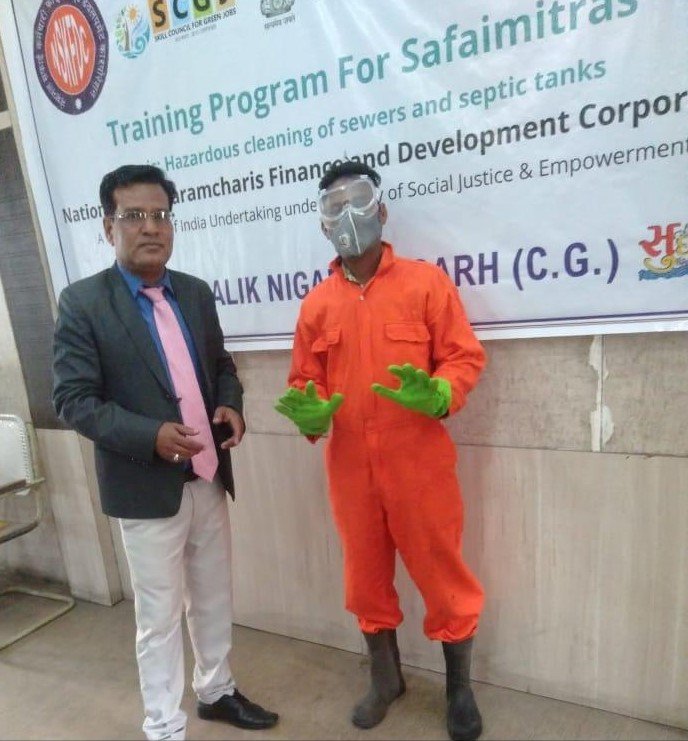
A sanitation worker in protective gear during a sewer and septic-tank safety training programme in Raigarh, Chhattisgarh. The State has secured joint first place nationally in implementation of the NAMASTE scheme, which promotes mechanised sanitation, PPE use, occupational safety and social-security coverage for sanitation workers. Photo: NSKFDC.
State shares national first rank in implementation of mechanised sanitation initiative; 1,428 sewer and septic tank workers provided PPE kits, 1,374 covered under Ayushman Bharat
Raipur: Chhattisgarh has secured joint first place nationally in the implementation of the Centre’s National Action for Mechanised Sanitation Ecosystem (NAMASTE) scheme, marking a significant achievement in efforts to improve the safety, dignity and social security of sanitation workers while reducing their exposure to hazardous work.
Chhattisgarh shares the top position with Andhra Pradesh, Odisha, Tripura, Uttar Pradesh and the Union Territory of Puducherry, according to the State Government.
Deputy Chief Minister and Urban Administration and Development Minister Arun Sao congratulated urban local bodies, departmental officials, employees and field personnel associated with the implementation of the programme.
“The safety, dignity and better working conditions of sanitation workers are among the State Government’s highest priorities,” Sao said.
Key Highlights
- Chhattisgarh secures joint first rank nationally in implementation of the NAMASTE scheme.
- 1,487 sewer and septic tank workers surveyed and 1,465 verified.
- 1,428 workers provided PPE kits across 169 urban local bodies.
- 1,374 workers issued Ayushman Bharat cards.
- 139 sewer and septic tank workers received occupational safety training.
- Another 923 sanitation workers were trained through safety workshops.
- 8,527 waste pickers profiled, of whom 6,799 have been verified.
- 991 waste pickers provided PPE kits and 512 given occupational safety training.
- 47 Emergency Response Sanitation Units (ERSUs) established across the State.
- The 14420 helpline is being operated to support emergency sanitation response.
- NAMASTE seeks to promote mechanisation and move towards zero fatalities in sanitation work.
‘Hazardous Sanitation Work Must Be Eliminated’
Sao said greater mechanisation was essential to remove workers from dangerous sanitation operations and provide them with a safer and more dignified working environment.
“By promoting mechanisation in sanitation work, eliminating hazardous operations and providing sanitation workers with a safe and dignified working environment, we are fulfilling an important commitment of the government,” Sao said.
He described the national ranking as recognition of the work being undertaken in worker verification, safety equipment, occupational training, social-security coverage, emergency response and mechanisation.
“Securing joint first position nationally in the implementation of the NAMASTE scheme is an important achievement in our efforts towards the dignity of sanitation workers, safer sanitation systems and the goal of zero deaths during sanitation work,” Sao said.
PPE Kits and Health Protection
According to the Urban Administration and Development Department, 1,487 sewer and septic tank workers have so far been surveyed in Chhattisgarh and 1,465 verified.
PPE kits have been distributed to 1,428 workers across 169 urban local bodies, while 1,374 workers have received Ayushman Bharat cards.
Occupational safety training has been provided to 139 sewer and septic tank workers, while another 923 sanitation workers have received safety-related training through workshops.
The State also observed NAMASTE Day on July 14 across its urban local bodies, with more than 15,000 sanitation workers, public representatives, government personnel and citizens participating. Activities included health examinations, occupational safety training, recognition of sanitation workers and distribution of PPE kits and health cards.
Waste Pickers Brought Under Safety Net
The programme has also been extended to waste pickers.
The department said 8,527 waste pickers have been profiled and 6,799 verified. PPE kits have been distributed to 991 waste pickers, while 512 have undergone occupational safety training.
Preparations are underway to provide similar training to another 6,287 waste pickers.
The expansion is significant because the objective of NAMASTE extends beyond sewer and septic tank operations to workers engaged in other potentially hazardous sanitation activities.
47 Emergency Response Sanitation Units Operational
Chhattisgarh has established 47 Emergency Response Sanitation Units (ERSUs) to strengthen emergency response for sanitation workers.
These include units in 14 municipal corporations, 24 district headquarters and nine other urban bodies identified on the basis of population. Safety kits have been supplied to 39 of the ERSUs.
The State is using these units along with the 14420 helpline to develop a system for rapid and safer intervention during sanitation emergencies.
How Chhattisgarh Reached the Top Rank
Implementation of NAMASTE was assessed on a 100-point evaluation framework.
The criteria included 20 marks for verification of profiled sanitation workers, 10 for mechanisation through SUY, 20 for operation of ERSUs and the 14420 helpline, 20 for social-security coverage, and 30 for enforcement, compensation and accountability relating to sanitation deaths.
The framework also provides for negative marking in cases involving sanitation-related fatalities.
On the basis of these parameters, Chhattisgarh secured the joint national first rank.
From Manual Risk to Mechanised Sanitation
Launched by the Government of India in 2023, NAMASTE aims to provide sewer and septic tank workers with safe and dignified livelihoods, social security and workplace protection.
The programme seeks to increase mechanisation, eliminate unsafe and hazardous manual cleaning practices and achieve the goal of zero fatalities during sanitation operations.
It covers sewer and septic tank workers, waste pickers, drain cleaners and personnel working at sewage treatment plants and faecal sludge treatment plants.
The scheme is jointly implemented by the Union Ministry of Housing and Urban Affairs and the Ministry of Social Justice and Empowerment, with the National Safai Karamcharis Finance and Development Corporation serving as the national implementing agency.
In Chhattisgarh, the Urban Administration and Development Department is implementing the programme through urban local bodies across the State.
For Sao, however, the ranking represents more than an administrative achievement. The larger objective remains ensuring that those responsible for keeping cities clean do not have to risk their lives while doing their jobs.

YOU MAY LIKE THIS