Reg No. - CHHBIL/2010/41479ISSN - 2582-919X

Chhattisgarh Bets Beyond Mining, Eyes High-Value Manufacturing as Next Growth Engine-By-Dhananjay Rathore
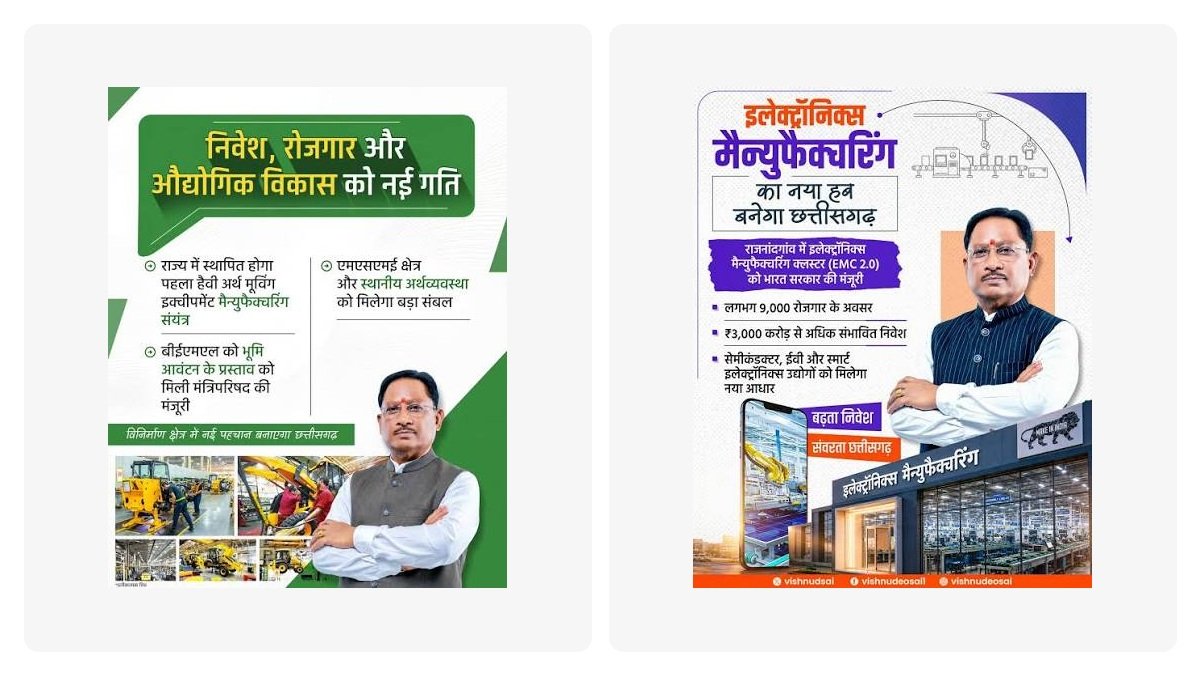
Chhattisgarh is seeking to broaden its industrial base beyond mining and primary processing, with new investment focused on electronics manufacturing, semiconductors, AI, pharmaceuticals, engineering and other high-value sectors under the state’s evolving industrial strategy. (Graphics: Chhattisgarh Government)
Nearly ₹8 lakh crore in investment proposals underline the state’s ambition to expand into electronics, semiconductors, AI, pharmaceuticals and green steel
For decades, Chhattisgarh’s industrial strength has been closely associated with what lies beneath its soil. Rich mineral reserves, steel production and primary processing have provided the foundation for the state’s industrial economy. The emerging challenge, however, is to create substantially greater value from those resources within Chhattisgarh itself.
The state is now seeking to broaden that industrial identity by moving from extraction and primary processing towards value-added and technology-driven manufacturing. Electronics, semiconductors, pharmaceuticals, engineering, automobile components, defence equipment, artificial intelligence, data centres and green steel are increasingly becoming part of this new industrial landscape.
The Industrial Development Policy 2024-30 provides the framework for this transition. While encouraging better utilisation and value addition of local resources, the policy also seeks investment in electronics, information technology, AI, robotics, biotechnology, pharmaceuticals, defence and engineering.
The underlying objective is significant: Chhattisgarh should not remain merely a source of minerals and raw materials for industries elsewhere. It should increasingly become a place where those advantages are converted into finished products, advanced manufacturing and employment.
Investment Interest Moves Into New Sectors
The changing direction is reflected in the scale and composition of investment proposals received by the state.
Over roughly the past 18 months, Chhattisgarh has received investment proposals approaching ₹8 lakh crore, according to the state’s investment promotion portal. If implemented, these projects have the potential to generate more than 1.5 lakh employment opportunities.
The numbers are important, but the sectors attracting investors reveal an equally significant change.
Investment interest is no longer concentrated only in conventional mineral-based industries. Proposals are emerging in areas such as AI, data centres, semiconductors, pharmaceuticals, textiles and agro-processing, indicating a gradual diversification of the state’s industrial base.
Nava Raipur is becoming particularly important in this transition, with investments linked to artificial intelligence and data centres. Semiconductor-related proposals exceeding ₹18,000 crore further indicate the state’s intention to participate in India’s expanding high-technology manufacturing ecosystem.
Another major development is the approval of an Electronics Manufacturing Cluster under EMC 2.0 in Rajnandgaon. The cluster is expected to facilitate investment of more than ₹3,000 crore and generate around 9,000 direct and indirect jobs.
Such a project has implications beyond a single manufacturing facility. Electronics manufacturing requires component suppliers, logistics, engineering services, technical skills and supporting enterprises. A successful cluster can therefore create an industrial ecosystem around the principal investors and open opportunities for smaller businesses as well.
Chhattisgarh’s Steel Strength Enters the Green Era
Steel remains one of Chhattisgarh’s greatest industrial strengths, but the sector itself is changing.
As India moves towards lower carbon emissions and cleaner manufacturing, green steel is emerging as an important opportunity for a state that already possesses iron ore, an established steel industry and a substantial energy base.
Investment commitments of around ₹13,840 crore during the recent Chhattisgarh Green Steel Dialogue demonstrate the potential of this transition.
The opportunity is not simply to produce more steel. It is to move towards cleaner processes and higher-value steel products capable of competing in markets where carbon intensity and sustainability are becoming increasingly important considerations.
National initiatives encouraging speciality steel production also create an enabling environment for this transformation. Chhattisgarh can combine its existing mineral and industrial advantages with newer technologies to move further up the manufacturing value chain.
Pharma and Electronics Broaden the Industrial Base
Pharmaceuticals are another sector beginning to occupy a larger place in Chhattisgarh’s industrial plans.
During the past 18 months, the state has received pharmaceutical investment proposals of around ₹992.53 crore, while four projects involving approximately ₹216 crore have reached the implementation stage.
Pharmaceutical manufacturing brings requirements very different from traditional mineral-based industries. Skilled manpower, laboratories, research capabilities, quality-control systems and specialised infrastructure become increasingly important. Expansion in this sector can therefore diversify both industrial activity and employment opportunities.
Electronics presents a similar possibility.
India’s rapid expansion of domestic electronics and component manufacturing is creating new supply chains across the country. With the Rajnandgaon EMC 2.0 initiative, Chhattisgarh has an opportunity to become part of those networks rather than remaining primarily a supplier of raw materials and energy to manufacturing centres located elsewhere.
Value Addition Must Reach Bastar and Surguja Too
The transformation of Chhattisgarh’s industrial economy cannot, however, depend entirely upon large technology projects or manufacturing clusters.
Regions such as Bastar and Surguja possess their own economic strengths. Forest produce, agriculture, food processing and other locally available resources can support smaller and region-specific industries.
Processing resources closer to where they originate can create additional value locally, generate employment and encourage entrepreneurship. Such an approach is particularly relevant for areas where industrialisation must complement local livelihoods rather than simply replicate the model followed by established industrial centres.
This gives Chhattisgarh’s industrial strategy two dimensions — attracting large investments in emerging sectors while simultaneously strengthening local economies through resource-based value addition.
From Investment Proposals to Production
Attracting investment is only the beginning. The larger challenge is converting proposals into functioning industries.
To reduce procedural delays, the state has been strengthening its single-window clearance mechanism, State Investment Promotion Board (SIPB) system and online approval processes. Priority facilitation and faster approvals have also been envisaged for projects involving investment exceeding ₹100 crore.
The effectiveness of these measures will ultimately be judged not by the value of proposals announced but by how many projects reach implementation, how quickly factories begin production and how much sustainable employment they create.
Availability of skilled manpower, infrastructure, reliable energy, efficient logistics and predictable regulatory processes will remain crucial as Chhattisgarh competes with other states for technology-intensive investment.
The state nevertheless begins this transition with considerable advantages. It already possesses minerals, energy, steel-making capacity and an established industrial base. The task now is to use those strengths as foundations for industries that generate greater value.
If semiconductor proposals become manufacturing units, electronics clusters develop supporting supply chains, pharmaceutical projects move into production and the steel industry successfully embraces cleaner technologies, Chhattisgarh’s industrial profile could look considerably different in the years ahead.
The state’s industrial story has long been defined by the resources extracted from its land. Its next chapter will depend increasingly on the value, technology and products it creates from them.
Author is Joint Director, Chhattisgarh Department of Public Relations, Raipur

YOU MAY LIKE THIS