Reg No. - CHHBIL/2010/41479ISSN - 2582-919X

A Healthy Mind Is Not a Luxury — It Is a Necessity-By Kumar Bahukhandi

Beyond the smiles we wear and the success we celebrate lies an often-neglected reality: mental wellbeing is as essential to human dignity as physical health, and a compassionate society must learn to recognise the struggles that remain unseen.
We live in an age in which almost everything is measured. We count our steps, monitor our heartbeats, calculate calories, track productivity and celebrate professional achievements. We invest in physical fitness, appearance and material comfort, yet often overlook the one thing that influences how we experience every aspect of life: the health of our minds.
A person may appear physically fit, professionally successful and socially confident, yet struggle silently with anxiety, emotional exhaustion, loneliness or depression. A cheerful photograph may conceal a difficult day. A confident voice may belong to someone who has spent the night worrying. A successful career may coexist with an overwhelming sense of emptiness.
And therein lies one of the greatest contradictions of modern society.
We have learnt to recognise physical pain, but we are still learning how to acknowledge emotional suffering.
World Mental Health Day, observed every year on October 10, should therefore be more than an occasion for messages, seminars and social media campaigns. It should encourage us to examine how we treat people, how we define success and whether our families, educational institutions and workplaces genuinely provide space for emotional wellbeing.
The Invisible Burden Behind a Confident Smile
Human behaviour is complex. People do not always reveal what they feel, and outward appearances seldom tell the complete story.
The colleague who greets everyone cheerfully may be dealing with personal difficulties. A student who performs exceptionally well may be struggling under academic expectations. A parent who appears strong may be overwhelmed by responsibilities that leave little room for personal rest.
Not every smile conceals suffering, and not every moment of sadness indicates a mental health condition. Nevertheless, we should never assume that outward confidence is proof of inner peace.
Society has developed a habit of admiring resilience without asking what it costs the individual.
We praise people who work without rest, remain available at all hours and continue performing despite personal difficulties. We sometimes interpret exhaustion as dedication and silence as strength.
But emotional wellbeing cannot be sustained indefinitely through endurance alone.
There comes a point when people need understanding rather than advice, companionship rather than criticism and an opportunity to speak without fear of being judged.
When Success Becomes a Source of Stress
Modern society celebrates achievement, often without acknowledging the pressures that accompany it.
A student is expected to secure excellent marks, gain admission to a prestigious institution and establish a successful career. A young professional is encouraged to earn more, achieve promotions and remain constantly competitive. Parents are expected to provide financial security while fulfilling family and social obligations.
There is nothing inherently wrong with ambition. The problem begins when personal worth becomes inseparable from achievement.
A disappointing examination result is then interpreted as personal failure. A delayed promotion becomes a source of shame. Financial difficulty is mistaken for inadequacy.
Social media can intensify these comparisons by presenting carefully selected moments from other people’s lives as though they represent everyday reality.
We see celebrations but rarely the disappointments that preceded them. We admire success without witnessing the uncertainty, rejection and struggle behind it.
Gradually, individuals may begin comparing their private difficulties with the public achievements of others.
Success should enrich life, not become a burden that makes life unbearable.
Mental Health Is Not a Question of Weakness
One of the most damaging misconceptions surrounding mental health is the belief that emotional difficulties reflect a lack of willpower or personal strength.
People experiencing depression may be told to think positively. Those struggling with anxiety may be advised to stop worrying. Someone experiencing prolonged emotional distress may hear that they simply need to become stronger.
Such responses, even when well intentioned, can discourage people from seeking appropriate help.
Mental health conditions involve complex interactions among biological, psychological and social factors. They cannot always be resolved through motivation, positive thinking or determination.
Professional assessment, counselling, psychological therapies and, where appropriate, medical treatment can make a meaningful difference.
Seeking support should be regarded with the same seriousness and respect as consulting a physician for a physical illness.
Nobody should feel ashamed of asking for help when emotional distress begins affecting daily life, relationships, sleep, concentration or personal safety.
Acknowledging that we need help is not surrender. It is an act of self-awareness and courage.
Students Need Understanding, Not Unrelenting Pressure
Educational institutions have a particularly important responsibility.
For students, academic life is not limited to lectures, examinations and assignments. It also involves questions of identity, belonging, financial security, career prospects and personal expectations.
Young people may face pressure from families, peers and their own ambitions. Some struggle with the fear of disappointing their parents, while others worry about employment opportunities or their ability to meet professional expectations.
In medical and dental education, demanding academic schedules and clinical training can add further pressures.
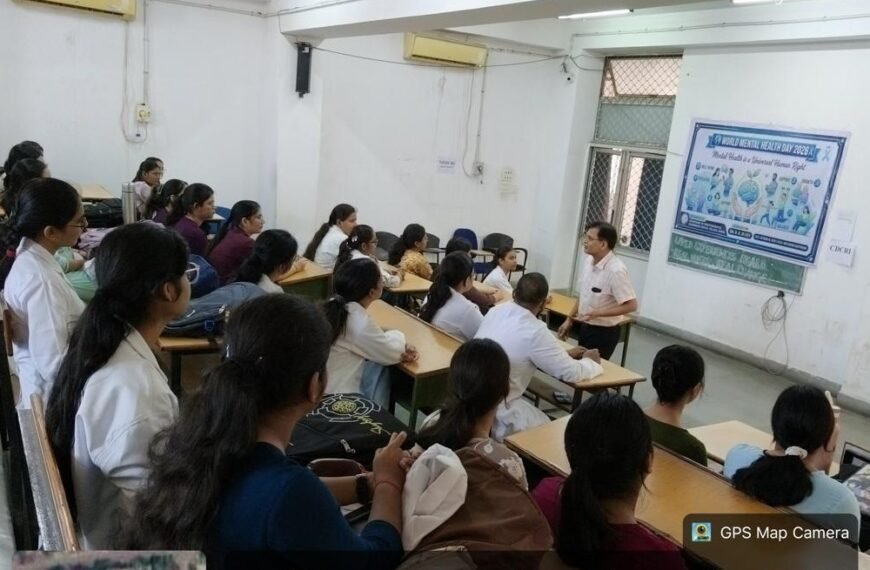
Awareness programmes, such as those organised by educational institutions on World Mental Health Day, can help students understand the importance of emotional wellbeing. But the responsibility should not end with a single event.
Colleges and universities should encourage approachable teachers, confidential counselling services, responsible academic practices and supportive environments in which students can discuss difficulties without humiliation.
Teachers must also recognise that discipline and compassion are not opposing principles.
An educator’s responsibility is not merely to assess performance but also to encourage intellectual growth, confidence and emotional maturity.
A student who receives understanding during a difficult period may remember that kindness long after forgetting a classroom lesson.
Workplaces Must Recognise the Human Being Behind the Employee
Professional life presents another challenge.
Long working hours, unrealistic deadlines, job insecurity, financial obligations and constant digital connectivity can affect emotional wellbeing.
Technology has made communication easier, but it has also blurred the boundaries between professional and personal life.
Messages arrive after office hours. Meetings extend into family time. Employees may feel compelled to remain available even when they are exhausted.
In such circumstances, work-life balance becomes more than a fashionable expression. It becomes a matter of wellbeing.
Employers should recognise that productivity cannot be sustained by treating employees as though they have unlimited emotional and physical resources.
Reasonable workloads, respectful communication, fair treatment, appropriate leave and access to mental health support can help create healthier workplaces.
Equally important is an organisational culture in which seeking assistance does not threaten an employee’s dignity or career prospects.
A successful organisation should not be judged solely by its financial performance, but also by how responsibly it treats the people who contribute to that success.
Families Must Become Places of Conversation, Not Judgement
The family is often described as an individual’s strongest support system. Yet families can sometimes become places where emotional difficulties remain unspoken.
Parents may dismiss their children’s concerns as immaturity. Young people may hesitate to discuss personal struggles because they fear criticism. Older family members may conceal loneliness because they do not want to burden others.
These silences can create emotional distances even among people living under the same roof.
Listening is therefore one of the most valuable forms of care.
It does not require us to possess every answer. Nor does it mean agreeing with every concern expressed.
Sometimes, simply allowing someone to speak without interruption or ridicule can help them feel less isolated.
However, compassionate listening should not be mistaken for a substitute for professional care when someone needs clinical support.
Families must learn to recognise when a problem requires more than reassurance and should encourage timely consultation with qualified mental health professionals.
The Loneliness of a Hyperconnected Generation
Never before have human beings had so many ways to communicate.
We have smartphones, messaging platforms, video calls and social networks capable of connecting people across continents within seconds.
Yet digital connection does not always produce emotional closeness.
A person may have hundreds of online contacts and still lack someone with whom they can discuss a personal difficulty.
We exchange messages but sometimes neglect meaningful conversations. We react to photographs but may overlook changes in the behaviour of people close to us.
This does not mean technology is inherently harmful. Digital platforms can provide friendship, access to information and valuable mental health resources.
The challenge is to use technology without allowing it to replace every form of personal interaction.
A conversation across a table, a walk with a friend or an unhurried evening with family can offer something that constant notifications cannot always provide: undivided attention.
Mental Health Awareness Must Go Beyond One Day
World Mental Health Day provides a valuable opportunity to encourage public discussion, but awareness must become a continuing social responsibility.
Educational institutions should integrate mental health literacy into student support systems. Workplaces should create psychologically safer environments. Families should encourage open conversations. Public healthcare systems should work towards making appropriate mental health services more accessible and affordable.
The media also has a responsibility.
Journalists should report on mental health with sensitivity, avoid sensational descriptions and refrain from portraying individuals experiencing psychological difficulties through stereotypes.
Responsible journalism can challenge stigma, communicate reliable information and help readers understand when professional support may be necessary.
Language matters. The words we use can either encourage someone to seek help or deepen their fear of being judged.
Mental health awareness is not simply about identifying conditions. It is about creating a society in which people can seek care without losing respect.
Compassion Is Not a Weakness; It Is a Social Strength
We often associate strength with authority, achievement and the ability to overcome adversity.
But there is another form of strength that deserves greater recognition: the willingness to treat others with compassion.
It takes maturity to listen without immediately judging. It takes patience to understand experiences different from our own. It takes courage to acknowledge our vulnerabilities.
Compassion does not require us to ignore responsibility or excuse harmful behaviour. It requires us to recognise that people are more complex than their mistakes, circumstances or outward appearances.
A healthier society cannot emerge from medical infrastructure alone. It also requires dignity, social support, access to appropriate care and a culture that respects emotional wellbeing.
A Healthy Society Begins With Healthy Minds
Perhaps the most important question on World Mental Health Day is not whether we have posted an inspiring message or attended an awareness programme.
It is whether our behaviour towards others will change after the occasion has passed.
Will we listen more patiently?
Will we stop treating emotional distress as a personal weakness?
Will we encourage someone who needs professional assistance to seek it without embarrassment?
Will we allow ourselves time to rest without feeling guilty?
And will we recognise that our own wellbeing matters just as much as the expectations placed upon us?
The answers to these questions will determine whether mental health awareness becomes a meaningful social movement or remains an annual observance.
We must learn that a person’s value cannot be measured solely through professional success, academic achievement, financial status or public recognition.
Human dignity belongs equally to those who are flourishing and those who are struggling.
Mental health deserves understanding, not judgement; compassion, not criticism; and conversation, not silence.
A healthy mind is not a luxury reserved for those who can afford leisure, comfort or professional success. Mental wellbeing is an essential part of human health, and access to appropriate mental healthcare should be available to everyone.
Behind every confident smile may be a story we do not know. Before judging another person’s silence, behaviour or struggle, perhaps we should first offer the simple kindness of understanding.
Because ultimately, a healthy society begins with healthy minds.
— Kumar Bahukhandi
Editor, Prime Look
Assistant Professor, Journalism & Mass Communication, Pragati College, Raipur

YOU MAY LIKE THIS