Reg No. - CHHBIL/2010/41479ISSN - 2582-919X

Pakistan Has Lost Control of Terrorism It Created, India Tells UN
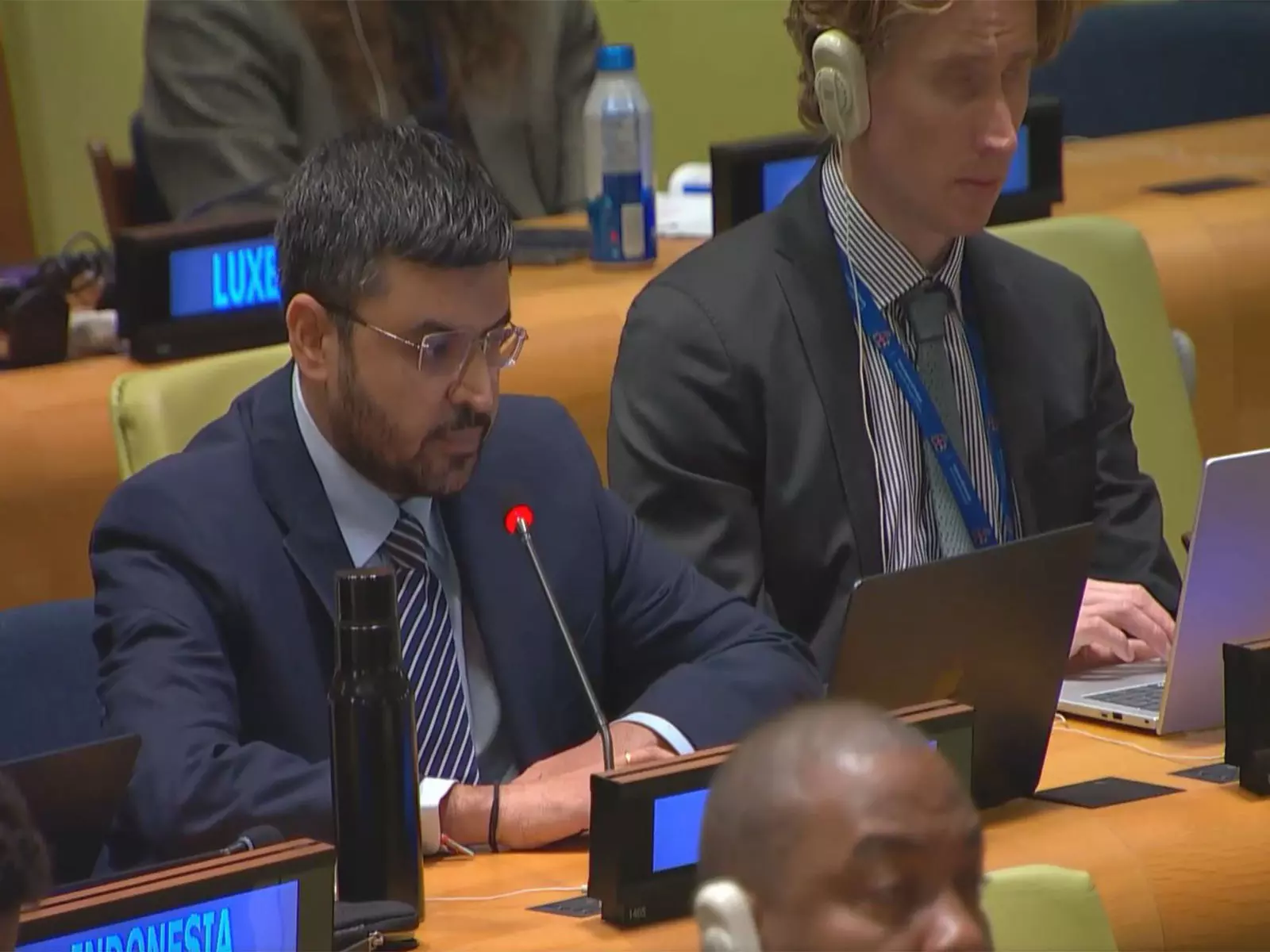
First Secretary Raghoo Puri of India’s Permanent Mission to the United Nations delivers India’s Right of Reply during proceedings of the UN General Assembly’s Sixth Committee in New York. Puri accused Pakistan of losing control of the terrorism ecosystem it allegedly created and called for stronger action against perpetrators, financiers and sponsors of terrorism. Photo: X/@IndiaUNNewYork
First Secretary Raghoo Puri accuses Islamabad of presenting itself simultaneously as a victim of terrorism and a frontline combatant while allegedly allowing terror networks to operate; India calls for action against perpetrators, financiers and state sponsors
Key Highlights
- India accuses Pakistan of losing control over the terrorism ecosystem it allegedly helped create.
- First Secretary Raghoo Puri delivers India’s Right of Reply at the UN General Assembly’s Sixth Committee.
- Puri invokes remarks by Pakistani leaders to challenge Islamabad’s position on terrorism.
- India questions Pakistan’s handling of UN-listed Jaish-e-Mohammed chief Masood Azhar.
- Puri refers to 9/11, the 26/11 Mumbai attacks and the Pahalgam terror attack while pressing for accountability.
- Diplomatic exchange also touches upon Operation Sindoor and Pakistan’s claims about its outcome.
United Nations/New York: India launched a sharp attack on Pakistan at the United Nations, accusing Islamabad of having lost control of the terrorism it allegedly fostered and arguing that the violence it once enabled beyond its borders was now increasingly affecting Pakistan itself.
First Secretary Raghoo Puri, representing India’s Permanent Mission to the United Nations, made the remarks while exercising India’s Right of Reply to Pakistan’s Deputy Permanent Representative Usman Jadoon during proceedings of the UN General Assembly’s Sixth Committee, which deals with legal matters.
Puri accused Pakistan of attempting to portray itself both as a victim of terrorism and as a frontline state fighting it.
“Pakistan has presented itself as a frontline state in combating terrorism and as a victim, while masking the fact that the Frankenstein’s [monster] the Pakistani state has created and lost control over have moved from wreaking havoc in neighbouring countries to doing the same in Pakistan,” Puri said.
He argued that statements made by Pakistani political leaders themselves had exposed contradictions in Islamabad’s position.
Without naming them directly, Puri referred to recent remarks by Pakistan’s Punjab Chief Minister Maryam Nawaz and to a 2018 interview given by her father and former Pakistan Prime Minister Nawaz Sharif.
“You cannot run with the hares and hunt with the hounds. Reality never works like that,” Puri told the committee. IANS News
India Raises Masood Azhar Question
Puri also questioned Pakistan’s approach towards Masood Azhar, the UN-listed chief of Jaish-e-Mohammed.
India argued that Islamabad’s announcement of an increased reward for Azhar’s apprehension did little to address the larger issue of terror groups and their leadership operating from Pakistani territory.
Puri said that if journalists could reach Azhar and obtain comments from him, Pakistani authorities should also be capable of establishing his whereabouts.
He further recalled that Pakistani representatives had previously described Jaish-e-Mohammed as a defunct organisation.
For India, Puri said, the fundamental issue was not declarations against terrorism but concrete action against those responsible for organising, financing, facilitating and sponsoring it.
“When terrorist groups are allowed to operate under state political power, international commitments become meaningless, and when perpetrators are provided safe havens, the victims of terrorism are denied justice,” he said.
‘World Has Not Forgotten’
Puri invoked some of the most consequential terror attacks of recent decades while making India’s case.
He referred to the September 11 attacks in the United States and the fact that al-Qaeda chief Osama bin Laden was eventually found in Abbottabad, Pakistan. He also recalled the 26/11 Mumbai attacks and the Pahalgam terror attack.
“The world has not forgotten 9/11,” Puri said, before adding that the world had neither forgotten 26/11 nor Pahalgam.
Responding to Pakistan’s comments concerning religious minorities in India, Puri referred specifically to the Pahalgam victims.
“The victims in Pahalgam were not asked about their political orientation; they were asked about their religion,” he said.
Puri described it as deeply ironic for Pakistan to speak about combating religious hatred while, according to India’s position, permitting conditions that facilitate cross-border terrorism.
Operation Sindoor Enters UN Exchange
The diplomatic confrontation also extended to competing Indian and Pakistani narratives surrounding Operation Sindoor, launched by India following the Pahalgam terror attack.
Rejecting Pakistan’s account of the military confrontation, Puri remarked:
“If bombed-out airfields and cratered runways look like victory to Pakistan, they are, of course, welcome to enjoy it.”
The remark represented India’s position in an ongoing and contested India-Pakistan narrative over the operation and its military outcome.
When Pakistan exercised another Right of Reply, Puri returned to the floor and accused Islamabad of concentrating on narratives rather than counter-terrorism.
“Pakistan believes in the circular economy of words and narratives,” he said.
He added that greater effort devoted to fighting terrorism rather than what India described as misinformation and narrative-building would have served the international community better.
India Calls for International Accountability
Beyond the India-Pakistan exchange, Puri sought to frame the issue as one requiring broader international action.
India’s argument before the committee was that counter-terrorism cannot succeed merely through public declarations. States must act against perpetrators, organisers, financiers and sponsors, while preventing their territories from providing safe havens or support.
Puri also referred to the Financial Action Task Force (FATF) and its forthcoming plenary, pointing to terror financing as an area requiring continued international scrutiny.
The exchange once again brought the long-running dispute between India and Pakistan over cross-border terrorism onto the UN stage, with New Delhi maintaining that international commitments against terrorism must ultimately be judged by action rather than declarations.

YOU MAY LIKE THIS