Reg No. - CHHBIL/2010/41479ISSN - 2582-919X

Pragati College Pays Tribute to Mahatma Gandhi and Lal Bahadur Shastri, Recalls Their Enduring Legacy
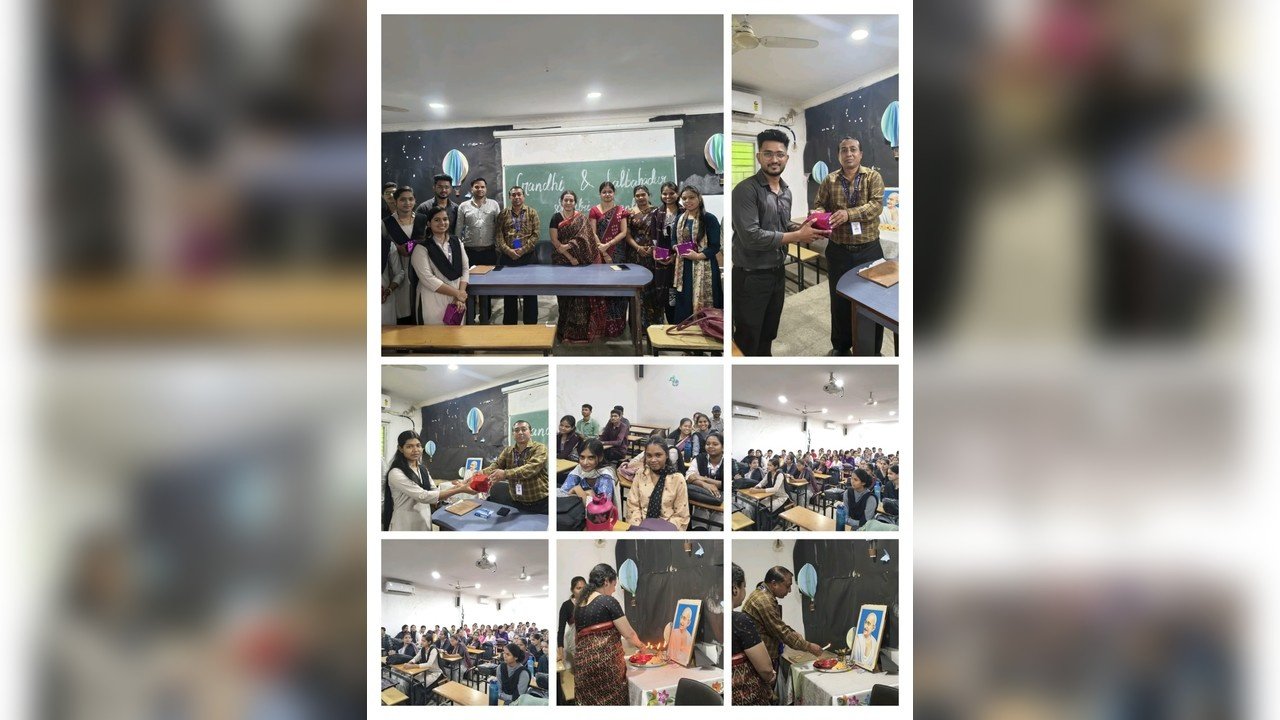
Faculties and students the Education Department of Pragati College, Raipur, pay homage to Mahatma Gandhi and former Prime Minister Lal Bahadur Shastri during a commemorative programme marking their birth anniversaries. Head of the Education Department K. N. Gajpal initiated the programme by offering floral tributes, while Dr Gunjan Sharma conducted the proceedings. Students also participated in the programme and were presented tokens on the occasion. Photo: Pragati College, Raipur
Education Department commemorates the birth anniversaries of two national leaders, highlighting Gandhi’s message of non-violence and Shastri’s simplicity, courage and commitment to national service
Key Highlights
- Education Department of Pragati College, Raipur, organised a commemorative programme honouring Mahatma Gandhi and former Prime Minister Lal Bahadur Shastri.
- Head of the Department K. N. Gajpal initiated the programme by offering floral tributes to the two national leaders.
- Dr Gunjan Sharma conducted the programme.
- Gajpal highlighted Gandhi’s philosophy of truth and non-violence and his contribution to India’s freedom struggle.
- Remembering Shastri, he spoke about his modest background, simplicity and leadership during a crucial period in India’s history.
- The significance of Shastri’s enduring call “Jai Jawan, Jai Kisan” was highlighted before students.
- Students and members of the department participated in the programme and paid their respects.
Raipur: The Education Department of Pragati College, Raipur, paid homage to Mahatma Gandhi and former Prime Minister Lal Bahadur Shastri, remembering their contribution to the nation and reflecting on the values that continue to make their lives relevant to successive generations.
The commemorative programme brought students and members of the department together to remember two leaders whose lives, though shaped by different periods and responsibilities, became closely associated with simplicity, public service and commitment to the country.
Head of the Education Department K. N. Gajpal initiated the programme by offering floral tributes to the portraits of Mahatma Gandhi and Lal Bahadur Shastri. Other members of the department and students subsequently joined in paying homage.
Addressing the gathering, Gajpal recalled Gandhi’s contribution to India’s freedom struggle and emphasised the lasting importance of his principles of truth and non-violence.
He said Gandhi demonstrated that struggle need not necessarily depend upon violence and that moral conviction, discipline and peaceful resistance could become powerful instruments in the pursuit of justice and freedom.
Gajpal encouraged students to look beyond ceremonial remembrance and understand the values represented by Gandhi’s life. Principles such as truthfulness, tolerance, peaceful coexistence and respect for others, he observed, remain meaningful in contemporary society and can help young people develop a stronger sense of social responsibility.
Turning to Lal Bahadur Shastri, Gajpal recalled the former Prime Minister’s modest beginnings and his journey to the country’s highest political office through perseverance, simplicity and dedication to public service.
He said Shastri’s life demonstrated that a person’s circumstances at birth need not determine the limits of what he or she can contribute to society. Coming from a family of limited means, Shastri went on to shoulder the responsibility of leading India at a demanding period in the country’s history.
Particular attention was drawn to Shastri’s celebrated call, “Jai Jawan, Jai Kisan,” which brought the soldier and the farmer together in a powerful expression of national responsibility. The gathering was reminded that while soldiers safeguard the nation’s borders, farmers contribute fundamentally to its food security and everyday sustenance.
The programme also provided students an opportunity to reflect on the sacrifices associated with India’s national movement and on the responsibilities that accompany citizenship.
Dr Gunjan Sharma, who conducted the programme, connected its different segments and encouraged students to understand the relevance of the ideals represented by Gandhi and Shastri rather than viewing their birth anniversaries merely as commemorative occasions.
The participation of students added significance to the programme, turning the observance into an opportunity for learning and reflection. The occasion underlined the role educational institutions can play in familiarising younger generations with the lives, ideas and public contributions of national figures.
The programme concluded with a collective remembrance of Mahatma Gandhi and Lal Bahadur Shastri and a message to carry forward the values of peace, simplicity, service, responsibility and commitment to the nation in everyday life.

YOU MAY LIKE THIS