Reg No. - CHHBIL/2010/41479ISSN - 2582-919X

Lal Bahadur Shastri: The Quiet Man Who Led India Through One of Its Toughest Hours-By-Kumar Bahukhandi
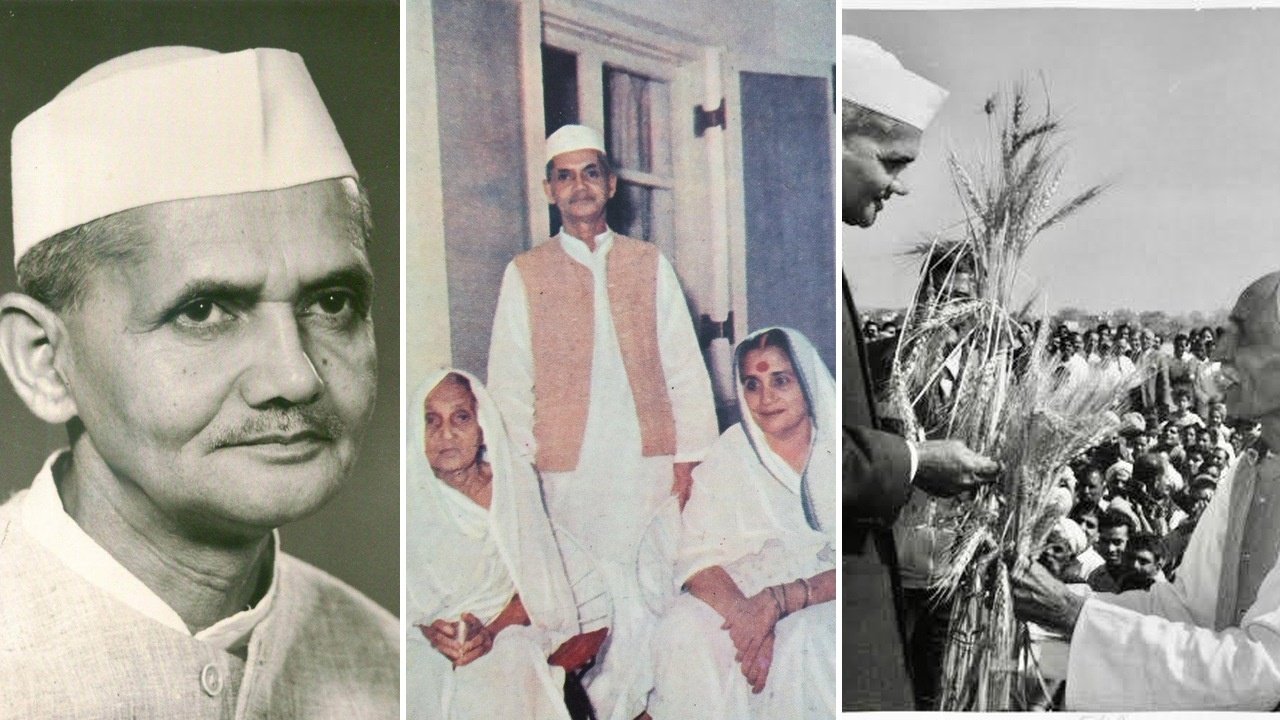
Lal Bahadur Shastri in three chapters of a remarkable life — the statesman, the family man and the leader among India’s farmers. Born in modest circumstances on October 2, 1904, Shastri travelled from the freedom struggle and years of imprisonment to become India’s second Prime Minister. His enduring call, “Jai Jawan, Jai Kisan”, placed the soldier and the farmer together at the heart of India’s national priorities. Photos: Archival
From a fatherless childhood and barefoot journeys to school to the freedom struggle, ministerial responsibility, the 1965 war and “Jai Jawan, Jai Kisan” — the journey of a man whose premiership lasted barely nineteen months but whose words still echo across India
Every October 2, India remembers Mahatma Gandhi. On the same day in 1904, in the railway town of Mughalsarai near Varanasi, another child was born who would one day occupy the office of the Prime Minister of India.
His name was Lal Bahadur.
There was little in his childhood to suggest that the boy affectionately called “Nanhe” would one day lead the world’s largest democracy through war and a severe food crisis. His father died when Lal Bahadur was barely a year and a half old. His mother, Ramdulari Devi, was left to raise her children in circumstances where money was scarce and hardship familiar.
His official biography records that as a schoolboy in Varanasi, Lal Bahadur would walk several miles to school, sometimes without shoes—even when the summer roads were scorching hot.
Those details matter because simplicity did not enter Shastri’s life after he entered politics. It preceded politics.
Decades later, when critics mistook his modest physical appearance and soft-spoken manner for weakness, Shastri himself addressed the perception:
“Perhaps due to my being small in size and soft of tongue, people are apt to believe that I am not able to be very firm.”
India would eventually discover how misleading that assumption could be.
Then I would continue directly into Gandhi’s influence and his decision at 16 to leave conventional education, followed naturally by Kashi Vidyapith and how “Shastri” became part of his name. His marriage and refusal of an elaborate dowry should come next—not as a trivia box, but as part of understanding the man. The detail that he accepted only a spinning wheel and a few yards of handspun cloth is particularly telling.
From there, the freedom struggle should flow into his roughly seven years in British prisons, Independence, his administrative career in Uttar Pradesh, and his movement into national politics.
The Railway Minister resignation deserves a substantial section because it tells readers something about his understanding of political responsibility. We should explain the accident, his resignation, Nehru’s response and why the episode became significant in India’s parliamentary tradition—rather than merely writing that “Shastri was an honest man.”
Then comes Nehru’s death, Shastri becoming Prime Minister on June 9, 1964, the enormous shadow of his predecessor, the food crisis and finally the 1965 war.
At that point the article reaches its emotional centre:
Jai Jawan, Jai Kisan
India needed the soldier at its frontier.
India also needed the farmer in its fields.
Shastri found four words for both:
“Jai Jawan, Jai Kisan.”
The phrase was short enough to be a slogan, but large enough to contain a national philosophy: security without food was insufficient, and food security without national security was equally fragile.
That section can include the family’s own observance of a fast before Shastri appealed to citizens to voluntarily miss a meal during the food shortage. His words are more powerful than our description:
“I had always been feeling uncomfortable in my mind about giving advice to others and not acting upon it myself.”
We then move into the 1965 India-Pakistan war, showing the contrast between the apparently mild man and the decisions he took as Prime Minister. Instead of repeatedly calling him “strong”, we let his record and words establish that.
His idea of national defence was also broader than the battlefield:
“The preservation of freedom is not the task of soldiers alone. The whole nation has to be strong.”
And after war, his emphasis returned to peace:
“We must fight for peace bravely as we fought in war.”
That provides the perfect bridge to Tashkent.
The final section should slow down considerably: his journey to Tashkent, negotiations with Pakistan President Ayub Khan, signing of the Tashkent Declaration on January 10, 1966, and his death in the early hours of January 11.
Then we end not by declaring him India’s greatest Prime Minister, but with the question you originally wanted to place before your readers:
Nineteen Months — and the Question History Leaves Behind
Lal Bahadur Shastri did not govern India for ten years.
He did not govern for five.
He did not even complete two.
His premiership lasted barely nineteen months.
Yet within those nineteen months came a war, a food crisis, the push towards greater agricultural self-reliance, the continuing development of India’s dairy cooperative movement, the call of “Jai Jawan, Jai Kisan”, and finally the journey to Tashkent in search of peace.
Before becoming Prime Minister, he had already provided another example through his resignation as Railway Minister: political office carried responsibility, not merely authority.
So perhaps the more interesting question is not whether Lal Bahadur Shastri was India’s “best” Prime Minister.
The question is: what should Indians expect from a good Prime Minister?
Length of tenure? Electoral victories? Economic growth? Military leadership? Administrative reforms? Personal integrity? The willingness to accept responsibility when something goes wrong? Or the ability to ask citizens for sacrifice only after making that sacrifice oneself?
India has been led by Prime Ministers belonging to different generations, facing different circumstances and holding different political philosophies. History records their decisions and their consequences.
The evidence belongs to history. The judgment belongs to the people.
And somewhere in that judgment remain four words spoken during one of India’s difficult periods:
“Jai Jawan, Jai Kisan.”

YOU MAY LIKE THIS