Reg No. - CHHBIL/2010/41479ISSN - 2582-919X

The Alluring Mirage: A Conceptual Study of Perception, Memory and Belief in Supernatural Experiences-
About the Author
Kumar Bahukhandi is a journalist, editor and educator with experience in journalism, mass communication and digital media. He serves as Assistant Professor of Journalism & Mass Communication at Pragati College, Raipur, Chhattisgarh. His areas of interest include journalism, media studies, communication, society, human behaviour and contemporary issues.
Abstract
Human beings have probably wondered about the supernatural for as long as they have wondered about death itself. Scientific advancement has explained many phenomena once surrounded by mystery, yet experiences described as paranormal, spiritual or supernatural have not disappeared from human narratives. People continue to speak of unexplained sounds, shadows, sensed presences, communication with deceased loved ones, dreams that appear unusually meaningful and moments in which imagination and reality seem difficult to separate.
This conceptual paper does not attempt to establish whether spirits or supernatural entities exist. Nor does it begin with the assumption that people reporting such experiences are necessarily describing objective external events. Instead, it asks a different question: why does an experience feel real to the person experiencing it, and what makes one individual interpret it as supernatural while another interprets a similar experience psychologically or rationally?
The paper explores the relationship between perception, memory, grief, fear, expectation and culturally inherited beliefs. It also proposes the expression “ontological mirage” as a conceptual description for experiences that possess a powerful sense of reality for the individual while their independent external existence remains uncertain or unverified. The argument advanced here is that an experience can produce genuine emotional and behavioural consequences without necessarily proving the objective existence of what appears to have caused it. Between unquestioning belief and outright dismissal lies an intellectually important territory—the alluring mirage of human perception.
Keywords: supernatural experience, perception, memory, belief, grief, fear, hallucination, cultural belief, ontological mirage
Introduction
Since time immemorial, human beings have wondered whether there is something beyond what the eyes can see and reason can comfortably explain.
Some believe there is.
Some are certain there is not.
Many of us probably stand somewhere in between.
Despite extraordinary scientific progress, stories about supernatural experiences have never completely disappeared. They may change their language and surroundings, but the basic human experience remains familiar. Somebody hears footsteps when nobody appears to be there. Another person feels the presence of a deceased relative. A shadow seen from the corner of the eye suddenly acquires a human shape. A dream seems too meaningful to be dismissed as merely a dream.
What happened?
Was it an external event? A mistake of perception? Memory? Fear? Expectation? Coincidence? Or something for which the individual simply had no explanation?
The temptation is to choose a side immediately. Either the supernatural explanation must be accepted, or the experience must be dismissed.
This paper takes neither route.
Its concern is not primarily with proving ghosts, spirits or other supernatural entities. The more interesting question for the present discussion is how human beings experience, interpret and give meaning to the unexplained.
A frightened person and a grieving person may both experience what they describe as a “presence”. Yet society may call one experience hallucination and the other spiritual comfort. Why does the vocabulary change?
Perhaps the answer lies not only in what we see, but also in what we bring with us when we see it.
Research Questions
This conceptual inquiry is guided by four questions:
- How do perception, memory and expectation influence experiences interpreted as supernatural?
- What role do grief, affection and fear play in giving meaning to an unexplained experience?
- How do family, culture, folklore and popular media shape the interpretation of ambiguous events?
- Can an experience be psychologically and emotionally real without establishing that its apparent supernatural cause objectively exists?
These questions deliberately avoid the question, “Are ghosts real?”
That question has occupied human beings for centuries. This paper asks instead: what happens in the human mind when something feels real but cannot easily be established as such?
Conceptual Approach
This is a conceptual and interpretative paper. It does not report a survey, experiment or clinical study and therefore makes no claim to provide empirical proof for or against supernatural phenomena.
Its purpose is to examine an apparent contradiction in everyday human experience.
We frequently accept that perception can be mistaken. A distant object can look like a person. Clothes hanging in a dark room can momentarily resemble a human figure. A familiar sound can be misunderstood when heard unexpectedly.
Yet when the experience carries strong emotional meaning, our interpretation may change.
The important distinction, therefore, is between the reality of an experience and the reality of its presumed cause.
A person may genuinely experience fear.
That does not establish that the object feared actually existed.
A grieving person may genuinely feel the presence of someone who has died.
That feeling should not be mocked or casually dismissed. But the sincerity and emotional reality of the experience do not, by themselves, establish that the deceased person was physically or supernaturally present.
This distinction provides the conceptual foundation of the present paper.
Perception: Do We Always See What Is There?
Human beings do not experience their surroundings like cameras recording everything without interpretation.
We notice, select, recognise and interpret.
Imagine walking alone late at night. There is little light. A shape appears some distance away.
During daylight, the same shape might immediately be recognised as a tree, an electric pole or a piece of cloth.
At midnight, the mind may not wait for complete information.
For a few seconds, it becomes someone.
Perhaps somebody following us.
Perhaps something worse.
The physical object has not necessarily changed. What has changed is the condition under which it is being perceived.
This becomes particularly interesting when fear is already present.
A cremation ground is, physically, a place. Yet for many people it carries meanings accumulated through childhood stories, religious practices, films, warnings and personal associations. Walking beside it at noon and walking beside it alone at midnight are therefore not necessarily identical psychological experiences.
The surroundings may be the same.
The mind entering those surroundings is not.
Fear, Folklore and the Things We Carry With Us
Many beliefs reach us long before we are old enough to examine them critically.
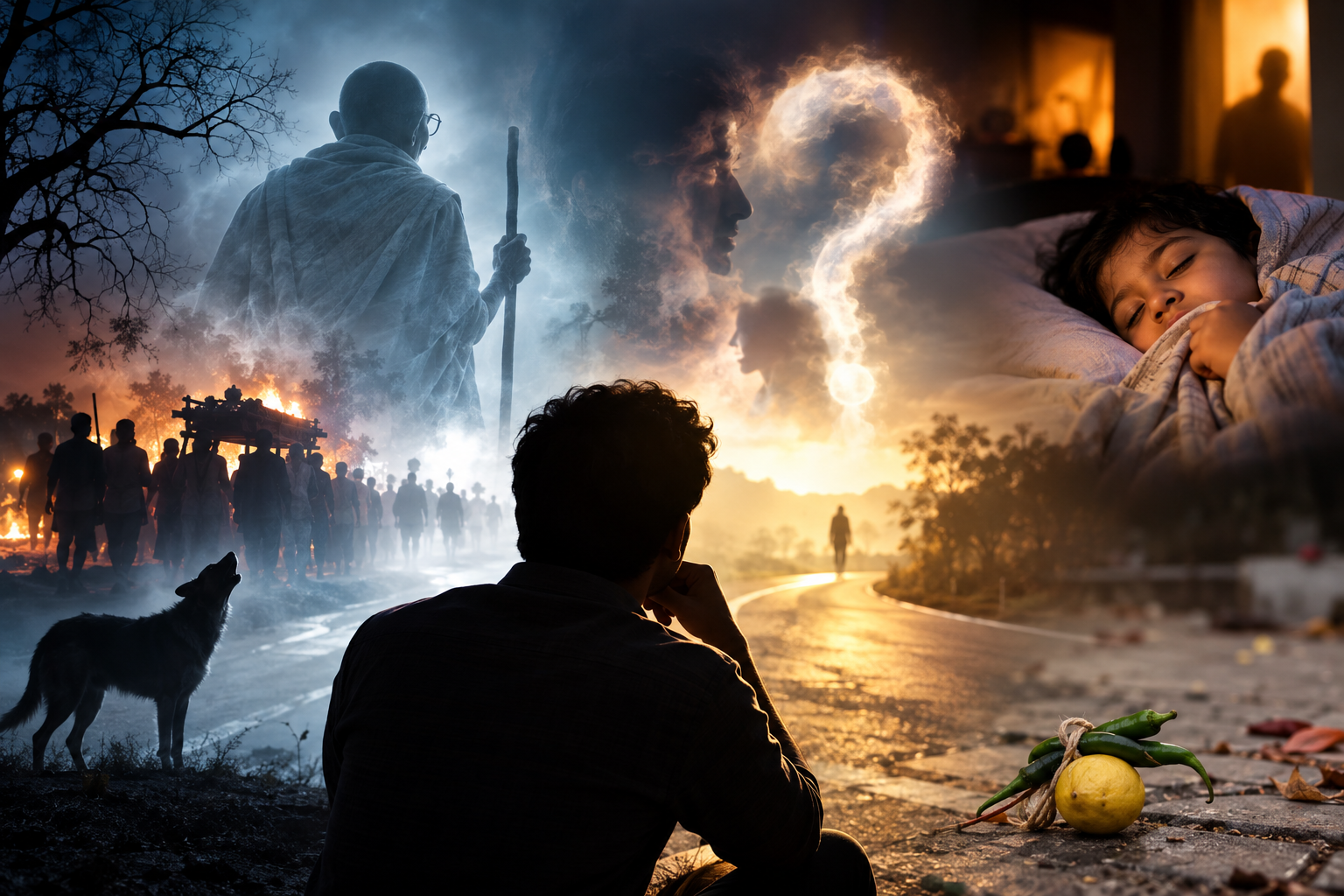
A dog howling continuously at night is sometimes associated with impending misfortune. A lemon and chillies lying at a crossing may make someone avoid stepping over them. A funeral procession may be accompanied by instructions about what one should or should not do.
Such beliefs differ between families, communities and cultures. Their importance here is not whether they are objectively correct.
Their importance is that they can influence behaviour even when the individual consciously claims not to believe in them.
This is one of the curious characteristics of inherited belief.
A person may laugh at a superstition and still hesitate before violating it.
“Why take a chance?” becomes an interesting compromise between belief and disbelief.
Children provide an even simpler example.
A child refuses to sleep.
An adult says, “Sleep, otherwise Baba will come.”
Suddenly the blanket is pulled up and the eyes close.
Where is Baba?
Under the bed?
Behind the curtain?
Outside the window?
Most probably nowhere.
Yet Baba has already produced a measurable result: the child is frightened.
An imaginary presence has caused a real emotional and behavioural response.
Adults may smile at this, but perhaps adulthood does not completely remove our Babas. We merely give them more sophisticated names.
Memory, Grief and the Feeling of Presence
The relationship between memory and supernatural interpretation becomes more delicate when death is involved.
People who have lost somebody deeply important sometimes describe feeling that person’s presence afterwards. The experience may occur in dreams, familiar places, moments of loneliness or during difficult decisions.
Such experiences deserve sensitivity rather than ridicule.
Suppose two people have lived together for forty years. Each knows the other’s habits, expressions, arguments and advice. When one dies, decades of shared life do not vanish from the surviving person’s mind.
At a difficult moment, the survivor may ask internally:
“What would she have told me?”
And the answer may arrive almost immediately.
Where did it come from?
Was it communication?
Was it memory?
Was it the mind reconstructing the response of somebody it knew intimately?
This paper does not claim to settle that question.
But it suggests that memory can sometimes become so vivid that the distinction between remembering a presence and feeling a presence becomes remarkably thin.
Death removes a person from physical life. It does not instantly remove that person from the psychological world of those who loved them.
That distinction matters.
Why Does Love Change the Explanation?
Consider two hypothetical statements.
The first:
“Last night I saw my mother, who died several years ago. She smiled at me and I felt peaceful.”
The second:
“Last night I saw an unknown man standing beside my bed. When I switched on the light, nobody was there.”
The perceptual claim in both cases is broadly similar: a person reports seeing somebody who was not demonstrably physically present.
Yet the language used to interpret the two experiences may be completely different.
The first may be called spiritual.
The second may be called frightening, imaginary or hallucinatory.
Why should affection change our vocabulary?
The difference may reveal something about the way meaning is attached to perception. Human beings do not merely ask what did I see? They also ask—often unconsciously—who did I see, what does that person mean to me, and how did the experience make me feel?
The emotional character of an experience may therefore influence the explanation given to it.
This does not prove that either explanation is correct.
It does suggest that interpretation is inseparable from context.
Cinema and the Supernatural Imagination
Popular cinema provides an interesting cultural space in which these uncertainties can be examined.
The Hindi film Lage Raho Munna Bhai offers a familiar example. Munna sees Mahatma Gandhi, speaks with him and receives guidance from him. Within the film, this device allows Gandhian thought to enter Munna’s everyday world.
The present paper is not concerned with analysing the film itself. The example is useful for a simpler reason.
Take away the cinema screen.
Suppose a person in ordinary life says that he repeatedly sees and converses with somebody who died decades ago.
How would we describe the experience?
Vision?
Imagination?
Hallucination?
Spiritual encounter?
Our answer may depend considerably upon what we already believe.
Cinema does not create this human uncertainty. It simply makes it visible.
The Ontological Mirage
This paper proposes the expression “ontological mirage” as a conceptual device for thinking about such experiences.
The term is used here to describe:
An experience in which something is perceived or felt as possessing an independent external presence, while the objective existence of that presence remains uncertain or unverified.
The ordinary mirage provides a useful analogy.
A traveller sees what appears to be water shimmering in the distance.
The water is not there.
But it would also be incorrect to say that the traveller experienced nothing.
Something was genuinely perceived.
The mistake concerns the interpretation of what was perceived.
The idea of an ontological mirage extends this distinction to certain human experiences involving presence, memory, fear and belief.
A sound is real; its presumed source may not be.
Fear is real; the feared entity may not be.
A memory is real; the person remembered is no longer physically present.
A sensed presence may be experientially real; its external explanation remains another question.
The concept therefore separates experience from explanation.
This separation may allow supernatural claims to be discussed without either mocking the experiencer or prematurely accepting the supernatural interpretation.
Between Belief and Dismissal
Discussion of supernatural experiences frequently becomes unnecessarily polarised.
One side may insist that science cannot explain everything and therefore supernatural explanations must remain possible.
The other may dismiss all such experiences as nonsense.
Both responses can sometimes close the discussion too quickly.
Not knowing what caused an experience does not establish a supernatural cause.
But not knowing also means precisely that: not knowing.
There should be intellectual room for uncertainty.
“I don’t know” is not an intellectually weak answer.
Sometimes it is the most accurate one available.
Scientific reasoning requires evidence before extraordinary claims can be accepted as established facts. That principle remains essential. At the same time, studying human experience requires acknowledging that people can sincerely perceive, remember and feel things whose causes they themselves cannot explain.
The experiencer need not be dishonest.
The explanation need not be supernatural.
Both statements can be true simultaneously.
Discussion
The conceptual argument developed in this paper suggests that supernatural experience should not always be approached as a simple contest between belief and disbelief.
At least three separate elements may be involved:
Experience — what the individual actually felt, saw or heard.
Interpretation — what the individual believes the experience meant.
Explanation — what produced the experience.
These are not necessarily the same thing.
Confusing them can create unnecessary conflict.
If a person says, “I felt my father’s presence,” questioning the supernatural explanation does not require denying that the person genuinely experienced something powerful.
Likewise, respecting that person’s emotional experience does not require accepting the presence of a spirit as established fact.
The distinction becomes especially important in societies where religious traditions, family beliefs, folklore, cinema and modern scientific education exist side by side.
The same individual can be highly rational in professional life and surprisingly cautious about crossing a deserted cremation ground at midnight.
Human beings are capable of carrying apparently contradictory beliefs without experiencing them as contradictions.
Perhaps this is not merely irrationality.
Perhaps it is part of being human.
Limitations
This paper is conceptual rather than empirical. It does not test the proposed idea of the “ontological mirage” through experiments, surveys, interviews or clinical observations.
It also does not attempt to provide medical explanations for hallucinations or other perceptual experiences, which require appropriate clinical expertise and individual assessment.
Cultural beliefs concerning spirits, death and supernatural experiences vary considerably. No single conceptual discussion can represent their full diversity.
The proposed concept should therefore be understood as an interpretative framework that may be examined, criticised and tested through future research rather than as an established psychological or philosophical theory.
Conclusion
So, do spirits exist?
This paper deliberately leaves the question unanswered.
Its concern has been something different: the fascinating territory between an event and our interpretation of it.
Human beings do not simply observe the world. We remember it, fear it, love within it and attach meanings to it. Sometimes those meanings become so powerful that what exists within the mind appears almost to stand before us.
A traveller may see water where there is none, but the shimmering image is nevertheless part of the traveller’s experience.
Fear may create no ghost, yet the heartbeat is real.
Memory may not bring back the dead, yet it can make somebody who has been gone for years feel astonishingly close.
Perhaps this is where the alluring mirage lies.
Not necessarily in proving that something supernatural exists, nor in confidently declaring that it cannot exist, but in recognising how difficult it can sometimes be to determine where perception ends, memory begins and belief supplies the explanation.
There may always remain things we cannot immediately explain.
And there is nothing unscientific about admitting that.
Sometimes three words are sufficient:
I don’t know.
Declaration
This paper is a conceptual and interpretative study. It does not report original survey, interview, experimental or clinical data. The expression “ontological mirage” is proposed by the author in this paper as an interpretative concept and is not presented as an established clinical or scientific term.
Author: Kumar Bahukhandi
© 2026 Kumar Bahukhandi. All rights reserved.

YOU MAY LIKE THIS